Reading may seem like a solitary pleasure, but we do not believe it is so. As we read, we intimately interact with writers, the worlds they create, and our own inner selves as well as the real world that surrounds us. Some of us are also blessed enough to have friends to share the experience with.

While discussing the idyllic village of Three Pines and the captivating characters author Louise Penny created in the Inspector Gamache books, we were aware of the sensory pleasure to be had in the meals described. Olivier’s Bistro, Gabri’s baking, and dinners at the Morrow’s can easily make us salivate while reading the books… Louise Penny's books, are a wonderful entrée into a sensual world, where each book is a season, capturing its mood and flavours, and contributing to the layers of meaning about the characters, who are marvellously revealed over the series.

At one point, a daydream of going through the series with a notebook in hand, writing down all these meals and later cooking them, took shape. This is our "notebook". We hope you enjoy this literary-culinary-sensory-philosophical journey.

Showing posts with label lies. Show all posts

Friday, February 26, 2016

Fettuccine with shrimp sautéed in garlic and olive oil

by Amy


Gabri approached carrying a tray with four steaming plates. Within minutes they were sitting around the fireplace eating fettuccine with shrimp and scallops sautéed in garlic and olive oil. Fresh bread was produced and glasses of dry white wine poured.”

This isn’t the first time Gabri finds a culinary solution for an awkward moment. There’s a meal for every occasion and he is a master at producing them. I was looking forward to this one. I love pasta.

Once again, this project introduced an ingredient I had never cooked before. I like shrimp. I order shrimp at restaurants, but had never made any at home. The main reason is that I live far from the coast and sea-food isn’t as fresh or as affordable here.

The other ingredients were easier. I picked some basil, marjoram, and grape tomatoes from my backyard garden. I didn’t have scallops, but I had leeks and I absolutely LOVE leeks. So I used that instead. I cooked the fettuccine al dente while I made the sauce. I’ve actually made this meal numerous times – without the shrimp. Sometimes I’ll add chicken or sausage or some other meat, but I’ll usually make vegetarian pasta and make some kind of meat on the side for my husband.


This meal matches the scene in the books perfectly. It’s pretty effortless in terms of mental engagement. It gives the cook a chance to think about other things and listen in on conversations.  I’m sure Gabri was listening with at least half an ear (even if he was all the way in the kitchen) while Olivier and Gamache talked. I was cooking while my husband sat at the table nearby and shared tidbits on his day. In the meantime, my eight-year-old was pacing and talking non-stop about the new characters he’s invented to compose the Marvel universe and what adventures they – and the regular heroes – got into. I confess that I only listened to that conversation with half an ear myself. It was a very convoluted plot.

The only secret to this meal is that you cannot prepare it in advance. This is the kind of meal that you make minutes before you’re to eat it and, preferably, have the table set and everyone hungry before you’re halfway into cooking it… AND, ideally, there are no leftovers. I hate leftover sea food.


I sliced two cloves of garlic, 1 red chili (I removed the seeds, but I’m sure some people prefer to use them for a bit more bite), and half a large leek. I chopped the basil and marjoram leaves (I usually leave the thinner stalks as well). Then I halved the grape tomatoes.


In a large pan over medium heat, I placed a bit of olive oil and fried the garlic, chili, leeks, basil, marjoram and tomatoes. I added some white wine (about 2/3 of a glass) and the juice of one lime. I let it simmer for a couple of minutes, then added the shrimp and cooked it all for about 5 minutes. I didn’t add salt to the sauce because I’d cooked the pasta in very salty water, but I think some people might need an extra pinch of salt.


Toss the pasta with the sauce and you’re done!

“Chaos is coming, old son. It’s taken a long time, but it’s finally here.”

In a previous post we talked about secrets and the little lies we tell ourselves. I can only imagine how it felt like to be Olivier right then. He had so many secrets and lies… but he had questions, too. He knew the Hermit and he knew he’d been killed. But he wasn’t the murderer and he wasn’t the one who placed him in the bistro. On the other hand, he had so many of the answers that were crucial to the investigation and he wasn’t willing to share his information because it would compromise his secrets. He shared many of their questions, too…

“People lied all the time in murder investigations. If the first victim of war was the truth, some of the first victims of a murder investigation were people’s lies. The lies they told themselves, the lies they told each other. The little lies that allowed them to get out of bed on cold, dark mornings. Gamache and his team hunted the lies down and exposed them. Until all the small tales told to ease everyday lives disappeared. And people were left naked. The trick was distinguishing the important fibs from the rest. This one appeared tiny. In which case, why bother lying at all?”

This paragraph is the core of this book, in my opinion. Lies were exposed. Olivier was left naked and vulnerable. But the main question, for all of us, is “why bother lying at all”?

I wonder how frequently our little lies are an attempt to make us look better – even if the only ones judging are ourselves. Frequently they are reinterpretation of motivation and significance, not of facts. They are tiny lies when it comes to the facts of a murder investigation, but they might be crucial when it comes to our understanding of ourselves.

All quotes from The Brutal Telling. Page 33 in the paperback edition.

Saturday, November 21, 2015

Salad and Little Lies

by Amy


“You didn’t recognize him?” asked Clara as she sliced some fresh bread from Sarah’s Boulangerie.
There was only one “him” Myrna’s friend could be talking about. Myrna shook her head and sliced tomatoes into the salad, then turned to the shallots, all freshly picked from Peter and Clara’s vegetable garden.”


When we talked about comfort food I mentioned how much I love bread. I make my own bread, but I buy bread, too. Bakeries are dangerous places.  I’ve stood at the counter eating fresh warm bread while preparing a meal…  I’ve stood at the kitchen counter eating warm bread way before mealtime just because the bread was there, it was warm… 

“She picked up a slice of baguette and chewed on it. The bread was warm, soft and fragrant. The outer crust was crispy.“For God’s sake,” said Clara, waving the knife at the half eaten bread in Myrna’s hand.”“Want some?” Myrna offered her a piece.The two women stood at the counter eating fresh warm bread…”

I didn’t make these baguettes. Unlike Libby, my culinary expertise should be rated as beginner level. Until I started to write this post it hadn’t even occurred to me to make the baguettes. I might try to eventually. I like baking bread. No one (not even Gabri & Olivier) make their own baguettes in the series. So I bought mine from the local bakery like everyone else does!

The Brutal Telling might be my favorite book of the series. Not because of the murder. Nor is it because of the mystery. I was squirming most of the way through the book because I spent most of the story imagining how Olivier felt.

If the first victim of war was the truth, some of the first victims of a murder investigation were people’s lies. The lies they told themselves, the lies they told each other. The little lies that allowed them to get out of bed on cold, dark mornings.”

I winced when I read that. It’s not that I’m guilty of murder. It’s that I’m guilty of lying to myself. I suppose we all are.

“The police were at the door. Soon they’d be in their homes, in their kitchens and bedrooms. In their heads.”

I think it was when reading this book that I was truly struck by Louise Penny’s writing. I think her genius is that she’s actually a philosopher disguised as a mystery writer.

“Stories have a strange power of attraction. When we tell stories, we touch hearts. If we talk about theories or speak about ideas, the mind may assimilate them but the heart remains untouched.” (Jean Vanier - BECOMING HUMAN)

Olivier’s story is particularly touching. We all have “versions” of our lives, little lies we tell ourselves. This is a recurring theme in these books. “Lies are the first victims of murder investigations”. This is said more than once. They’re usually innocent lies. They can be coping strategies - more like self delusion than a lie. They can be very useful tools for surviving in the world.

Your mother’s kisses healed your scraped knees. It didn’t hurt when they called you names. If you press the snooze button just one more time you won’t be late. You didn’t even want the “whatever it was” you couldn’t afford. That extra piece of chocolate won’t make a difference. You don’t mind that your birthday was forgotten. You’re not jealous of the friend who effortlessly managed what you’ve been striving for years to do. You’re not afraid of heights. The airplane won’t crash today. Nothing bad will ever happen to anyone in your family. You’re not really sick, you can manage to go to work today. That can never happen to you. It's not your fault. It's not that late. You're not upset. It didn't hurt. You're fine. 

Then there are lies that go beyond coping. The little boy Olivier grew adept at keeping secrets and hiding his true self because he was convinced he wouldn’t be accepted or loved otherwise. Not that he knew unconditional love as a child. He created a character. He acted out this carefully crafted persona all through his life. He became convinced that there was a huge gap between the person inside and the one other people saw.


What he didn’t realize what that his friends knew him. They loved him. They saw the real him. Not that they knew what he had done to the hermit or the extent of his avarice. But they knew the potential for it. Ruth makes that clear. They knew he was greedy. They loved him in spite of it.

Another thing that he didn’t realize is that, in some ways, while the little lies we tell ourselves do not change the truth, they slowly change us. The change can be for the worse. At times it is those little lies that allow us to justify small wrongs and deny our own guilt. That’s when they can become a kind of rot that kills us slowly from the inside out. They change us in awful ways. Beauvoir and his addiction were a fascinating study down a terrible road. I digress… I’ll leave the subject of Beauvoir’s addiction for another post. The change can also mean improvement. Doesn't the saying go fake it till you make it

Olivier’s case was a bit more complex, though. The lies he told and the secrets he felt compelled to keep weren’t as bad as he thought. He was so afraid of being eschewed by his friends and community that he continued to hide the person he believed they could never love. He had no idea. They loved him – although they were all hurt and a bit shocked – even when they believed him to be a murderer. A greedy secretive hoarder of treasures seems so much easier to accept than a murderer.

Although he had that “other side”, the horrible side, the hidden side of himself, the hidden Olivier wasn't the "true" one. It was just one part of the whole. He spent so much time hiding behind a carefully groomed image (a sort of lie he told himself) he didn’t realize that the little (big) lie had slowly become as much a part of him as the needy void he was so keen on hiding from his friends.

I think most of us will agree that while he was greedy, he wasn’t selfish. He was stingy with money and with treasures, but he was generous in his time and kindness. He was frequently the first to see someone’s need and to find a way to help. Many times he does so with ulterior motives, but still… 
Remember the whole storyline with the elderly lady who sold her antiques at a bargain and got Ikea in exchange? She was happy. He might have cheated her, in a way, but they both felt it had been a fair exchange.

It puts me in mind of one of Neil Gaiman’s tumbler posts. Someone asked how he could become a better person. Neil answered that he should fake it. Everyone is horrible at times. None of us are truly altruistic all the time (and probably not even most of the time). Gaiman’s suggestion is to fake it and, eventually, it will become habit. (Here’s the link: http://neil-gaiman.tumblr.com/post/116751720466/dear-neil-i-am-a-horrible-person-how-to-be)

I think Olivier created a lie. He created a character that he could live with and he faked it. He was loved and he loved in return, but he wasn’t free. It took a murder and painful deconstruction of his lie to expose the vulnerable, scarred, frightened man that lived within the groomed exterior. It wasn’t his murder. The investigation, in truth, wasn’t about him. Nor would such full disclosure have become necessary had he been confident enough to tell the truth from the start. But then it was the greed that started the secrecy regarding the hermit, not lack of confidence.

“Myrna and Clara joined Peter at the table and as the women talked Peter thought of the man in charge of the investigation. He was dangerous, Peter knew. Dangerous to whoever had killed that man next door. He wondered whether the murderer knew what sort of man was after him. But Peter was afraid the murderer knew all too well.”

I think Peter’s discomfort in this scene, eating salad and bread, is telling. The characters who most lie to themselves and who are most afraid of being vulnerable and of exposing their souls are the ones who most fear Gamache, even when they are not murderers. Peter, Olivier, Ruth… and it is the unmaskings that have us turning the pages of the Inspector Gamache books.

I find myself reflecting on this idea again and again. In a way, ever since I first read it, this book has never left me. I find myself questioning what lies I tell myself and how harmless, damaging, or maybe even worthy they are. Some of them are useful to help me cope (I absolutely DO need a snooze button and 10 extra minutes before I get up). Some of them help me fake it into becoming the person I would like to be – even when I don’t feel like it (I love running early in the morning! Of course I want to talk about Pokemon and play with LEGOs for the thousandth time!) Others aren’t harmless – to me or others. Those are the ones I want to be brave enough to confront. Olivier’s story tells me that the people who love me don’t need those lies – they can handle the imperfect, vulnerable, and scared parts of me, too.


Salad
I had my gardening assistant (8 year old son) help me pick tomatoes from the garden. We also picked lettuce, arugula, mint leaves, and basil. I added chicken cubes which I’d grilled on an open pan earlier the same day. I cubed a Fuji apple and drenched it in the juice of one lime (it keeps it from becoming brown and adds flavor to the salad). 


All quotes, unless otherwise specified, are from THE BRUTAL TELLING, the scene that begins on page 28 of the paperback edition.

Sunday, November 15, 2015

Lunch at the Bistro...Secrets and Lies

by Libby


Secrets,said Beauvoir. More secrets. (The Brutal Telling, Kindle, p.223)
The Surete team have gathered at the Bistro for a generous lunch (main course and dessert) as the evidence builds that Olivier is a man who is something of a fiction. Lacoste reveals what she has learned from Olivier's former employers and his estranged father, and it is apparent that his life is shrouded with secrets, including that he has somehow acquired a huge fortune, and bought up much of Three Pines.

And where there are secrets, there are lies. And where there is betrayal of trust, there is loss of a sense of security with what is real, what is true. 

Much of Olivier's life had been built on a foundation of secrets and lies. Residing with kind, thoughtful Olivier was another Olivier who was fearful, secretive, greedy, calculating and vindictive. How else could he have kept the Hermit 'captive' all that time, implicated the Gilberts in the murder, and so profoundly betrayed the trust of Gabri, their friends and their lives together. He had picked up on the trail of lies and greed that the Hermit had brought to Three Pines, and then blazed a trail of his own. 
‘Why didn’t you tell us you knew the Hermit when the body was found?’ ‘I should have, but I thought you might not find the cabin.’ ‘And why would you hope that?’...‘Because there were things in the cabin I wanted. For myself.’ (The Brutal Telling, Kindle, p.325) 
I think we all have secrets. And we can all, at times, be evasive or lie. Isn't that what we do when we say what we think the other person might want to hear? It might be a case of not wanting to upset someone or worry them, or trying to be kind. Dominique Gilbert lies to her husband about a horse's name. She senses some connection between the difficult, wounded nature and reactions of that beast and her husband. So for her a 'small' lie seems more prudent, kinder, than to tell her husband that the horse is also called Marc!

Sometimes lies can be about avoiding conflict, or fear of disapproval or just because you want to avoid doing something. And for some it's a matter of exaggerating things to 'beat their own drum', in terms of their accomplishments and influence. Lying to themselves, deceiving themselves they are better than others, is part of it. Sadly, Peter Morrow is something of a case in point. 
It was, he liked to tell art critics at his many sold-out vernissages, an allegory for life. ... They ate it up. But this time it hadn’t worked. He’d been unable to see the simple truth. Instead, he’d painted this. When Clara left Peter plopped down in his chair and stared at the bewildering piece of work on his easel and repeated silently to himself, I’m brilliant, I’m brilliant. Then he whispered, so quietly he barely heard it himself, ‘I’m better than Clara.’ (The Brutal Telling, Kindle, p.242) 
Having secrets can be about protecting ourselves, or to protect others. It can also be a matter of desiring privacy or being guarded, just not wanting to share some things. 
Beauvoir had lied to the Chief. He didn’t do it often, and he had no idea why he’d done it this time. He’d told the Chief he’d thrown them all out, all the stupid words Ruth had tacked onto his door, shoved into his pocket. Given others to give to him. He’d wanted to throw them out, but even more than that he’d wanted to know what they meant. (The Brutal Telling, Kindle, p.496) 
Some secrets we keep completely to ourselves out of guilt or shame, or because they're hidden desires and pleasures. Some can be carried from childhood, as Olivier has done. 
It was about a little boy with secrets. Who became a big boy with secrets. Who became a man. (The Brutal Telling, Kindle, p.446)
Some secrets we are prepared to share with a trusted significant other/s. I guess it depends on the 'secrets' and the connection with the person. Certain trusted girlfriends come to mind, those very few special ones with whom you feel you can 'unload' just about anything...the 'Myrnas' in your life. At its heart is mutual trust and honesty (sometimes brutal). And that can be a wonderful thing.

 
At this Bistro lunch the team's only distraction, from Olivier's secrets and lies, was the food.
... she looked with envy at the steaming plate of Portobello mushrooms, garlic, basil and Parmesan on top of homemade pasta in front of the Chief. (The Brutal Telling, Kindle, p.222)
The garlic is missing!!
Gamache's lunch choice was mine, too. I have always loved mushrooms and find them hard to resist on a menu. This dish was easy to recreate as there were no secrets about the ingredients! 

My version included frying the mushrooms with white salad onions (that quickly soften) and garlic to make a buttery sauce that clings to the pasta. 

Hand-made pasta ingredients
Fresh homemade pasta is very easy and has a silky finish unlike dried pasta. I used a hand-cranked pasta making machine that rolls out the dough effortlessly. A rolling pin also works. I make pasta with just flour and eggs for a tasty, nutritious result.

Homemade pasta
440g/14oz durum wheat flour or Italian '00' flour
4 to 5 eggs


1.  Make a well in the sifted flour and add 4 of the eggs. 

2.  Mix in with a fork and work through the flour by hand. Add the fifth egg only if the mixture is too dry. It must not be sticky.

3.  Knead and then wrap the dough in plastic wrap and leave on the bench to rest for 30 minutes.

4.  Break off small sections, sprinkle with flour and roll with a rolling pin and then feed through a pasta machine several times (or roll by hand), until the desired thickness and texture is achieved. Cut to shape. I cut it roughly into short ribbons. 


5.  When the mushroom sauce is ready, cook the pasta in boiling salted water for 2-3 minutes and drain. Fresh pasta is very quick to cook.


Mushroom sauce
500g/ 1lb 2oz large open portobello/Swiss brown mushrooms, sliced thickly
2 brown shallots
2 to 3 large white salad onions, sliced thinly
8 cloves of garlic, finely chopped
1/4 cup extra-virgin olive oil plus an extra 2 tablespoons
3 tablespoons of unsalted butter
1/2 cup of chicken stock
1/2 cup of dry white wine
sea salt and freshly ground black pepper
bunch of fresh basil
shavings of Parmigiana Reggiano

1.  For an intense mushroom flavoured sauce, very slowly sauté a couple of finely chopped portobellos and brown shallots in one tablespoons of unsalted butter and two of extra-virgin olive oil. 

2.  When cooked right down so that maximum flavour is extracted, deglaze the pan with 2 tablespoons of dry Marsala or sherry.

3. Finish with freshly ground black pepper and a little sea salt. Set aside to add to the mushroom sauce later. 

4.  Sauté the sliced mushrooms, salad onions and garlic in 2 tablespoons of butter and 1/4 cup of oil until the mushrooms have browned.

5.  Add the chicken stock and wine and reduce to a saucy consistency. Add the cooked, finely chopped mushroom and shallot mix. Finish with a little sea salt and grinding of black pepper.

6. Generously spoon over freshly cooked pasta. Toss through a cup or two of basil leaves and plenty of Parmigiana Reggiano or other parmesan cheese. Finish with a little drizzle of extra-virgin olive oil and another grind of black pepper.


When secrets are revealed and lies uncovered, there comes a loss of trust, and that's something not easily regained. How can you possibly know when someone is telling the truth if they repeatedly lie. Even Olivier recognised this.
‘No, I didn’t kill him.’ But even as Olivier said it he realized the disaster of what he’d done. In lying at every turn he’d made the truth unrecognizable...I didn’t take the last cookie, I didn’t break the fine bone china cup, I didn’t steal the money from your purse. I’m not gay. All lies. All his life. All the time. (The Brutal Telling, Kindle, p.334)
Significantly, The Brutal Telling reveals that secrets and lies abound.
Who had done worse? While Louise Penny asks this question about the Gilberts, Marc and his mother Carole, it could apply to others.
Who had done worse? Carole by lying to her son for years, and telling him his father was dead? Or Marc by moving a dead man down to the bistro, and in one gesture ruining their chances of being accepted in the small community. (The Brutal Telling, Kindle, p.280)
While Peter Morrow jealously guards and keeps his work a secret, the thought of Clara's imminent success fills him with fear and causes him to advise Clara to take a course of action that he knows will most likely be the undoing of her career opportunity. In that moment he breaks any trust that exists between them. It's a defining moment for their relationship. It was not without a battle of conscience.
He’d gone into his studio last night to think, and finally to stop thinking. To clear his mind of the howl that had grown, like something massive approaching. And finally, just before sunrise, he knew what he had to say to Clara. ‘I think you should talk to him.’ (The Brutal Telling, Kindle, p.355)
Such a betrayal of trust will inevitably be accompanied by guilt, shame, hurt and even misery. We are horrified at Peter's behaviour. But perhaps we are not so horrified with Beauvoir as he withdraws to his basement...we might even be excited about what is emerging? Both are betrayals of trust, but 'who had done worse?'
And he imagined her there. Maddening, passionate, full of life. Filling the empty, quiet corners of his life. With life. And when the case was over he’d slipped the lion into his bag and brought it down here. Where Enid never came. (The Brutal Telling, Kindle, p.497)
Probably the most astounding thing was learning that Olivier was the one behind 'the brutal telling', the stories that inspired the Hermit's carvings. Ironically, what emerged was the truth of those stories.
But what Olivier hadn’t appreciated was that his stories were actually true. An allegory, yes. But no less real for that. A mountain of misery was approaching. And growing with each new lie, each new tale. A Hungry Ghost. (The Brutal Telling, Kindle, p.491)


Enough! Back to that lunch!
‘Who’ll share a profiterole with me?’ asked Beauvoir. They’d have to solve this case soon or he’d need a whole new wardrobe. ‘I will,’ said Lacoste. The pastries filled with ice cream and covered in warm chocolate sauce arrived. (The Brutal Telling, Kindle, p.222)

Well I'm with Lacoste, resisting a whole dessert but happy to share one, which somehow always seems less indulgent (Is this a case of lying to yourself?)! I love to make icecream so it was no chore thinking of one that would go with the choux pastry puffs and warm chocolate sauce. I love honey and orange together and thought that a subtle spicy note might be a welcome addition.

Profiteroles with orange, honey and star anise icecream with warm chocolate sauce
The icecream recipe is an adaption of the one in the August 31 post, In Search of a Licorice Pipe.

Icecream ingredients
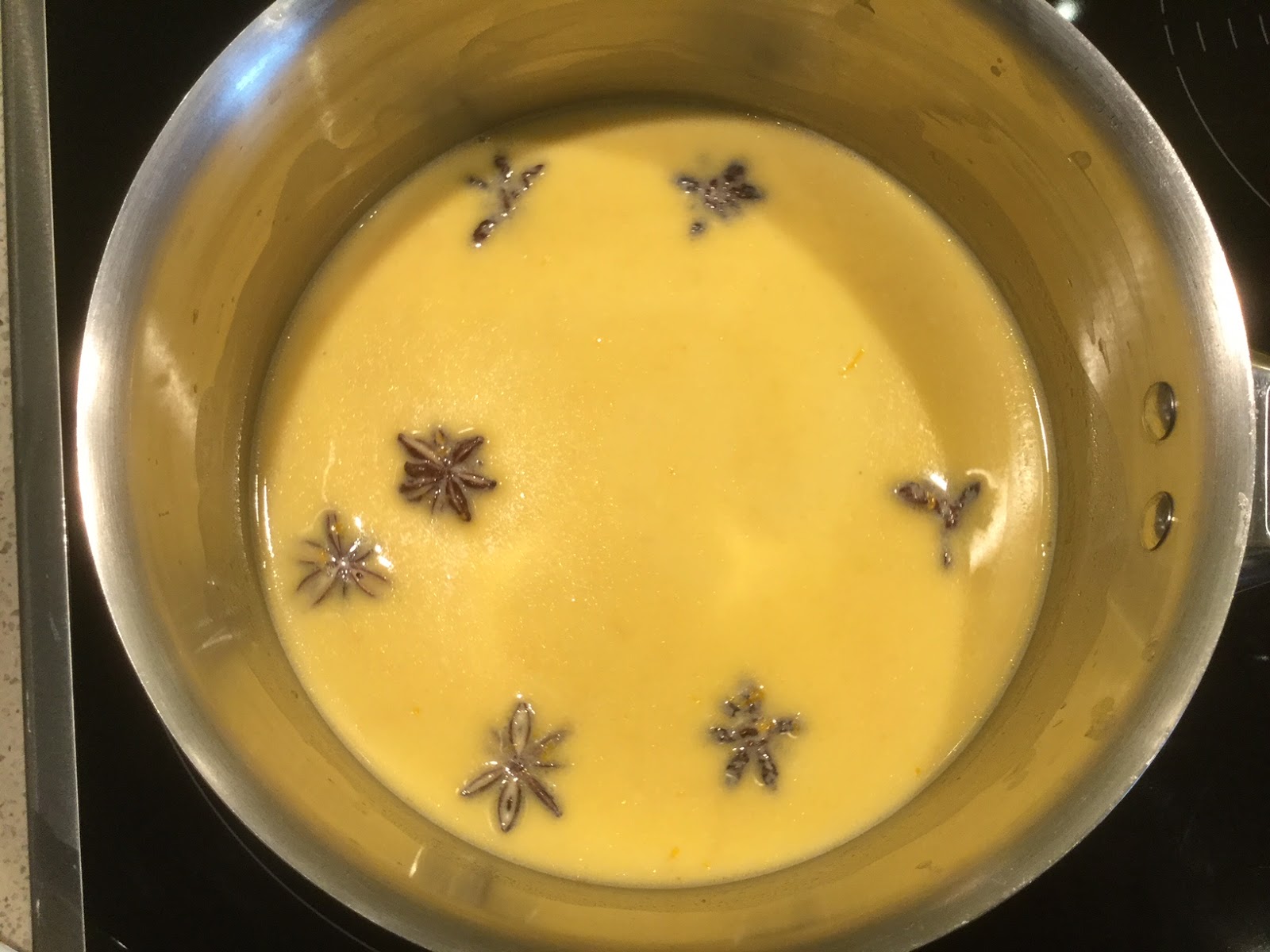
For this recipe the cream and milk are infused with 2 tablespoons of grated orange rind that has been pounded with a teaspoon of sugar, and seven star anise.

Infusing the cream/milk with grated orange and star anise
The egg yolks are creamed with two thirds of a cup of honey (instead of sugar) until thick and light.


The cream/milk infusion is added to this and cooked while stirring over low heat for 10 minutes.

The cooled custard is best refrigerated overnight, and churned the next day once the star anise have been removed. I add 2 tablespoons of Cointreau in the final 5 minutes of churning. This very creamy icecream has a subtle fragrance to it that works perfectly in this dessert. And it can be made well ahead of time.


Choux puffs
These crispy creations provide a nice texture contrast to the icecream and sauce.

Choux puffs' ingredients

1 cup of water
85g/3oz unsalted butter, cut into small pieces
1 teaspoon of sugar
a pinch of salt
1 cup of all purpose flour, sifted
4 eggs, at room temperature

1.  Heat the water, butter, sugar and salt in a saucepan until the butter is melted and then bring to the boil.

2.  Remove from the heat and immediately add all the flour and stir vigorously with a wooden spoon until combined. Return to a moderate heat and stir continuously until the dough forms a ball.

3.  Remove from the heat and beat in one egg until it is completely absorbed. Add each of the other eggs, one at a time, in the same way. This is a great workout for your arm and shoulder.

4.  Allow the mixture to cool for a few minutes before placing spoonfuls, about the size of an egg, onto a baking sheet covered with baking paper. Leave space between them for puffing.

5.  Bake in an oven that has been pre-heated to 220C/425F for 25-30 minutes, depending on the size.

6.  When puffed and golden brown, remove from the oven and place a small slit in the side of each puff. Return to the turned off oven and leave for 10-15 minutes with the door open. This helps to dry out their centres.

7.  Cool on a wire rack.

Warm chocolate sauce
With a dessert like this it's important not to skimp on the sauce. It needs to be rich, thick, luscious and chocolatey without being sickly sweet. This sauce works! The bittersweet chocolate makes all the difference.

Chocolate sauce ingredients
125g/4.5oz bittersweet chocolate (70% cocoa mass), cut into small pieces or grated
1 cup of pouring cream (pure cream with 35% fat content, also known as single cream)
1 tablespoon unsalted butter, cut into small pieces
1 teaspoon honey

Place all ingredients into a small saucepan and gently heat. Stir until fully melted and combined. Keep warm for serving. 
Assembling the profiteroles 
Cut the choux puffs in half. Spoon out and discard any moist pastry still inside the puffs.
Fill with quenelles of the honey, orange and star anise icecream. Sandwich with the top of the puff and pour over warm chocolate sauce. Worth the calories!!


Gamache regretted not ordering some himself. He watched, mesmerized, as Beauvoir and Lacoste took spoonfuls of the now melting ice cream mixed with pastry and the warm, dark chocolate. (The Brutal Telling, Kindle, p.222)