Reading may seem like a solitary pleasure, but we do not believe it is so. As we read, we intimately interact with writers, the worlds they create, and our own inner selves as well as the real world that surrounds us. Some of us are also blessed enough to have friends to share the experience with.

While discussing the idyllic village of Three Pines and the captivating characters author Louise Penny created in the Inspector Gamache books, we were aware of the sensory pleasure to be had in the meals described. Olivier’s Bistro, Gabri’s baking, and dinners at the Morrow’s can easily make us salivate while reading the books… Louise Penny's books, are a wonderful entrée into a sensual world, where each book is a season, capturing its mood and flavours, and contributing to the layers of meaning about the characters, who are marvellously revealed over the series.

At one point, a daydream of going through the series with a notebook in hand, writing down all these meals and later cooking them, took shape. This is our "notebook". We hope you enjoy this literary-culinary-sensory-philosophical journey.

Showing posts with label Libby. Show all posts

Friday, December 16, 2016

Salmon en Croute -- The Abuses of Power

by Libby


Francoeur cut through the puff pastry of his salmon en croute and saw the flaky pink fish, with watercress on top. Lemon and tarragon butter dripped out of the pastry. (How the Light Gets In, Kindle, p. 258)

Sylvain Francoeur is dining with a companion whose identity is not revealed. It is someone in a position of power to whom Francoeur reports, and who is even more dangerous. I can remember thinking how wrong it seemed that such fine food, so evocatively described, should be savoured by such odious characters. The fine food and fine dining experience contrasts starkly with the corrupt and sinister air surrounding the two diners.

In the brief snapshot of this meal we learn that the two men are anticipating the culmination of a conspiracy hatched thirty years earlier. Any possible threat to their ambitions is ruthlessly and cold-bloodedly dispensed with. The demise of Armand Gamache is a necessary event.

They eat their fine food in a fine restaurant and lead their lives, with rottenness at the core, a long, slow ruthless pursuit of power, at any cost, leaving a staggering trail of death and destruction. We learn later that the separation of Québec from Canada is the intended result. It exemplifies where greed for power or money, or opportunity at the expense of others has no limits. There are no morals, only expedience. These are people already with considerable power, whose frightening ambition for more has no boundaries. At their core is a moral vacuum.

It's not hard to extrapolate some of this to the behaviour of individuals, groups, corporations and governments that will do almost anything to shore up power, wealth and vested interests; protect or advance their ambitions, meet their targets and bottom lines, behave corruptly, exploit others and often the people and the environments that they should be serving or protecting. Certain interests and groups are served at the expense of others and ethical arguments about rights and responsibilities are of little consideration.

We see it in individuals who are intoxicated by power and wealth, who take what they want with an unerring belief in entitlement, and need for self-aggrandisement. It robs them of any real sense of fairness, empathy and generosity, leaving them to pay only lip service to the fact that others exist, with perhaps less fortunate lives than they. We see it in the way power and wealth is concentrated in the hands of a few at the expense of many, a wealth divide that continues to increase alarmingly.

How the Light Gets In is a study of two types of leaders whose power and influence is in marked contrast. Francoeur and Renard, the Premier of Québec, wield power with no moral or ethical considerations, no constraints to their intended goal. They do what they do because they can get away with it.

Contrasted with this is a man of conscience, Armand Gamache, whose moral duty to those he serves is at the heart of him. His clarity of purpose, his moral compass makes him nothing but tenacious in finding and dealing with the Sûreté's rotten core. But even he is overwhelmed at how brutally deep it festers.
He believed that light would banish the shadows. That kindness was more powerful than cruelty, and that goodness existed, even in the most desperate places. He believed that evil had its limits. ... Chief Inspector Gamache wondered if he could have been wrong all this time. Maybe the darkness sometimes won. Maybe evil had no limits. (How the Light Gets In, Kindle, p. 271)
We wonder at Francoeur and Renard. How could they abuse their power so completely, corrupt the very instrument in place to protect communities over all Québec through law enforcement, the Sûreté, with no moral conscience? 

Abraham Lincoln said:
“Nearly all men can stand adversity, but if you want to test a man’s character, give him power.”
Well it seems that power is freeing.
'What power does is that it liberates the true self to emerge. ... More of us walk around with kinds of social norms; we work in groups that exert all pressures on us to conform. Once you get into a position of power, then you can be whoever you are.' (Joe Magee, power researcher and professor of management, New York University)
And it might unleash a beast.

In How the Light Gets In we are reminded of the power of those people of conscience with a moral sense and duty, a social responsibility, who are principled, who are community-minded, who don't just watch but are prepared to intervene, make sacrifices and take risks to defend and protect what they believe in, or those in whom they believe. Motivated by goodness. We have a snapshot of the Three Pine's community as they put aside their fears and band together to help Gamache, the Brunels and Yvette Nichol in their time of greatest need. Their moral fortitude is steadfast.
“Do you know what you’re offering?” Thérèse asked. “A safe place,” said Myrna. “Who doesn’t need that at least once in their lives?” “The people who’re looking for us don’t want a simple chat,” said Thérèse, holding Myrna’s eyes. “They don’t want to negotiate, they don’t even want to threaten us. They want to kill us. And they’ll kill you too, if we’re found in your home. There is no safe place, I’m afraid.” She needed Myrna to understand. Myrna stood before her, clearly frightened, but determined. ... “Armand wouldn’t have brought you here if he didn’t think we’d protect you. “But they’ll still come looking for us.” “We thought so.” “We?” Myrna turned to look at the road and Thérèse followed her glance. Standing on the snow-covered path were Clara, Gabri, Olivier, and Ruth and Rosa. (How the Light Gets In, Kindle, p.339-40)
Viet Thanh Nguyen the American Pulitzer Prize winning novelist (2016 prize for fiction for his debut novel, The Sympathiser) recently wrote about understanding 'the basic paradox at the heart of literature and philosophy'. 'Even as each of us is solitary as a reader or a writer, we are reminded of our shared humanity and our inhumanity.'

Could this not be more evident in Louise Penny's How the Light Gets In?


Salmon en Croute


This is rather a special occasion/festive dish, with wonderful contrasts of flavour and texture. It's seriously delicious! Fish baked in an envelope of light, buttery pastry and made succulent with a fragrant herb butter is something worth experiencing. Seriously, there are moments of rapture as it all comes together in a mouthful! And it is really worth making your own pastry, particularly as there are some shortcuts to a brilliant result. This recipe feeds four. And it's not as complicated as it might first seem. Lots can be done ahead of time, including making the pastry and herb butter. I hope my step-by-step descriptions are not too tedious. The photos are meant to be the key to it all!

- 600-700g/1lb5oz-1lb8oz of fresh Atlantic salmon, skinned and pin-boned (I get my fishmonger to do this)
- puff pastry
- watercress or spinach filling
- herb butter
- 1 egg, beaten, for egg wash
- sea salt
- cracked black pepper


Rough Puff Pastry


This pastry is an easy, shortened version of conventional puff pastry, but I think the result is just as good. It's very easy to make and can be done a day or two ahead of time. It uses equal measures of flour and butter. It's best to work in a cool kitchen as you don't want the butter to melt into the flour as you work. That will reduce the puff and lightness of the pastry.


- 250g/9oz plain flour

- 250g/9oz unsalted cold butter, cut into small cubes

- 125 ml/4fl oz of ice cold water

- 1/2 tbsp fine sea salt


1.  Sieve the flour and salt into a mound on the bench or pastry mat and add the butter.


2.  Lightly work the butter into the flour using your finger tips, ensuring that the pieces of butter stay relatively large.


3.  Make a well, add the water and mix in with your hands, to bring all the ingredients together. The flecks of butter should still be obvious.


4.  Wrap in plastic film and chill in the fridge for 15-20 minutes.


5.  Lightly dust the surface with flour and roll out the dough into a rectangle (approx 40x25cm/15x10"). 

Dust with a little flour as you work to prevent sticking. You should still be able to see the pieces of butter in the rolled out dough.


6.  Fold over one end of the dough a third of the way. 

Fold over the other end of the dough on top of that. This is called the first turn.


7.  Turn the dough 90 degrees and then roll it out again into a rectangle (the same size as before) and fold it exactly as for the first turn. This is now the second turn.

8.  Wrap in plastic film and chill for 20-30 minutes.

9. Roll the dough again for two turns, repeating the process just as before. Rest in the fridge once again and then it is ready to use.


Watercress filling


This adds a nice succulence to the salmon en croute and cuts through the richness of the herb butter. If watercress is not available, baby spinach leaves are a good substitute.

- generous bunch of watercress, thicker stems discarded
- 2-3 spring onions, finely sliced
- clove of garlic, finely chopped
- unsalted butter


1.  Gently sauté the spring onion and garlic in a little unsalted butter until soft.


2.  Add the watercress and stir until wilted, but so it still has some crunch. Season very lightly with salt and cracked black pepper. 


3. Allow to cool and then place in a sieve and press on it to extract as much moisture as possible. This is an important step to ensure that the pastry doesn't get soggy from excess moisture. Set aside.


Herb butter


I used dill and basil, instead of tarragon, in this butter. They work beautifully with the lemon zest. And the addition of salty, fragrant capers and Dijon mustard lifts the flavours a notch. This butter would also be a nice addition to a piece of fried or poached fish.

- fresh dill, chopped
- fresh basil leaves,finely sliced
- fine zest from one lemon
- 1 tbsp of salted capers, soaked in water to remove the salt, drained and chopped
- 60g/2oz unsalted butter, at room temperature
- sea salt
- cracked black pepper


1.  Mash the butter with a spoon and stir in the lemon zest.
2. Add the dill, basil and capers.
3. Very lightly season with sea salt and cracked black pepper. 
4. Refrigerate if made ahead of time. Bring to room temperature before using.


Bringing it all together


1.  Place a baking sheet in the oven and preheat it to 220C/430F.


2.  Trim the piece of fish to an even rectangular shape.
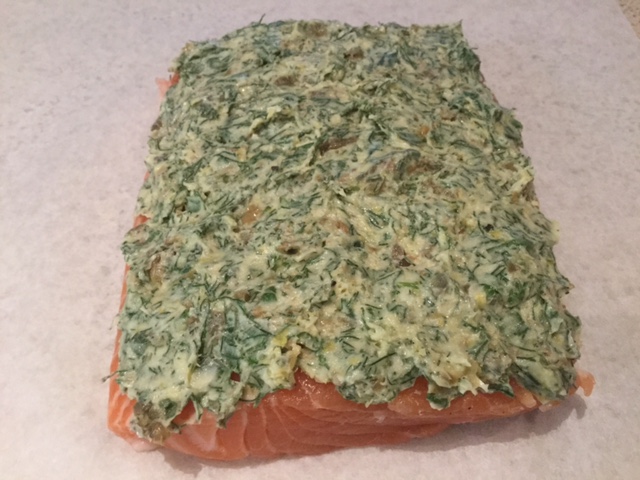


3.  Spread the herb butter in a thick even layer on the upper side of the fish. Refrigerate.


4.  Dust the bench/pastry mat with flour and roll out the pastry into a rectangle of 3-4mm/ 1/8in thickness. 

Work quickly while the pastry is still cold.


5.  Spread the watercress mixture in the centre of the pastry.


6.  Place the herb butter side of the fish down on the watercress.


7. Trim the pastry to a size where it will fold over the fish and enclose it like a parcel.


8.  Fold the pastry tightly over the salmon, sealing it with egg wash where it meets.   

Repeat this with each end, trimming off any excess pastry.

9.  Place the salmon parcel, seam side down, on a length of baking parchment that will fit the baking sheet in the oven. 

At this stage if the pastry is getting quite sticky place the parcel in the fridge for 15 mins.


10.  Score the surface of the pastry with the back of a knife but don't cut through it. Brush the top, sides and ends with egg wash and sprinkle sea salt and cracked black pepper over it.
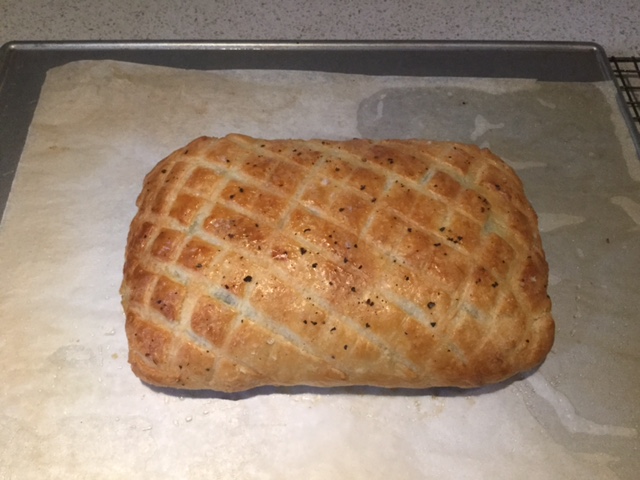
11.  Transfer the salmon en croute to the fridge on the baking/parchment paper and let it chill for at least 15 minutes, or longer if you've made it ahead of time.

12.  Place the parcel and the paper onto the hot oven tray straight from the fridge. Bake for 20-25 minutes or until the pastry is golden brown on both the top and the bottom.

13.  Remove from the oven and rest for 15 minutes. Slice into servings using a sharp serrated knife.


The salmon en croute is delicious served with a little salad that has simply been dressed with a squeeze of lemon juice and a grinding of black pepper. This is a nice foil to the rich, buttery flavours of the fish and pastry.


Friday, December 2, 2016

Green Pea and Mint Soup..."Some Malady is Coming Upon Us"

by Libby


Tureens filled with brilliant pea and mint soup sat on the table, next to baskets of fresh, warm baguette. (The Beautiful Mystery, Kindle, p.290)

By the time this meal is served Beauvoir has lost his appetite, and resonating in Gamache's head is the line, "Some malady is coming upon us", (from TS Eliot's play, Murder in the Cathedral). It is indeed a harbinger.

I think the food in The Beautiful Mystery, more than in any other book in the series, drew me in with its fresh seasonal produce. Its gentle nurturing and cultivation and the nutritious meals prepared from it by the monks are strikingly juxtaposed with the tension, simmering conflict and stark rage played out within the monastery walls.

Preparing food from new season produce, more than at any other time, is always a delight to me. Young vegetables and fresh herbs and flowers make for quite a delicious meal. There's little you need to do but savour the delicate, juicy flavours and crisp textures when vegetables are young. Recently I made a vegetable salad (served at room temperature) with young vegetables from the market and my garden. It was part of the vegetable course of a meal I prepared for friends.  As I put it together I couldn't help thinking of The Beautiful Mystery and imagining this salad on the refectory table.


It can be made a little ahead of time (always handy) and kept at room temperature. I loved foraging for all the herbs and flowers that added little punches of flavour to the salad. The vegetables were all quickly poached (to keep some crispness) in lightly salted water. I poached each vegetable separately, so as not to mask their individual flavours or colours by cooking them all together. By quickly transferring them to an ice bath you halt the cooking and preserve the colour.

I used different coloured baby carrots, radishes (which turn a delightful pink colour), asparagus, broad beans (I peeled them down to the heart), shelled peas, spring onions and cloves of garlic. After arranging the cooked vegetables on a large platter I scattered fresh nasturtium, borage, rocket and chive flowers, elderflower and lemon flower buds, fennel fronds and nasturtium, baby sorrel and rocket leaves amongst them. It was just a delightful, aesthetic experience watching it all come together. I love that! And I couldn't help taking a photo! A drizzle with good extra-virgin olive oil was all that was needed. I served the vegetables with a lemon confit, made with the zest and juicy flesh (all the membranes removed) of lemons from my garden. Cooked with sugar and reduced to a jam consistency it provides a lovely bitter-sweet contrast.

The Beautiful Mystery was a difficult one to read with Beauvoir's internal drug-fuelled crisis and loss of control, and Gamache's fight to save him which leaves him isolated and steeling himself for future confrontation. Never had both been so vulnerable. And never had the foundations of their relationship been so undermined and shockingly rocked.
Gamache grabbed at Beauvoir’s hand, trying to loosen the gun. From Jean-Guy’s throat came a wail, a cry of desperation. He fought wildly, flailing and kicking and bucking but finally Gamache twisted Beauvoir’s arm behind his back and the firearm clattered to the floor. Both men were gasping for breath. Gamache held Jean-Guy’s face against the rough stone wall. Beauvoir bucked and sidled but Gamache held firm. “Let go,” Beauvoir screamed into the stone. “Those pills are mine. My property.” (The Beautiful Mystery, Kindle, p.364)
There seems a striking parallel with the foundations of the monastery which, too, are collapsing.

Amidst all the dissent and internal conflict, a terrible rage emerges which has caused death amongst the monks, and threatens death amongst the Surete officers.
Gamache put his face against Francoeur’s. “You could’ve killed him,” Gamache snarled. “You almost killed him. How can you do this to one of your own?” Gamache had Francoeur’s shirt in his fist, yanking it. He felt the man’s warm breath on his face, in short, terrified puffs. And Gamache knew. Just a little more pressure. Just a few moments more, and this problem would disappear. This man would disappear. One more twist. And who would blame him? (The Beautiful Mystery, Kindle, p.366)
The enmity between Gamache and Francoeur is fully exposed. Gamache's rage is both shocking and buoying. Who would blame him, indeed!!

The conflict amongst the monks to embrace 'modern times', the way that Francoeur 'had gotten into Jean-Guy', the corruption deep within the Surete and the evidence that Gamache uncovers to reveal that it goes beyond Francoeur, give substance to "some malady is coming upon us".
The last chapter is shattering with its volatility, uncertainty and ominous ending.
The Chief Inspector looked into the sky and felt the north wind on his upturned face. Some malady is coming upon us. (The Beautiful Mystery, Kindle, p.372)
We are confronted with the prospect of what Gamache must face next. But nonetheless we feel his quiet strength and steely determination.

It's not hard to make parallels to recent events that have left many feeling degrees of uncertainty, isolation, some trepidation and fear, and even rage about what the time ahead might hold. Finding positive means to deal with uncertainty and adversity, clear and respectful ways of expressing our feelings and responding to others, steeling our strengths and sighting the cracks that let the light in, challenges us all.

Green Pea and Mint Soup

This is a tasty, brilliantly coloured soup with the fresh flavour of peas dominating but greatly enhanced with a few additions, particularly fresh mint. It's perfect for a light meal, served with crusty bread. I rather enjoyed making it as there is something very therapeutic about shelling peas. Though I have to admit, after all the shelling I was a bit short on peas so I made up the difference with some frozen baby ones. A tasty, nutritious stock, which can be made well ahead of time, is the basis for this recipe. I made a chicken stock but a vegetable one would work well too.

The Stock

A little more body or thickness is given to this stock with the addition of a small amount of glutinous/sweet rice. The recipe makes approximately 1.5 litres/quarts, but you'll only need half of this amount. 


700g / 1.5lbs of chicken wings, each wing chopped into 3 pieces (I got the butcher to do this.)
2 tablespoons of light oil (I used grapeseed oil.)
2 litres / 2 quarts of water
2 small inner stalks of celery, finely chopped
6 spring onions, white part only, finely sliced
1 clove of garlic, chopped
2 teaspoons of chopped root ginger
100ml / 3.5fl oz of dry white wine, sake or verjuice (I used sake.)
30g / 1oz glutinous rice (also known as sweet rice or sticky rice)sea salt

1.  Heat the oil in a pot and sauté the chicken wing pieces until lightly coloured all over.
2.  Add the celery, spring onion, garlic and ginger and cook for another couple of minutes, stirring continuously.
3.  Pour in the wine, sake or verjuice to deglaze and reduce it until almost evaporated.
4.  Add the water, bring to the boil and then reduce the heat to a simmer.
5.  Skim the surface to remove any foam.
6.  Add the glutinous/sweet rice.
7.  Periodically taste the stock and add a little salt to help bring out the flavours.
8.  Allow the stock to simmer away for 1-2 hrs.
9.  Pour through a fine sieve and discard the solids.
10.  Cool the stock and refrigerate. It cools into a soft jelly.
11.  Decant 3/4 litre / 3/4 quart for the soup and freeze the remainder.

The Soup

This recipe will serve four as a starter, or two as a meal. It's really quite a simple soup but the addition of crème fraîche, lightly sautéed pea sprouts and fresh mint as a topping provides an enhancing burst of flavours and textures. They all go so well together in this soup.


3/4 litre / 3/4 quart of chicken stock
500g / 18oz fresh shelled or frozen green peas
2 tbsp unsalted butter
5 spring onions, finely sliced
sea salt


1.  Melt the butter in a pot over medium heat and gently sauté the spring onions for several minutes until soft.


2.  Add the peas and continue to gently sauté, stirring them well together.


3.  Add the stock and bring to a simmer. Cook until the peas are tender.

4.  Allow the soup to cool a little, then blend for a smooth texture. I used a stick blender which is so much more convenient than having to transfer the soup to a bench top blender.

5.  Add a little sea salt to taste.


Finishing and Serving the Soup


half a lemon
handful of fresh pea sprouts
unsalted butter
crème fraîche
mint leaves, finely sliced
cracked black pepper


1.  Stir a squeeze of lemon juice into the soup. Add more to taste.

2.  Lightly sauté the pea sprouts in a little unsalted butter until they wilt but still have their crunch. Season very lightly with sea salt flakes.


3. Ladle the soup into bowls. 

4. Swirl a generous dob of crème fraîche onto the surface. Add some pea sprouts and a generous sprinkle of mint. Finish with cracked black pepper.


After reading The Beautiful Mystery I remember devouring How the Light Gets In, with my heart in my mouth, to find out how it was all going to play out. Fortunately I came late to the series so was able to binge read the books in quick succession. Louise Penny did not disappoint.


Friday, October 14, 2016

Jean-Guy Beauvoir and Chocolate-covered Blueberries

by Libby


Beauvoir had never liked dark chocolate. It seemed unfriendly. ... And on the wooden counter sat small mounds of very dark chocolate. Long rows of them, like tiny monks. He picked one up, turning it this way and that. Then he ate it. (The Beautiful Mystery, Kindle, p.64)

Jean-Guy Beauvoir has just made one of his more pleasant discoveries at the secluded monastery of Saint-Gilbert-Entre-les-Loups in the Quebec wilderness. And with his usual loyalty, he shares it with Gamache in a companionable moment amidst the investigation of a murder within the small, reclusive monastic community.

Gamache picked up a chocolate and held it between his large fingers. It looked microscopic there. Then he ate it. And Beauvoir smiled to see the astonishment, and delight, on Gamache’s face. “Blueberry?Beauvoir nodded. “Those tiny wild ones. Chocolate covered. They make them by the bucketload here. I found the chocolaterie when I was looking for the monks. Seems like the better find.” (The Beautiful Mystery, Kindle, p.84)


Both are still recovering in the aftermath of the raid that went devastatingly wrong. But Beauvoir, the more fragile of the two, has been buoyed, being three months into a deeply loving and committed relationship with Annie.


Beauvoir now seemed happy. Indeed, happier than Gamache had ever seen him. Not the feverish, giddy highs of the addict, but a settled calm. Gamache knew it was a long and treacherous road back, but Beauvoir was at least on it. Gone were the mood swings, the irrational outbursts. The rage and the whining. Gone were the pills. The OxyContin... (The Beautiful Mystery, Kindle, p.34)


And we see the return of Beauvoir's wonderful appetite for food. I've always enjoyed it! He approaches it with such gusto, and he doesn't hold back in the early meals at the monks' table. But for me, Jean-Guy Beauvoir will always be associated with those chocolate-covered blueberries.


Throughout The Beautiful Mystery they are referenced, and along with his messages to Annie, seem to parallel Beauvoir's state of mind, and the spiralling changes that will take hold.

The Beautiful Mystery is a haunting work, as much for its setting as the harrowing contrasts of good and evil, light and dark: the deadly tensions amongst the monks contrasted with the wondrous beauty of their Gregorian chants; the delights of flavour rich, seasonal foods contrasted with the bitter pills of an addictive drug; the integrity and devotion of those who love contrasted with the machinations of those who seek to damage and destroy.

Early in the book it's easy to wallow in the happiness Beauvoir experiences with Annie, the love and playfulness they share. But also evident, and slightly unsettling, is something of Beauvoir's internal struggle, where self-doubt and anxiety reside. There is an unfamiliar vulnerability as he worries about Gamache's acceptance of his relationship with Annie, once it has been revealed.

They were a good team. A great team. Suppose he isn’t happy? The question snuck up on Beauvoir, out of the woods. Suppose he doesn’t want Annie to be with me? But that was, again, just fancy. Not fact. Not fact. Not fact. (The Beautiful Mystery, Kindle, p.22)

However Beauvoir and Gamache's familiar camaraderie as the investigation initially proceeds, his appetite for the monastery food, and his care and playfulness with Annie are reassuring.
“I found some more chocolate-covered blueberries and brought them back to my cell. I’ll save some for you.” ... “I miss you,” Jean-Guy wrote. “ Merde! All the chocolates are gone! How did that happen?” Then he rolled over, the BlackBerry held lightly in his hand. But not before typing, in the darkness, his final message of the day. “ Je t’aime .” He carefully wrapped the chocolates and put them in the nightstand drawer. For Annie. He closed his eyes, and slept soundly. (The Beautiful Mystery, Kindle, p.105)

But, just like the monastery's defences are breeched as its music has drawn the attention of the world and the Vatican, so too, over the course of the story, are Beauvoir's. His self-doubt and vulnerability are fuel to Gamache's nemesis, Sylvain Francoeur, whose ominous arrival signals the descent of Beauvoir into an eventual state of paranoia. And as Francoeur preys on him, relief from confusion and angst is soon close at hand, and it is not found in chocolate-covered blueberries.

Beauvoir thought about the tiny pills the size of wild blueberries. The ones still hidden in his apartment. And the burst they brought. Not of musky flavor, but of blessed oblivion. (The Beautiful Mystery, Kindle, p.186)

It is harrowing witnessing Beauvoir gradually isolate himself, even from Annie, increasingly powerless to control the turmoil he is feeling, as the OxyContin and Francoeur do their work.

Then he wrote back, describing where he was. Telling her they were making progress. He hesitated before hitting send, knowing while he hadn’t exactly lied, neither had he told her the complete truth. Of how he was feeling. His confusion, his anger. It seemed both directed at Francoeur and undirected. He was mad at Frère Raymond, mad at the monks, mad at being in the monastery instead of with Annie. Mad at the silence, broken by interminable masses. Mad at himself for letting Francoeur get under his skin. (The Beautiful Mystery, Kindle, p.240)

By the book's conclusion we are left stunned and saddened at Beauvoir's spiralling decline into a state of insecurity, suspicion and paranoia. As one of the monks prophetically tells Gamache:

“Most people don’t die at once.” ... “They die a bit at a time,” ... "They lose heart. They lose hope. They lose faith. They lose interest. And finally, they lose themselves.” (The Beautiful Mystery, Kindle, p.277)

Is this Beauvoir? His loss of trust, growing resentment and feelings of blame toward Gamache and his ultimate desertion of him are shocking. And with the choices made, we are left with someone we no longer quite recognise as Jean-Guy...and one final reference to the chocolate-covered blueberries.

Jean-Guy looked down as they banked. A few monks were outside the walls, picking wild blueberries. He realized he didn’t have any of the chocolates to take back to Annie. But Beauvoir had a sick feeling that it no longer mattered. (The Beautiful Mystery, Kindle, p.371)

Inspirational site


Last year two dear friends and I toured the Eastern Townships region and visited the Abbaye de Saint-Benoit-du-Lac. It was Louise Penny's inspiration for Saint-Gilbert-Entre-les-Loups. We were fortunate to witness a service in Gregorian chant, but alas, the Abbaye had run out of the chocolate-covered blueberries for which they are renowned!


Chocolate-covered blueberries


While I would love to be able to use wild blueberries (for their 'immediate wallop of flavour') in this recipe, the only ones available here are cultivated. Good dark chocolate for the covering is readily available, though. But this recipe isn't just a matter of dipping the blueberries in melted dark chocolate. I have been uncovering something of 'the beautiful mystery' of tempering chocolate. This is what chocolatiers do to coat fruit and all manner of tempting fillings. 

Tempering is what gives chocolate its sheen and snap and stops it from melting on your fingertips as soon as you touch it. Tempering is about re-stabilising the crystals in the cocoa butter in the chocolate once it has been melted, through a temperature control process. Tempering prevents the chocolate from getting a whitish bloom when it sets.


A digital or chocolate thermometer is best used for tempering to get accurate  readings needed for success. You need to use chocolate with a high cocoa butter content, and that is why couverture* chocolate is used by chocolatiers with its minimum cocoa butter content of 32%. 
* The Hot Chocolate and Regret post gives the lowdown on couverture chocolate.


300g/10.5oz blueberries
380g/13.5oz dark couverture chocolate
* I used Valrhona couverture with a cocoa mass of 66%.


1.  Wash and completely dry the blueberries.


2.  Chop the chocolate into small pieces. Place 3/4 of the chocolate (set aside the other quarter) into a bowl that will fit snugly over a saucepan. No moisture must get into the chocolate.


3. Heat about an inch (3cm) of water in the saucepan until boiling. Reduce the heat so that the water is barely simmering and not steaming.


4. Place the bowl of chocolate over the saucepan (the bowl must not touch the water) and stir continuously with a flexible spatula as the chocolate melts.

Keep checking the temperature of the chocolate until it slowly reaches 116-119F/46-48C (don't let it exceed this temperature range).


5.  Immediately remove the bowl from the heat and stir in the remaining chocolate.

6.  Continuously stir the chocolate to gradually reduce the temperature (it will take a while) to 82-84F/28-29C to temper it.

7.  Now raise the temperature of the chocolate to the optimal working temperature of 88-91F/31-32C by placing the bowl in another bowl of warm water with a temperature of no more than 91F/32C. Stir continuously, moving the chocolate from the sides of the bowl as you do.

Maintain this temperature while dipping the blueberries. If you exceed this temperature the chocolate will come out of temper, and you will need to re-temper.


8.  Use a skewer to dip each blueberry into the chocolate. Allow excess chocolate to drip off.


9.  Use a second skewer to help ease the blueberry onto a tray lined with baking paper.

 
10.  Allow to set.

11.  As you work stir the chocolate occasionally and keep the temperature constant in the 86-88F/30-31C range.

12.  Eat the chocolate covered blueberries within two to three days. Leftover chocolate can be spread onto a sheet of baking paper and later broken into bite-sized pieces for eating, making hot chocolate or stored for later use.


I need to practise tempering to learn to manage the temperatures better, particularly when you have a load of berries to painstakingly dip, one by one. It will be worth it though as I really love the burst of the berry as you bite into and snap through the chocolate covering, and let it all melt in your mouth. The chocolate has a deep, rich flavour without being sickly sweet. And serving them with a glass of whisky is quite a match!


 [1]

Friday, September 9, 2016

Éclairs and Growing Apart

by Libby


“Do you think people change?” Myrna, the éclair on its way to her mouth, paused. Lowering the pastry she looked at the Chief Inspector with clear, searching eyes. (A Trick of the Light, Kindle, p.244)

Gamache has just had a conversation with Beauvoir about the breakdown of Annie's marriage. He is trying to understand it. And given Jean-Guy's personal circumstances, it was inevitable Gamache would seek his counsel, trying to make some sense of it.

So what happened?” Gamache asked. “Did you change? Did Enid? Something changed.” Beauvoir looked at Gamache with surprise. The Chief was genuinely perturbed. (A Trick of the Light, Kindle, p.237)

How easy is it to grow apart in a relationship, particularly a long-term one? Pretty easy I think without some effort. Who isn't familiar with the old adages, 'relationships aren't easy', 'you have to work at relationships, nurture them'?

I think most couples struggle with 'compatibility' at some stage/s in their relationship. Feelings of 'not quite fitting with each other' are inevitable over the years as we change and grow, and not always at the same times and in the same ways. Sometimes a spouse can be left behind. It can be a temporary transition or a symptom of growing distance in a relationship. Over time feelings of being stifled or resentful can emerge. Loneliness and distance can ensue.

Living with another person can be very hard and demands commitment by both to keep balance and fairness and joy in the mix. The commitments and responsibilities and changing dynamics of our busy lives, taking the other one for granted and even complacency can get in the way and at times create distance in a relationship. And then there's the niggling and arguments over inconsequential things that fuel frustration and resentment. There is the inevitable tension between your self-identity and theirs, and perhaps times of tip-toeing around the other person's ego and needs. It can all contribute to changing perspectives, losing interest in each other and an emotional disconnection, a loss of intimacy, closeness. It makes me think of a detached Beauvoir retreating to his basement, away from Enid.

When you drift apart, you either want to commit to closing the gap, do nothing about it, or end the relationship.
Acknowledging that there is a problem, the changes you see in your relationship and yourselves, is an obvious start. It's a desire to change, a commitment to persist, get closer, have deeper conversations (which may have become superficial dealing with the daily mechanics of life), about your innermost thought feelings and aspirations. How to reconnect where there is an emotional disconnection? Easier said than done at times!!! It can be difficult expressing your deepest feelings and needs when you've grown apart.

How easy is it to lose the ‘spark’ in a relationship when we take the other one for granted, and lose sight of each other's unique qualities? It’s a matter of striking a balance between your individual interests and those which you have in common, making some effort to nurture your individuality but also invest time and effort in each other.
And you just have to find the laughter, the fun, the lightness of being. Gamache and Reine-Marie's relationship throughout the series is epitomised by their ability to do this. Even as they consider the thought that Annie has perhaps found someone else they are naturally playful with each other.

Armand,” she’d asked, ... “What would you have done if you’d been married when we met?” ... “God help me,” he finally said, turning to her. “I’d have left her. A terrible, selfish decision, but I’d have made a rotten husband after that. All your fault, you hussy.” Reine-Marie had nodded. “I’d have done the same thing. Brought little Julio Jr. and Francesca with me, of course.” “Julio and Francesca?” “My children by Julio Iglesias.” “Poor man, no wonder he sings so many sad songs. You broke his heart.” “He’s never recovered.” She smiled. “Perhaps we can introduce him to my ex,” said Gamache. “Isabella Rossellini. (A Trick of the Light, Kindle, p.242)

Where such a commitment can't be made, where there is no point in trying to work at or salvage a relationship, where you no longer fit with the other in any meaningful way, the relationship will invariably have run its course.

“Suppose you and Dad had been married to different people when you met,” Annie finally asked, looking them square in the face. “What would you have done?” They were silent, staring at their daughter. It had been, thought Gamache, exactly the same question Beauvoir had recently asked. “Are you saying you’ve met someone else?” Reine-Marie asked. “No,” Annie shook her head. “I’m saying the right person is out there for David and for me. And holding on to something wrong isn’t going to fix it. This will never be right.” (A Trick of the Light, Kindle, p.241)

You can't help holding up a mirror at different times, maybe when you turn 30, 40, 50, 60, retire ... and take stock of your life, and how things fit. Whether this is the life you imagined for yourself, weighing up the positive and negative aspects of a relationship and all those questions of compatibility, and even fundamental differences that may have become more obvious over time. And when things are insurmountable, sometimes it's an event or emotional trigger that hastens the ending of a relationship as in the case of Beauvoir and Enid. Do you wonder if Enid was also taking stock of her relationship with Beauvoir or whether she was taken by surprise? Regardless, there is always pain when a relationship ends.
“You said the raid on the factory was what finally made you decide to separate from Enid.” Beauvoir nodded. That much was the truth. “I wonder if it had the same effect on Annie.” “How so?” “It was a shattering experience, for everyone,” said the Chief. “Not just us. But our families too. Maybe, like you, it made Annie reexamine her life.” (A Trick of the Light, Kindle, p.242)

Then this:
“Are Annie and David growing apart?” “She didn’t say anything to you?” Beauvoir shook his head. His brain sloshing about in there. With only one thought now. Annie and David were growing apart. (A Trick of the Light, Kindle, p.237)

I've got to admit to being quite excited at the prospect and laughed at the thought of Beauvoir's sloshing brain! This was rather a favourite part of the book for me. So many revelations in this one exchange between Gamache and Beauvoir, including the fact that Beauvoir had loved Annie since three years previously. Didn't we all want this to end well for him?


Orange and ruby grapefruit éclairs


Myrna's eclair was never described but this is my take on it.

I've made choux pastry many times before but never éclairs. I actually had to buy a pastry bag and  a larger size piping nozzle for the pastry shapes. But I'm glad I did as these éclairs were easy to make and I ended up with quite a scrumptious dessert to take to a friend's dinner party.

Éclairs can  simply be filled with cream and topped with icing. But for dessert a filling of orange crème pâtissière (pastry cream) made even more tangy with orange and ruby grapefruit curd, some whipped cream and a sprinkling of walnut praline is a nice indulgence. Particularly since the top of the eclairs were dipped in chocolate ganache. Double yum!! The crème pâtissière, curd and ganache can be made a day or two before you bake the pastries.

I chose oranges and ruby grapefruit (sweeter tasting than the yellow grapefruit) for the flavouring as they were at peak ripeness in my garden.

This recipe made twelve éclairs.

Choux pastry


I find it easier to make this pastry by hand but you can also use a food processor when it comes to adding the eggs to the dough. The baking process is about getting a good rise and colour, and then drying them out for a crisp shell.


60g/2.5oz unsalted butter

3/4 cup of water

pinch of salt

130g/4.5oz plain flour, sifted

3 large free range eggs, lightly whisked


1.  Preheat the oven to 220C/430F

2.  Put the butter, salt and water in a saucepan and bring to the boil, ensuring the butter melts before boiling point is reached.

3.  Remove from the heat and add all of the sifted flour. Stir vigorously with a wooden spoon to combine.

4.  Return the saucepan to the stove and medium heat and cook the dough for a couple of minutes, stirring continuously until it comes together.

5.  Remove the saucepan from the stove and beat in a third of the whisked eggs until completely absorbed into the dough.

6.  Add another third of the eggs and beat into the dough until absorbed.


7.  Add as much of the remaining whisked egg to ensure a soft glossy dough that holds its shape.

8.  Allow the dough to cool and then spoon into a pastry bag with a 15mm/0.6 inch piping nozzle.

9. Line a baking sheet with baking paper securing the sides with a smear of butter.


10.  Pipe 12x10cm/4 inch lengths, spaced generously apart.

11.  Bake for 10mins at 220C/430F, then reduce the oven to 180C/350F for another 20-25 mins.
The choux pastries are ready when they are puffed and brown.Switch off the oven, and open the door a third of the way. Leave the pastries to dry out for 15 mins. You can aid the drying out by making a small incision with a knife at the end of each pastry. 

12.  Cool on a wire rack.


Orange and ruby grapefruit curd


This is a rich citrusy curd with a buttery, soft texture that can be cooked quickly on the stove top. It makes about 2 cups of curd. I store it in a lidded glass container in the fridge. It's usually gone within a week!

4 large egg yolks, free range

2/3 cup of caster/superfine sugar

60g/2.5oz unsalted butter, diced

1tbsp of orange and ruby grapefruit zest

100ml/3.5fl oz of freshly squeezed orange and ruby grapefruit juice, strained


1.  Whisk the egg yolks and sugar until pale and creamy.


2.  Combine with the butter, juice and zest in a saucepan over medium heat.


3.  Stir continuously and bring to a simmer.


4.  When it starts to bubble remove from the heat. Continue to stir.


5. Cool and store in sterilised jars in the fridge.


Orange crème pâtissière


Crème pâtissière is a traditional filling for many sweet pastries. I added orange zest and a little orange liqueur to ramp up the citrus flavours in the éclairs.

1 cup of full cream milk

2tbsp of orange zest

3 egg yolks, free range

50g/1.75oz caster/superfine sugar

20g/0.75oz cornflour/cornstarch

2 tbsp Grand Marnier


1.  Combine the milk and orange zest in a saucepan over medium heat and slowly bring to a simmer, then remove from the heat.

2.  In a bowl, whisk together the eggs, sugar and cornflour/cornstarch until thick and creamy.


3.  Pour on the hot milk and zest and whisk all the ingredients until smooth.

4.  Transfer the mixture to the saucepan and cook over a medium heat. Stir continuously as it thickens and comes to the boil.


5.  Remove from the heat and continue to stir until it cools down. 
Note: If your crème pâtissière is a little lumpy don't worry. Just blitz it in a food processor or blender and it will be silky smooth in seconds.

6. Scrape into a glass bowl, and cover and refrigerate when cool.


Cream and walnut praline


A little bit of cream adds a lighter note to the éclair filling. And the walnut praline packs a bit of crunch and flavour punch. Follow the recipe for pecan praline in this earlier post:


3/4 cup pure cream, lightly whipped to hold its shape, and unsweetened
2/3 cup of chopped walnut praline


Chocolate ganache


This deep rich chocolate, not-overly-sweet topping is the perfect companion, I think to the éclair fillings. 

This recipe will provide you with plenty of left over ganache to cover a cake or fill little tartlets, topped with crème fraîche and a sprinkle of praline. 

So many possibilities, including eating it by the spoonful for a chocolate hit!!
 

160g/5.5oz couverture chocolate* -- I used Valrhona (66% cocoa mass)

125ml/4fl oz of pure cream

*You can find out more about couverture chocolate in this post: Hot Chocolate and Regret

1.  Chop the chocolate into small pieces.

2.  Heat the chocolate and cream together over gentle heat until the chocolate melts, stirring continuously.

3.  Remove from the heat and beat until it thickens and is cool.

4.  Store in the fridge until ready to use. Warm very slightly to soften for dipping the pastry tops.


Decoration


I love to make glacé oranges and cumquats using fruit from the garden. They last for many months stored in the fridge in their syrup. They are great for flavour and decoration. 

I also often pick flowers from the garden to use in salads or to decorate sweets. For the éclairs, in keeping with the orange theme, I used glacé orange and calendula (pot marigold) petals.

small wedges of glacé orange
petals from an edible flower (eg calendula)


Assembling the éclairs


1.Fold one cup of the orange and grapefruit curd into the orange crème pâtissière until well blended.

2.  Cut the éclairs in half lengthways with a sharp knife. Gently scrape out any soft dough inside.

3.  Fill the bottom half of each pastry, generously with the crème pâtissière and curd mixture.

4.  Spoon on a layer of whipped cream.

5.  Sprinkle walnut praline over the cream.

6.  Dip each pastry top into a small bowl of soft chocolate ganache, to form a smooth even layer.

7. Place each top on its bottom.

8.  Top with glacé orange, calendula petals or whatever you choose.

9.  Refrigerate until required. Serve slightly chilled


Don't even bother with a cake spoon and fork. Fingers and a napkin do these éclairs far more justice!

Bon appetit!