Reading may seem like a solitary pleasure, but we do not believe it is so. As we read, we intimately interact with writers, the worlds they create, and our own inner selves as well as the real world that surrounds us. Some of us are also blessed enough to have friends to share the experience with.

While discussing the idyllic village of Three Pines and the captivating characters author Louise Penny created in the Inspector Gamache books, we were aware of the sensory pleasure to be had in the meals described. Olivier’s Bistro, Gabri’s baking, and dinners at the Morrow’s can easily make us salivate while reading the books… Louise Penny's books, are a wonderful entrée into a sensual world, where each book is a season, capturing its mood and flavours, and contributing to the layers of meaning about the characters, who are marvellously revealed over the series.

At one point, a daydream of going through the series with a notebook in hand, writing down all these meals and later cooking them, took shape. This is our "notebook". We hope you enjoy this literary-culinary-sensory-philosophical journey.

Saturday, January 2, 2016

Chicken Pesto Sandwich and Letting Go

by Amy

Hungry?” Gamache opened the door to the old train station and held out the brown paper bag.
“Starving, merci.” Beauvoir almost ran over, and taking the bag he pulled out a thick sandwich of chicken, Brie and pesto. There was also a Coke and patisserie.”

Years ago, when I first started dating my husband, I gave him a picture book. It was written by a Brazilian author and educator: Rubem Alves. It told the story of a little girl and her beautiful multicolored bird. The bird traveled all over the world and, every time he came home, his plumage would have the colors of the last place he’d visited. He spent hours with the little girl telling her stories of the places he’d been and the people he’d met.

The little girl loved her bird and his fascinating stories and yearned for his return whenever he flew away. One day she had a brilliant idea. She decided to build him a lavish golden cage. It was the most beautiful cage in the world and she was excited for his return because she knew he’d be happy in that cage, and she would be happy because he would always be with her and tell her stories.

The bird came home. He saw the cage. He loved the little girl and didn’t want to disappoint her. He stepped into the cage and did his best to keep her company, but when he lost the freedom to fly, he also lost the source of his entertaining stories. Without his travels, his feathers lost their reflected colors and became gray and lifeless.

I’m not sure what my husband – who was then a 20 year old in his first real relationship – thought I was trying to tell him. He did tell me - a few years into the relationship - not to mourn if he died doing something he loved. He enjoyed some risky sports at the time. I laughed and said he couldn't tell me not to mourn. I would keep in mind that he'd died happy... and that might be of some comfort. He is a lot like the bird, I think… In our twenty years together I have never tried to put him in a cage. Although, unlike the bird, I doubt he’d meekly comply and willingly lock himself in.

This is not an anti-marriage or anti-fidelity manifesto. That’s not what the story is about. The story was written for parents and children, originally, and speaks of the impulse we have, when we love someone, to keep them sheltered and safe and as close to us as possible. As parents we want to shield our children. As spouses, our reflex is to want to protect our loved one. Isn’t that what Madame Gamache knows so well and Annie is beginning to understand?


“Inspector Beauvoir finished his lunch and went to direct the setup of the Incident Room. Agent Lacoste left to conduct interviews. A part of Gamache always hated to see his team members go off. He warned them time and again not to forget what they were doing, and who they were looking for. A killer.”

The Chief, like most everyone, is both protected and protector. Beauvoir is probably the one who most watches out for him; he’s almost a mother hen at times – although I doubt he’d appreciate the comparison. Gamache's protectiveness carries the weight of leadership as well. It’s not an easy burden at the best of times and, in Gamache’s case, when the dangers are quite real and can easily boil down to life and  death, it’s especially fearsome.

“The Chief Inspector had lost one agent, years ago, to a murderer. He was damned if he was going to lose another. But he couldn’t protect them all, all the time. Like Annie, he finally had to let them go.”

He not only couldn’t protect them all, all the time, usually he can’t really protect them at all. This paragraph is foreshadowing. It proves he’s always known it’s a Herculean task. It doesn’t mean he excuses himself from the responsibility. Nor does it mean he forgives himself for the loss.

I know how he feels. I can empathize, as a mother, with the desire to keep a child safe and sheltered and away from all harm. I understand the angst of being aware of the dangers in the world and knowing, with devastating certainty, that even if I were to be with my son every minute of every day, I would not be enough to shield him from the minor, much less the great perils of life.
I think we all can empathize.

“It was clear as Chief Inspector he had to consider everyone a suspect. But it was also clear he wasn’t happy about it.”

This phrase says a lot about Gamache's character. While he is undoubtedly aware of evil and danger, he doesn’t dwell in it. While he recognizes that everyone is a potential suspect, he would prefer to view them all as potential friends.

At first glance, his predicament is very different from our own. Unlike Gamache, we are not required to consider everyone a suspect… Are we? I was shaken to discover that his unhappiness in having to suspect his fellow man wasn’t as alien a feeling as I’d first thought.

Walking alone in the evening in my city, I tend to see men as threats before I’d consider them friendly. If I stop at a street light and someone walks towards my car, I not only keep my windows up and doors locked, I tend to avoid eye contact. We teach our children not to talk to strangers (although my own son hasn’t been as indoctrinated as I was as a child – I probably err on the side of the pendulum that assumes people are nice and not potential kidnappers). But still. It’s a sobering thought.

It is in this world, full of peril and evil and danger that we must be prepared to let our loved ones go. I think the only way to do this (and not lose my mind) is to acknowledge that while there are risks, there is much more wonder. It’s worth it.

Life was not meant to be lived within a safety bubble. Letting go may feel frightening at times but, like the bird in the story, we should not deprive those we love of the wonder that is in the world. Like Gamache, we can recognize danger, but choose not to dwell on it. We can dwell, instead, on grace and beauty and love and goodness and hope.

Three Pines is a beacon of hope (even if it does appear to have the highest rate of murder per capita in the fictional world). Louise Penny wrote books in which light pours in through the cracks, goodness prevails and characters find grace and hope and resilience in trying and horrendous situations.

May we all, like Gamache, let our loved ones go… even as we keep an eye on them and do our utmost to ensure their safety without caging them. And may we all remember that while there is danger and evil in this world, there is grace. And hope. And goodness. And love.

On the homepage of her website,  Louise Penny says just that. And I quote:

“My books are about terror. That brooding terror curled deep down inside us. But more than that, more than murder, more than all the rancid emotions and actions, my books are about goodness. And kindness. About choices. About friendship and belonging. And love. Enduring love. If you take only one thing away from any of my books I’d like it to be this:
Goodness exists.”
She’s right. And, reading her books, it isn’t hard to acquiesce to her request.

Monday, December 28, 2015

Annie Gamache...a dessert and a cocktail


by Libby


She’d leaned in and whispered into his ear, and he could smell her fragrance. It was slightly citrony. Clean and fresh. ... Annie smelled like a lemon grove in summer. (A Trick of the Light, Kindle, p.8)
Annie Gamache would never be the most attractive woman in the room. She never turned heads. Until she laughed. And spoke. ...Jean-Guy Beauvoir had figured out something many men never got. How very beautiful, how very attractive, happiness was. Annie Gamache was happy, and Beauvoir fell in love with her. (How the Light Gets In, Kindle, p.47)

This is a dessert bringing together several elements inspired by the character of Annie Gamache and how we see her, too, through the eyes of Jean-Guy Beauvoir and Armand Gamache.

So here is 'Annie Gamache', on a plate -- lemon sherbet, lemon madeleine, lemon butter sauce, a drizzle of sticky lemon caramel, creme fraiche with almond praline, fresh blueberries on chocolate ganache

There's a big lemon theme happening in this dessert with some punchy contrasts. Like the contrasts in Annie's character that Armand Gamache understood so well in his daughter. She was 'smart, competitive, funny', proud and fierce but also vulnerable. She's a passionate woman with a zest for life.
He’d seen her laugh with real gaiety, seen her listen to very boring people as though they were riveting. She looked as though she was genuinely glad to see them. As though they were important. He’d seen her dance, arms flailing and head tilted back. Eyes shining. And he’d felt her hand in his. Only once. In the hospital. (A Trick of the Light, Kindle, p.7)
The punchy contrasts In this desert also remind me of the tensions played out between Annie and Beauvoir.
They never talked. They argued. ... This was an argument played out every brunch, every Christmas, Thanksgiving, birthday. The words changed slightly. ... If Annie said blue, Beauvoir said orange. ... ‘You what?’ demanded Annie. ‘You pathetic piece of legal crap.’ ... ‘Legal crap?’ said Annie, her voice dripping disdain. ‘Brilliant. Fascist moron.’ ... ‘Fascist? Fascist?Jean Guy Beauvoir almost squealed. ... Annie said something unintelligible. But Beauvoir’s response was perfectly clear. ‘Screw you.’ (The Brutal Telling, Kindle, p.12-15)
If that isn't attraction!

The starting point for this dessert was lemon sherbet as to me it is quintessentially Annie; fresh, lively with a sharp, zingy lemon flavour that packs a bit of a punch, but with a soft creamy texture. It's an interesting contrast.
Opinionated, strong-willed, strong physically. ... Where other women, including Enid, were lovely, Annie Gamache was alive. Late, too late, Jean-Guy Beauvoir had come to appreciate how very important it was, how very attractive it was, how very rare it was, to be fully alive. (A Trick of the Light, Kindle, p.10)

Lemon Sherbet
(makes 1 quart/1 litre)
1 tbs lemon zest (from an organically grown lemon)
1 cup of superfine/ caster sugar
2 cups of lemon juice, including the juice of one lime
2/3 cup of pure cream
2 tablespoons of limoncello or Cointreau

1.  Blitz the lemon zest and sugar in a food processor.

2.  With the motor running, gradually pour in the lemon juice and process until the sugar is dissolved.

3.  Pour through a fine mesh strainer into a large jug. Chill.

4.  Lightly hand whisk the cream to soft peaks.

Ready for churning
5.  Gradually hand whisk the juice mixture into the cream until it is well incorporated.

6.  Chill for several hours or overnight.

7.  Churn for 25 minutes.

8.  Add the limoncello or Cointreau in the last 5 minutes of churning. Freeze. 


Note:  An electric hand whisk can be used instead of a churn. Whisk the mixture and place in the freezer. Whisk again after an hour and return to the freezer. Repeat once or twice more for a light sherbet.


I love the way different flavours and textures can be brought together to complement or contrast each other in a dessert. It can be as simple or as complex as you like, but it's really about trying to find ways for the parts to work together, so that there are surprises to your palate and some 'hmmm' moments. Well, shouldn't desserts be yummy and shouldn't you want to lick your plate?!

I thought that a little cake, a lemon madeleine, would be perfect to serve with the cold, creamy sherbet. But unlike the sharp tang of the sherbet, these cakes have a very subtle lemon flavour and delicate sweetness.


Madeleines really are the sweetest little cakes, French in origin, slightly crisp on the outside and soft and spongy on the inside. They are baked in special madeleine trays which are readily available and worth having as the cakes have instant eye appeal, as 'shells'. They're great for desserts. In this case though, the pattern on the madeleine's brought to mind the lines of whiskers around a lion's mouth. Of course! Annie the lion, loving and passionate, but also vulnerable.
Annie Gamache became their cub. And grew into a lioness. But sometimes, on quiet walks together, she’d tell her father about her fears and her disappointments and the everyday sorrows of her young life. And Chief Inspector Gamache would be seized with a desire to hold her to him, so that she needn’t pretend to be so brave all the time. She was fierce because she was afraid. Of everything. The rest of the world saw a strong, noble lioness. He looked at his daughter and saw Bert Lahr, though he’d never tell her that. (The Brutal Telling, Kindle, p.17)
Annie must still deal with her fears, while trying to keep her perspectives from becoming skewed.
After spending most of her life scanning the horizon for slights and threats, genuine and imagined, she knew the real threat to her happiness came not from the dot in the distance, but from looking for it. Expecting it. Waiting for it. And in some cases, creating it. Her father had jokingly accused her of living in the wreckage of her future. Until one day she’d looked deep into his eyes and saw he wasn’t joking. He was warning her. But it was a hard habit to break, especially since she now had so much to lose. And had almost lost it all. To a bullet. A needle. A tiny pill. (The Long Way Home, Kindle, p.22) 
Lemon Madeleines
This recipe makes 24 little cakes and they're perfect, too, for serving with tea, coffee, or a digestif.

Buttered and floured madeleine moulds
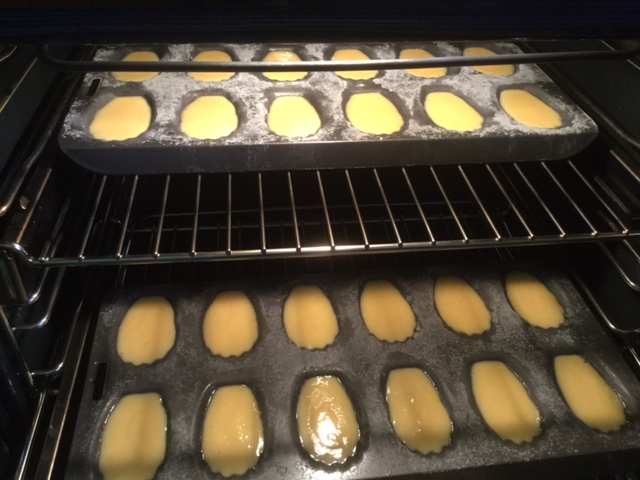
Ready for baking
90g/3oz unsalted butter
zest and the strained juice of half a lemon (organically grown)
2 free range eggs (room temperature)
1/3 cup of superfine/caster sugar
1 tbs of soft brown sugar
a drop of vanilla extract
90g/3oz all purpose flour
1 teaspoon of baking powder
pure icing sugar, for dusting

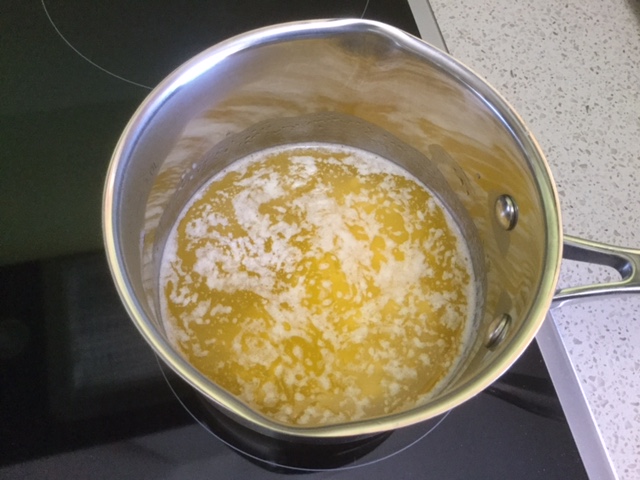
1.  On a low heat, melt the butter with the lemon juice and zest. Cool to room temperature. 

2.  Blend the eggs, the caster and brown sugars and vanilla in a blender or food processor.

3.  Sift the flour and baking powder into the mixture, add the cooled butter and blend until smooth.

4.  Rest the batter for an hour or two at room temperature. It can also be refrigerated overnight but then needs to be brought to room temperature.

5. Preheat the oven to 180C/360F.
Spoon the batter into the buttered and floured madeleine moulds so that they are about two thirds full. Bake for 9-12 minutes, depending on your oven. Test with a skewer. I baked them on two oven shelves and then swapped them over at the 7 minute mark, for an extra couple of minutes.

6.  Remove from the oven and after a minute bang the trays on the bench to dislodge the madeleines. Cool on a rack with the patterned side facing up. Dust with icing sugar just before serving.

Lemon Butter Sauce
The gentle velvety sweetness of the lemon butter sauce complements the ‘quieter’ madeleines and throws into relief the sharpness of the lemon sherbet. It at once, contrasts and harmonises with it. Not unlike Annie and Beauvoir.
As he spoke he looked at Annie. Her eyes never left him, barely blinked. She took in every word, every gesture, every inflection. Enid, his ex-wife, had also listened. ... Enid left him drained, and yet still feeling inadequate. But Annie was gentler. More generous. Like her father, she listened carefully and quietly. With Enid he never talked about his work, and she never asked. With Annie he told her everything. (The Beautiful Mystery, Kindle p.7) 
“What’ve you got there?” Annie Gamache asked, leaning across the table. ... “Nothing,” he grinned. “Just a little je ne sais quoi I saw, and thought of you.” Beauvoir lifted it into plain sight. “You asshole,” Annie said, and laughed. “It’s a toilet plunger.” “With a bow on it,” said Beauvoir. “Just for you, ma chère. We’ve been together for three months. Happy anniversary.” “Of course, the toilet plunger anniversary. And I got you nothing.” “I forgive you,” he said. Annie took the plunger. “I’ll think of you every time I use it. Though I think you’ll be the one using it most of the time. You are full of it, after all.” “Too kind,” said Beauvoir, ducking his head in a small bow. (The Beautiful Mystery, Kindle p.7)
Annie Gamache was none of the things he’d always found attractive in a woman. But Annie knew something most people never learn. She knew how great it was to be alive. It had taken him almost forty years, but Jean-Guy Beauvoir finally understood it too. And knew now there was no greater beauty. (The Beautiful Mystery, Kindle p.8)

This sauce is an important part of this desert in the way it brings together the other elements harmoniously. It really is rather luscious, but also lively.


2 egg yolks (free range)

40g/1.5oz unsalted butter

2/3 cup of caster/superfine sugar

2 teaspoons of grated lemon zest

100ml/3.4fl oz lemon juice


1.  Lightly hand whisk the egg yolks and sugar together in a bowl. 

2. Add the butter, zest and lemon juice and whisk over a saucepan of simmering water (don't let the bowl touch the water) until the butter melts and the sauce thickens slightly to a pouring consistency. 

Serve at room temperature or slightly chilled.

Sticky Lemon Caramel
Annie faces some difficult and heartbreaking experiences, and like Beauvoir and because of Beauvoir, she is forced to rethink the course of her life. Oh, the course of true love...
“Listen,” she said, leaning forward, her voice softening a bit. “I’m sorry about you and Enid. Your separation.” “Yeah, well, it happens. ... ” She looked at him with searching eyes ... “Especially after what you’ve been through, I guess. It makes you think about your life. Would you like to talk about it?” Talk about Enid with Annie? ... The thought revolted him and he must have shown it. Annie pulled back and reddened as though he’d slapped her. “Forget I said anything,” she snapped and lifted the paper to her face. (A Trick of the Light, Kindle, p.8) 
But all he saw was his daughter, his little girl, in their living room Sunday night. She’d swung from sobbing to raging. From hating David, to hating herself, to hating her parents for suggesting counseling. (A Trick of the Light, Kindle, p.238)
Annie Gamache sat in the dark, staring out the window. ... She’d kicked Jean-Guy out of their home when he refused to go back to rehab. They’d fought and fought, until there was nothing left to say. And then they fought some more. ... Finally, he’d left. But he hadn’t actually gone. He was still inside her, and she couldn’t get him out. ... And she sometimes wondered if that was him, beating on her heart. And she wondered what would happen if he stopped. Every night she came here. Parked. And stared at the window. Hoping to see some sign of life. (How the Light Gets In, Kindle p.162) 
This sticky lemon caramel provides an intense flavour and texture contrast in the dessert. The caramelised sugar and finely zested strips of lemon lend a richness, a hint of bitterness, and wonderful stickiness to the dessert.

1/2 cup of superfine/caster sugar 1/4 cup of water
fine strips of lemon zest from half a lemon
1 tbs limoncello (optional)

1.  Stir all the ingredients, except the limoncello, in a small saucepan over medium heat until all the sugar has dissolved.

2.  Stop stirring and allow the water to gradually evaporate as it comes to the boil so that the mixture thickens and turns amber in colour.   
3.  Remove from the heat. Stir in the limoncello as it cools. It should be thick and sticky but not set, when cool.

Crème Fraîche
This is a very versatile cream and goes with anything. It's soft creamy texture is a good foil for some of the sharper flavours in the dessert. A bit like Annie's gentle and constant heart.
Je t’aime,” he whispered into her ear, as he held her. “Je t’aime,” she whispered into his ear. ... Once he was gone and she could no longer see the back of his car, Annie Gamache closed the door and held her hand to her chest. She wondered if this was how her mother had felt, for all those years. How her mother felt at that very moment. Was she too leaning against the door, having watched her heart leave? Having let it go. (The Beautiful Mystery, Kindle, p.14)
I love the fresh taste of this cream, with its subtle tanginess. It's easy to purchase, but it's just as easy to make. It only takes a few hours to be ready.

1 cup of pure cream (no thickeners)
1 tbs of cultured yoghurt (whole milk)

1.  Mix the cream and yoghurt together in a small glass bowl. 

2.  Cover with a piece of muslin or fine netting and leave on the bench top at room temperature for several hours or overnight. 

3.  Give it a stir after a couple of hours. It will have already thickened. You can taste it every few hours to judge the degree of sourness (which is much lighter than sour cream) and thickness you prefer. 

4.  Cover and refrigerate. It lasts for a week.

Almond Praline
Annie is a spirited woman, not to be cowed by anything or anyone. She's got attitude! In the media campaign, linking Gamache to the man he brought down, Arnot, she too was hounded.
On the television was a live picture of a young woman leaving an apartment building, her briefcase up to her face. Annie. ‘Oh, God,’ whispered Gamache. Then she lowered the case and stood still. This seemed to stun the reporters who preferred their prey on the run. She smiled at them. ‘No, don’t,’ whispered Beauvoir. Annie raised her arm and gave them the finger. (The Cruellest Month, Kindle, p.383)
Now this Annie made me consider a 'crunch' factor in the dessert. What better than almond praline with its salty, caramel notes presenting a bit of 'attitude', too!

I love the flavour and texture of praline, which is lifted to another level with a tiny sprinkle of sea salt at the end of cooking. This method of making praline is based on that of food writer, David Lebovitz, and the result is the best ever. Chopped praline over creme fraiche contrasted with all the lemony bits in this dessert, is quite the thing!


1 cup of almonds, with skins
1/2 cup of superfine/caster sugar
1/4 cup of water
pinch of sea salt

Place the almonds sugar and water in a saucepan over medium heat. Stir with a wooden spoon until the sugar has completely dissolved.


Bring to the boil and then lower the heat slightly, stirring until all the water has evaporated and the mixture turns 'sandy'.
Continue to stir until the sugar crystals start to liquefy. Keep stirring until all the almonds are covered with a shiny glaze.

Watch closely so that the almonds don't burn.
Pour onto a baking sheet lined with baking paper and spread out. Sprinkle immediately with the sea salt.

Chop or blitz into small pieces, when cool. Store in an air-tight container.


Chocolate Ganache and Fresh Blueberries
Blueberries and chocolate, and Beauvoir go very well together so they had to feature in this dessert.
“I miss you,” Jean-Guy wrote. “ Merde! All the chocolates are gone! How did that happen?” Then he rolled over, the BlackBerry held lightly in his hand. But not before typing, in the darkness, his final message of the day. “ Je t’aime .” He carefully wrapped the chocolates and put them in the nightstand drawer. For Annie. He closed his eyes, and slept soundly. (The Beautiful Mystery, Kindle, p.106)
I made a little chocolate ganache to accompany the blueberries. However, fresh blueberries by themselves works well too. I couldn't avoid having two helpings of dessert for the purpose of this important 'tasting' research! Blueberries and lemon are also a great match. The in-season berries were needed for their 'explosive' texture and 'fresh fruitiness' against all the other elements in the dessert.

125g/4oz bittersweet dark chocolate
1 cup of pure cream
2 cups of fresh blueberries

Heat the cream in a bowl over a small saucepan of simmering water. Add the chocolate and stir until melted and well incorporated. Remove the bowl from the heat and whisk the mixture until cool, and soft peaks form.
A generous dob of chocolate ganache covered with a small handful of blueberries completes the dessert.


A serve of Annie Gamache
A coy smile could capture him, but it was finally a hearty laugh that had freed him. No knees would buckle for Annie Gamache. No eyes would follow her substantial body. No wolf calls for her pretty plain face. But she was by far the most attractive woman in any room. Late into his thirties, with a broken body and a shattered spirit, Jean-Guy Beauvoir had been seduced by happiness. (The Long Way Home, Kindle, p.103)
I hope there's plenty to be seduced by, in this dessert too!

On each plate place one madeleine, a quenelle of lemon sherbet, and 2 tablespoons of lemon  butter sauce between them.   

Add a generous dob of creme fraiche sprinkled with almond praline. Drizzle sticky lemon caramel around the creme and at the edge of the lemon butter sauce. 

In the space remaining, add a dob of ganache (or not) and cover with a mound of blueberries.

Voila! Annie Gamache! 


Santé! Annie and Jean-Guy


Ruth held Rosa and, leaning into Beauvoir, they kissed on both cheeks. “There’s pink lemonade in the fridge for you,” she said. “I made it.” (The Long Way Home, Kindle, p.18)
Someone suggested that 'Annie Gamache' could also be a cocktail. Well, I always find a good cocktail hard to resist! And I thrive on making ingredients for cocktails. So in keeping with the lemon theme and inspired by Ruth's pink lemonade for Beauvoir, I devised a cocktail using home-made limoncello (vodka infused, over time, with lemon rinds and mixed with a sugar syrup) and grenadine (freshly squeezed pomegranate juice mixed with a heavy sugar syrup). They last indefinitely stored in the freezer. 

This cocktail has a nice balance between a light sweetness, a sharp sourness and a dry finish. And as for that sparkle!!!  It's a perfect aperitif. I love the pink blush, too. Very Beauvoir!!  Now if I was making this cocktail for him, I'd substitute fresh lemon juice for the limoncello, and sparkling lemonade for the sparkling wine.

Annie Gamache cocktail
(Makes two servings)

1 measure/2.5 tbs limoncello
1 measure/2.5 tbs fresh lime juice, sieved
1/2 teaspoon of grenadine
8 ice cubes
dry sparkling white wine (I used Prosecco)
a curl of lemon rind and lime slices for decoration

Vigorously shake the limoncello, lime juice, grenadine and ice cubes together. 

Strain into two cocktail glasses. Top with dry sparkling wine. 

Decorate with a curl of lemon rind slightly submerged, and a half slice of lime on the glass edge.


Saturday, December 19, 2015

Full Breakfast and Awkward Interactions

By Amy

“Everyone was already around the table next morning when Morin arrived, more than a little disheveled. They glanced at him, and Agent Lacoste indicated the seat next to her, where, miraculously for the hungry young agent, there waited a bowl of strong café au lait along with a plate of scrambled eggs, bacon and thick-cut toast with jams.”

“Downstairs he found a full breakfast of bacon, eggs, toast and strong coffee.”

This blog keeps changing my grocery shopping list! I’d only ever bought bacon twice and both times were during long vacations overseas. Both my husband and son slept in, so I made myself a full breakfast one Saturday. Like Gamache, I ended up regretting the bacon and wishing I’d had the meal for dinner instead. It was a bit much for me that early in the morning.

The first scene is when Agent Morin comes back to the village after a night spent alone in the hermit’s cabin. The second is the breakfast Gamache eats in the Haida village right before flying to the totems and over the Gwaii Haanas.

In the first scene Agent Morin is the personification of the rookie trying to do the right thing and not appear inexperienced. In the second, Gamache is very aware that he is the outsider in a group of people who weren’t always treated kindly or justly by previous visitors. While he himself respected them, he realized he might be lumped together with people who didn’t share his sensibilities or his ideals.

“The pilot’s deep brown eyes were suspicious, as well they would be, thought Gamache. The arrival of yet another middle-aged white man in a suit was never a good sign. You didn’t have to be Haida to know that.”

I could identify with both Morin and Gamache as they navigated these tricky social situations. I have traveled a bit since I was a child and my parent's home, and later my own, have always been very open and hospitable. I enjoy interacting with different people – it doesn’t mean it’s always comfortable. It’s always easier to be on our own turf, so to speak, where we have the choice of being magnanimous and encouraging as Lacoste was to Morin and Esther was to Gamache.

It’s much harder to be in Morin shoes facing a prickly superior like Beauvoir. The most uncomfortable situation, to me, is facing the Lavinas of the world. She’s beyond prickly. She’s defensive, suspicious, and unwelcoming. She probably has good cause to be, but it’s not easy to begin a social interaction with someone who’s that standoffish. Gamache, who’s always attentive to everyone, even forgot to ask for her name!

“… the young bush pilot looking at her watch. Was her name Lavina? To his embarrassment he realized he’d never asked her.”

The main difference, I think, is perceived superiority. As a junior agent, inexperienced in homicide, as well as younger than the other officers at the table with him, Morin subjected his behavior to their judgement and was found wanting.

“Why didn’t you call?” demanded Beauvoir, tearing his eyes from the carvings to look at Morin.
“Should I have?” He looked stricken, his eyes bouncing among the officers. “I just thought there was nothing we could do until now anyway.”
“He’d longed to call; only a mighty effort had stopped him from dialing the B and B and waking them all up. But he didn’t want to give in to his fear. But he could see by their faces he’d made a mistake.”
“All his life he’d been afraid, and all his life it had marred his judgement. He’d hoped that had stopped, but apparently not.”

We’ve all been there: trying to measure up to a mentor, a professor, a new boss. Sometimes it’s easy to figure out what is wanted, evaluate if the requirements are compatible with our capacities and adjust our behavior to meet expectations. Other times, we miss our cue, misunderstand the requests, or simply don’t comply – either because we lack the means or because it would mean compromising our beliefs and ideals.

Leaders (good ones at any rate) assume responsibility and guide their subordinates while they gain the experience necessary to improve judgement. This is true of parenthood and it is true in any job. Parents, teachers, mentors, older siblings… they are all models of behavior (including how not to behave) and we can profit from their foresight and experience. While it was embarrassing for Morin to discover his action had been interpreted as foolish, instead of brave, he was in a position where minor mistakes were almost expected. That probably accounts for Beauvoir’s prickliness and unwillingness to have him join the team in the first place.

While being a good leader involves assuming responsibility and being a good model and teacher, the subordinate also has a role to play. In this sense, Morin was an easier novice to work with than was Agent Nicole. Her lack of self-worth and defensiveness was so intense that it was hard for her to listen to instructions or learn from her mistakes. Being admonished made her disengage and lick her wounds while justifying herself and ranting against those who criticized her. Morin was the braver soul, in my opinion. He understood his own feelings well and, in the end, instead of retreating, he reached out to make sure that his safety net was still in place.

“That was foolish of you,” said Gamache. He looked stern and his voice was without warmth. Morin instantly reddened. “Never, ever wander on you own into the woods, do you understand? You might have been lost.”
“But you’d find me, wouldn’ you?”
They all knew he would. Gamache had found them once, he’d find them again.
The Chief knows the importance of teaching and mentoring his agents. He has taught the same to Beauvoir and Lacoste – who both become mentors throughout the series, although they all go about it in different ways. Gamache also recognizes the need to allow people room to use their intuition, judgement, and their own personal style of doing things. In A TRICK OF THE LIGHT he makes that clear, both to Lacoste and to Adam Cohen:

“No matter what orders are issued, you must only do what you know to be right. You understand?”

In the scene with the Haida bush pilot, Lavina, although Gamache was an authoritative figure - a Chief Inspector of Homicide - he had no direct authority over her. He also represented a group of people who had, historically, marginalized the Haida. I think she expected him to be condescending or inadequate. I have the feeling that it made him uncomfortable; interactions could shadowed by nuances he wasn’t personally guilty of, but represented all the same.

A quick read though Wikipedia (probably not the best source, but it's the most readily available) shows that the Haida are a fierce, proud people. They were defeated by smallpox, not by the Europeans and North Americans they fought with. It is a measure of their strength that so much of their culture has survived.

Lavina was the most unwelcoming of the Haida I wonder why that is. Having lived in more than once place and experienced more than one culture in my formative years, I can certainly understand her annoyance. Age usually teaches you that lack of knowledge is not the same as lack of compassion or interest. Informing someone kindly is usually better than biting their nose off. Gamache did his best and, while the others were more forgiving, she was the mirror that reflected his blunders.

“So you’re from the Charlottes?”
“I’m from Haida Gwaii,” she said.
“Of course, I’m sorry. Are you with the Eagle clan?”
“Raven.”
“Ah,” said Gamache, and realized he sounded slightly ridiculous, but the young woman beside him didn’t seem to care. She seemed more interested in ignoring him completely.”

A friend, who’s a very vocal advocate about issues I won’t get into here (at the risk of deviating from the topic at hand) once told me that she realizes she comes off as bitter and judgmental. She says she hates my arguments and my concessions. While we share ideals, our approach is different. She says she wants to stay mad and angry and bitter and resentful. She wants to bother people and take them kicking and screaming away from their comfort zone. I obviously don’t feel the same, but I can understand where she’s coming from.

Maybe Lavina’s resentment has a deeper cause we may never find out about. Maybe she was having a bad day. And maybe the Chief was right.

“Gamache wondered if she was channeling Ruth Zardo. Was there one in every pack?”


Quotes from The Brutal Telling and How The Light Gets In.

Saturday, December 12, 2015

Vegetables from the Garden...and Motives

by Libby

Clara chopped the ends off the fresh carrots and watched Peter toss the tiny new potatoes into boiling water. They’d have a simple dinner tonight of vegetables from the garden with herbs and sweet butter. It was one of their favourite meals in late summer. (The Brutal Telling, Kindle p.349)


The striking thing about this meal, apart from the garden vegetables, was the conversation between Clara and Peter. But particularly the one that was playing out in Peter's head. He is deliberating over the possible responses he can give to Clara, after she has sought his advice. And she waits for a response with increasing frustration. In one incisive paragraph we get the idea, and know the feeling!
Peter took another slice of baguette, soft on the inside with a crispy crust. He smeared the butter to the edges, covering every millimetre, evenly. Methodically. Watching him Clara felt she’d surely scream or explode, or at the very least grab the fucking baguette and toss it until it was a grease stain on the wall. (The Brutal Telling, Kindle p.350)
Peter questions his own motives for what he wants to say to Clara. His eventual cryptic response leaves us with little doubt. This was a jaw-dropping passage! 

What should he tell her? To forget it? That what Fortin said wasn’t that bad? Certainly not worth risking her career. Just let it go. Besides, saying something almost certainly wouldn’t change Fortin’s mind about gays, and might just turn him against Clara. And this wasn’t some tiny show Fortin was giving her. This was everything Clara had dreamed of. Every artist dreamed of. Everyone from the art world would be there. Clara’s career would be made. Should he tell her to let it go, or tell Clara she had to speak to Fortin? For Gabri and Olivier and all their gay friends. But mostly for herself. But if she did that Fortin might get angry, might very well cancel her show. 
Peter dug the tip of the knife into a hole in the bread to get the butter out. He knew what he wanted to say, but he didn’t know if he’d be saying it for his sake, or for Clara’s. Well?’ she asked, and heard the impatience in her voice. ‘Well?’ she asked more softly. ‘What do you think?’ ‘What do you think?’ Clara searched his face. ‘I think I should just let it go. If he says it again maybe then I’ll say something. It’s a stressful time for all of us.’ ‘I’m sure you’re right.’ Clara looked down at her uneaten plate. She’d heard the hesitation in Peter’s voice. Still, he wasn’t the one risking everything. (The Brutal Telling, Kindle p.351)

Clara recognises at a moral level exactly what Peter is implying in his, 'I'm sure you're right' response. His duplicitous appeal to her moral sense, can have no other outcome. She does speak with Fortin.

The Brutal Telling leaves no doubt as to the underlying motives for Peter's behaviour. While he 'loves' Clara, he just can't get past himself. He needs to be the successful artist, and he needs Clara to be his emotional prop, his comfort, as he pursues his art. But his artistic expression has reached a dead end while hers is now powerfully blooming. He fears ceding his status as an artist to Clara. He can no longer deny how good she is. Grasping an opportunity to derail her burgeoning career is a measure of this fear, his neediness and dependency, his self-interest. Somewhere in there, though, is a prick of conscience, as he asks himself, 'What have I done?' 

A deep-seated jealously of Clara resides within him. Not only artistically and for the recognition she is now receiving, but also of the intimacy she has with others...something of which he is incapable. Peter is even jealous of Gamache's 'easy relationship with Clara'. The closest he gets to a real intimacy is with his finely detailed paintings behind the closed door of his studio. 'The place he kept his art. The place he kept his heart.'' Now even this is failing him. Welcome to the pathway to dissolution!


Motive is at the heart of every investigation for the Sûreté team. Beyond the facts of a case they look for motive and opportunity. A small patch of soil or an empty pot is all the opportunity I need to plant something. I like to grow what I eat, and take comfort in knowing that I can be right at the source of some of the food that my family eats. Ah, motive and opportunity! The freshness and flavour of organically grown seasonal produce is at the heart of it. There is nothing quite like the flavour and texture of vegetables eaten fresh from the garden. It's not always possible to grow your own, but even having a few pots of herbs is certainly worth considering. The addition of some fresh herbs can elevate a vegetable dish to something quite special.

I love a big platter of young, seasonal vegetables to pick and choose from at a meal. Even young children, who can be finicky (not to mention some adults), are quite happy to hoe into lots of the vegetables on offer in a platter like this! They can be enjoyed just as Clara and Peter did, or to accompany something else like fish, poultry, meat or pulses. I like to have a contrast between leafy greens, root vegetables or tubers, and those from the bush or vine. So at this time of year, early summer where I am, there is quite a range. 

Peter boiled the tiny potatoes but I steamed them until tender, only 20 minutes. A squeeze of fresh lemon juice, tossed in sweet (unsalted) butter and finished with chopped chives and flat leaf parsley, a grind of black pepper is all that is required for deliciousness. I find that the addition of herbs reduces the need for salt, a matter of personal taste though. I always use unsalted butter in my cooking as it allows me to control the seasoning of things.


I prefer to eat and cook young, finger-like carrots, and particularly like the multi-coloured heritage varieties that are available to grow or buy. They always look so festive! I poached them until tender, reduced the liquid to almost nothing, and then finished cooking them with a couple of tablespoons of honey, for a sweet glazing. Finally, a drizzle of extra-virgin olive oil, cracked black pepper and a generous sprinkling of fresh coriander leaves/cilantro (including some of the flowers).


Young fresh beetroot simply roasted are sweet, earthy and delicious. I don't peel them when they are young. I wrapped them in lightly oiled aluminium foil and cooked them for approximately 40 minutes in a 180C/350F oven. A drizzle of red wine vinegar, a tiny splash of extra-virgin olive oil, a grinding of black pepper, and Voila!


Small roasted tomatoes add a wonderful colour and texture contrast, and rich savouriness to the platter. Cut a small cross into the top of each tomato, give it a tiny splash of extra-virgin olive oil, a sprinkle of fresh thyme leaves, sea salt and ground black pepper. Cover the roasting dish with aluminium foil and roast in a 150C/300F oven for 30 minutes, remove the cover and increase the oven temperature to 190C/375F and cook until the tomatoes begin to collapse slightly. Lightly drizzle with balsamic vinegar just as they are removed from the oven.


Zucchini flower ready for pollination. Bzzzz...
 Asparagus, zucchini and peas just go well together! With the addition of spring onions, fresh dill, parsley and garlic they resonate spring and summer. I used snow peas/mangetout, as fresh shelling peas were not available.

Lightly fry the asparagus spears, zucchini slices and peas in a little extra-virgin olive oil and add a dash or two of chicken stock to help the cooking along and prevent the vegetables from sticking.


Fry for several minutes ensuring that the vegetables still have some 'crunch' at the end of cooking.

Just before removing them from the heat add chopped spring onion, fresh dill and 
flat-leaf parsley and one or two crushed and finely chopped garlic cloves. I also added some sliced zucchini flowers. The herbs provide a very complementary burst of flavour with the vegetables. Finish with a drizzle of extra-virgin olive oil and a grind of black pepper.
 

One of my favourite ways to eat spinach and other leafy greens is to cook them the way I first  experienced them in northern Italy. Finely chop a generous bunch of leaves (including the stems) and slowly braise in some water or chicken stock until very soft and tender, and rich in flavour. Alternatively you can braise the whole leaves and then finely chop them. I used spinach, young beetroot leaves, radicchio and sorrel from the garden.

At the end of cooking when the liquid has been reduced right down, stir through fresh finely chopped garlic to taste, and some extra-virgin olive oil and a little black pepper so that you have a dense mound of greens. So good!!


Even though some 'uncomfortable truths' exist between them, Clara has little reason to doubt Peter's motives in responding to her request for advice. Why would she? She believes he is very loyal. She trusts him. A new agent to the Sûreté team, on the other hand, and rather ironically, is bound to wonder at a colleague's motives.
He’d looked at her then, trying to figure out what her motives might be. Everyone had them, he knew. Some were driven by kindness, some not. And he’d been at the Sûreté long enough to know that most in the famous police force weren’t guided by a desire to be nice. It was brutally competitive, and nowhere more so than the scramble to get into homicide. The most prestigious posting. And the chance to work with Chief Inspector Gamache. He was barely in, and barely hanging on. One wrong move and he’d slide right out the door, and be forgotten in an instant. He wasn’t going to let that happen. And he knew, instinctively, this was a pivotal moment. Was Agent Lacoste sincere? (The Brutal Telling, Kindle p.156)
Of course she was! Her motives are not malevolent. Lacoste views Agent Morin as her 'protégé', mentoring him, just as Gamache first mentored her. And Morin's sense of trust in her is not misplaced, as he takes her advice.

Louise Penny introduces us to the young, 'gangly and awkward', and inexperienced Agent Paul Morin in The Brutal Telling. We are given a window into his character through his thoughts and actions and the observations and opinions of the Sûreté team. We feel for him and his uncertainties and fears of being inept, in a caring and sometimes amused sort of way.
So far so good, thought Morin. Seems the idiot agent act is working. Now if only it wasn’t an act. (The Brutal Telling, Kindle p.181)
While he always looks a bit 'clueless', he is determined, and proves his value by learning to watch, listen, research diligently and learn from the team. Gradually through the investigative processes, as his impressions and opinions are sought, he understands that the team is investing in him as a colleague. Even Beauvoir had 'quite warmed to the young man'. 

And how satisfying to discover that Morin is something of a revelation. Our hearts open further to him.
Agent Morin had changed. His loose-limbed awkward body contorted perfectly for the violin, as though created and designed for this purpose. To play. To produce this music. His eyes were closed and he looked the way Gamache felt. Filled with joy. Rapture even. Such was the power of this music. This instrument. ... The violin might be a masterpiece, but Agent Paul Morin certainly was. (The Brutal Telling, Kindle p.294)
And for me, having revisited the series, there is a poignant foreshadowing of what tragically lies ahead.
‘That was foolish of you,’ said Gamache. He looked stern and his voice was without warmth. Morin instantly reddened. ‘Never, ever wander on your own into the woods, do you understand? You might have been lost.’ ‘But you’d find me, wouldn’t you?’ (The Brutal Telling, Kindle p.226)
I like to think he is not forgotten.


To complete the dinner I served fish with the vegetable platter and baguettes.


It's always important to consider the balance of protein in a meal. I gently poached some Atlantic salmon cutlets and made a mousseline sauce, which is a very light, lemon-tangy accompaniment to the fish. It's a very versatile hollandaise-based sauce that works beautifully with vegetables or fish. A bit of lightly whipped cream added to the sauce base contributes to its lightness. It's worth getting to know this sauce.

Mousseline sauce
200g/7oz unsalted butter, chopped
2 egg yolks, at room temperature
40ml/1.4fl oz water
2 tablespoons fresh lemon juice, strained
pinch of salt and white pepper
1/3 cup of pure cream, lightly whipped

1.  Clarify the unsalted butter, by melting it on a low heat and cooking until the milk solids separate off to the bottom of the saucepan. Skim the surface and set aside.

2.  Hand whisk the egg yolks and water in a bowl over a pot of simmering water. Keep whisking (it takes a while) until the mixture has a thick, creamy consistency.

3.  Gradually whisk in the clarified butter, a drizzle at a time until completely absorbed. Gently fold in the lemon juice and salt and pepper. Serve warm. Pour over the fish and sprinkle with chopped chives.