Reading may seem like a solitary pleasure, but we do not believe it is so. As we read, we intimately interact with writers, the worlds they create, and our own inner selves as well as the real world that surrounds us. Some of us are also blessed enough to have friends to share the experience with.

While discussing the idyllic village of Three Pines and the captivating characters author Louise Penny created in the Inspector Gamache books, we were aware of the sensory pleasure to be had in the meals described. Olivier’s Bistro, Gabri’s baking, and dinners at the Morrow’s can easily make us salivate while reading the books… Louise Penny's books, are a wonderful entrée into a sensual world, where each book is a season, capturing its mood and flavours, and contributing to the layers of meaning about the characters, who are marvellously revealed over the series.

At one point, a daydream of going through the series with a notebook in hand, writing down all these meals and later cooking them, took shape. This is our "notebook". We hope you enjoy this literary-culinary-sensory-philosophical journey.

Friday, March 11, 2016

Quinoa & Pomegranate Salad and Mentors

by Amy


“And how’s Isabelle doing?” asked Gamache.
“Acting Chief Inspector Lacoste?” asked Beauvoir with a smile. His protégée had taken over as head of homicide for the Sûreté, a job everyone had once assumed would be his on the Chief’s retirement. Though Jean-Guy knew it wasn’t accurate to describe what had happened as a retirement. That made it sound predictable. No one could have predicted the events that had caused the head of homicide to quit the Sûreté and buy a home in a village so small and obscure it didn’t appear on any map.
“Isabelle’s doing fine.”
“You mean Ruth Zardo ‘fine’?” asked Gamache.
“Pretty much. With a little work she’ll get there. She had you as a role model, sir.”

And what a role model.

I read a book in my teens that has stayed with me. Don’t ask me the name or the author. I don’t remember. I was abroad, spending some months with friends, and found a book in English in their (very small and limited) library. The book was about the importance of relationships to keep you motivated and on track in life. It compared life to the Boston Marathon and mentioned the importance of motivation once you reach Heartbreak Hill. Relationships matter. The book goes on to describe five types of people in our lives.

It is a testament to the impact the book had in my life that over than two decades have passed and I still remember what they are (although I don’t remember the precise wording). The positive ones are the mentors, the friends, and the disciples or protégées. There are neutral people who neither applaud nor bring you down. Then there are the ones that drain you. They have a negative impact in your life.

The author distributes these people on a spectrum and turns their presence and influence in your life into a mathematical representation where mentors contribute with +++, friends ++, protégées +, neutrals 0, and drainers with -, --, ---...

Or at least that’s how I remember it.

Gamache is a wonderful role model. He not only sets a good example, but he makes sure to be available. That’s important. Some things can be learned by watching or reading, but it’s important to find the time to learn through interaction with people who know more than we do. The younger and the more inexperienced you are, the easier it is to find people to fulfill this role. As you yourself grow into a mentor, there are fewer and fewer people available to play that role in your own life. They should be cherished.

Sometimes books can act as mentors. We can converse with great thinkers long gone and we can strive to learn from their ideas. We can argue with their logic, and we can learn from their mistakes.
Friends – and even protégées - can sometimes play the role of counselors and supporters and listeners. 

But there is a certain comfort in talking to someone more experienced who knows what you’re going through, who you respect and whose opinion and validation matter. It’s like being able to crawl into a parent’s lap and be held. It makes you feel safe.
“Isabelle Lacoste called Gamache at least once a week, and they met for lunch in Montréal a couple times a month. Always away from Sûreté headquarters. He insisted on that, so he wouldn’t undermine the new Chief Inspector’s authority.” 
Lacoste had questions only the former Chief could answer. Sometimes procedural issues, but often questions that were more complex and human. About uncertainties, about insecurities. About her fears. 
Gamache listened and sometimes talked about his own experiences. Reassuring her that what she felt was natural, and normal, and healthy. He’d felt all those things almost every day of his career. Not that he was a fraud, but that he was afraid.”
Lacoste has Gamache, just as Gamache himself had Émile. When he was Chief he did the same. He visited his own mentor and, in his time of need, his mentor’s home was the safe haven he went to while he regrouped and recovered.

"Gamache stirred his coffee and watched his mentor.
He considered him a great man, one of the few he'd met. Great not in his singularity of purpose, but in his multiplicity. He'd taught his young protégé how to be a homicide investigator, but he'd taught him more besides.
Gamache remembered being shown into Chief Inspector Comeau's office his first week on the job, certain he was about to be fired for some mysterious transgression. Instead the wiry, self-contained man had stared at him for a few seconds then invited him to sit and told him the four sentences that lead to wisdom. He'd said them only once, never repeating them. But once had been enough for Gamache."
One of the things I admire is both these dynamics is that not only are the mentors willing to listen, but their protégés are respectful. It is not unusual for youth (and they say young is 10 years younger than you, right? So I'm not talking about an age group, I'm speaking of relative youth) to ignore, reject, belittle, or ridicule the past and those who lived it. I think both Gamache and Lacoste are wise in that they not only respect, but use their mentors as a foundation on which they build their own practice.
“Agent Cohen started this morning,” said Lacoste, taking a forkful of quinoa, feta, and pomegranate salad. “I called him into the office and told him that there were four statements that lead to wisdom. I said I was only going to recite them once, and he could do with them as he wished.”
Armand Gamache lowered his fork to his plate and listened.
“I don’t know. I was wrong. I’m sorry.” Lacoste recited them slowly, lifting a finger to count them off.
“I need help,” the Chief said, completing the statements. The ones he’d taught young Agent Lacoste many years ago. The ones he’d recited to all his new agents.”

And Lacoste is not only a respectful student, a good colleague, and a protégée who continues to honor and include her own mentor, but she is willing to do the (hard) work of mentoring others.

I was writing the first draft on a Sunday when a patient’s mom called asking me to talk to her little sister because she wasn’t feeling well. They’d just lost their mother to very aggressive leukemia. She died within three days of being first hospitalized. Her youngest daughter, at 11 year of age, was experiencing chest pains and shortness of breath. 

My patients frequently come to my home when there’s an emergency during the weekend or a holiday. So when she asked, I said sure. I’ll be waiting. And I was. My husband and son played a videogame inside and I sat in my living room with this child and listened to her pain.

This beautiful and articulate child asked me the questions everyone asks when faced with insurmountable challenges and pain. If it hurts this much now, will it get worse? Will I ever be happy again? How will I survive the pain? What if I feel so breathless that I can’t stand up? What if I faint?People say she can see me, but how do I know that for sure? She used to say change can be a good thing, but she was the one who helped me handle changes in my life – how will I manage this change without her? What if I can’t do my homework? Who will remind me and tell me to do it even when I don’t feel like it? What if I fail? She used to say she’d be sad if I didn’t do well at school – what if I’m so sad I can’t pay attention? Who will help me choose my wedding dress? What if I wake up in the middle of the night and forget she’s gone and try to find her? Who’s going to tell me jokes to make me laugh when I’m upset? Who’s going to tuck me in and say ‘I love you’? How will I tell my children about her?

We cried together. She told me stories about her mother and she made me laugh. She managed to smile and surprised herself when she realized she still knew how. At one point I asked if she wanted to curl up in my lap. It wasn’t the same, but it was available. She nodded and sobbed while I held her. I couldn’t stop my own tears. I didn't try. I'm used to getting emotional with patients and have learned that it's no use trying to stop myself from shedding a few tears (or a bucket-full) and people usually don't mind.

At one point she said her mother still sometimes cried when she thought of her own mother. I hugged her tighter and said, “So now you know what you’ll sometimes do when you talk about her for the rest of your life, right?” She nodded.

Her chest pains and shortness of breath were gone by the time she left for her mother’s funeral. I cried a little bit more for the little girl who lost her mentor. I cried at the thought of losing my own mother – who’s also one of my best friends. And I cried at the idea of leaving my own son behind when I know he still needs me. Needless to say, I cried while writing this post.

I have said, time and again, that this blog is a form of therapy. This time it was also preparation. I’d been writing right before she came. I’d been thinking of how wonderful it is to have mentors and to have people we look up to. I’d been thinking of how sometimes (and more frequently as we grow older or more experienced in our fields) there are less and less people to fulfill the role of mentor. I was thinking of how important it is to find the time to listen and help those who come to us for advice and help.

When I hugged this little girl and we cried together, we talked about how special her mom was and how she’d already taught her so much. The girl told me what her mother would have said and done if she were there. I repeated back to her what her mother would have said. I did what her mother would have done. It wasn’t her voice. My hug wasn’t the same hug. But, in the end, I told her she was stronger than she thought. And her mother was so real and present and important in her life that she knew exactly how to help me help her. I told her sometimes the people we need to hear are not with us. When that happens, we rely on memories, on stories, and on new sources of wisdom.

I realize not everyone is blessed with wonderful parents. Most of us will never have a professional mentor like Gamache. Maybe, at this point, we should remind ourselves to honor those we still have with us and gratefully remember those who are gone. But, more important still, we should strive to be good, empathetic mentors and to listen and share with those who are willing to learn from our experiences – and our mistakes.

My son and I both love pomegranates. They take very (very, very, very) long to ripen. It takes months to go from a flower to a ripe fruit. The tree is right outside my office window and we’ll both watch them bud and blossom and ripen. We both love to eat it plain.

I confess to feeling a little guilty for not sharing this one with him as he didn’t enjoy the salad. I cooked some quinoa and let it cool off. I then added pomegranate seeds, chopped parsley, a squeeze of lemon juice, a teaspoon of olive oil, a pinch (half a pinch) of salt, and a few nuts pulled out of the homemade granola jar that was on the counter. It was refreshing and delicious. I didn’t have any feta, but I didn’t miss it in the salad.

But then, you know that thing with mentors? When it comes to gardening and cooking, Libby is waaaaaay beyond my skills. A whole other category (probably many categories). When we first thought of making this blog she had ripe pomegranates in her garden (what are the odds? we live around the world from each other and both have pomegranates in their backyards!). She went ahead and made this salad - I think it was one of the first meals she made and photographed. It was one of the meals that's been circling in my head ever since.

Here's her fabulous recipe:

Quinoa, Pomegranate & Feta Salad
by Libby


This late summer/autumn salad, when pomegranates are in season, is all about balancing taste contrasts and interesting textures. Quinoa is a high protein cereal and a good substitute for rice. You can cook it similarly to rice. I cook it in chicken stock for added richness and flavour.

The nutty taste of quinoa works well with the sweet/tart explosion of pomegranate seeds and the rich salty creaminess of the feta. The crunch of fragrant pistachios is an added contrast.   Caramelising some red onion and garlic as a flavour base ensures that the salad won't be bland. This is a dish to taste as you put it together, to check that the balance of flavours is right for you.


1 cup of quinoa
2 cups of chicken stock (or water)
1 red onion, halved and sliced thinly
2 cloves garlic, finely chopped
seeds of 1 pomegranate
300g/10oz of feta cheese, broken into small bite-sized pieces
2/3 cup unsalted pistachios, toasted
3 spring onions, finely sliced
2/3 cup of flat leaf parsley, sliced
extra-virgin olive oil
one lemon, halved
sea salt and cracked black pepper

1.  Bring the chicken stock (or water) to the boil in a medium saucepan. Pour in the quinoa and simmer for about 15 minutes until the germ of the quinoa pops out. Strain and set aside.

2.  Fry the red onion, garlic and a pinch of salt in extra-virgin olive oil in a large heavy-based frypan on a low to medium heat. Add a squeeze of lemon juice.Allow the onion to soften and slowly caramelise. This will give a lovely savoury base note to the salad.

3.  Reduce the heat to low and add the cooked quinoa. Mix thoroughly with the onion and garlic.

4.  Toss through the pistachios, spring onions, parsley and feta cheese.

5.  Generously drizzle with good extra-virgin olive oil and lemon juice. Season with cracked black pepper.

6. Toss through the pomegranate seeds.

Taste and adjust the balance of ingredients to maximise the flavour contrasts. You might, for example, prefer more or less feta cheese, or more lemon for added sharpness.
Serve warm.


I couldn't resist making a 'zingy' drink of freshly squeezed pomegranate juice, grapefruit juice and sparkling mineral water to accompany the salad. 


So there you have it! Two salads!

Saturday, March 5, 2016

French Onion Soup ... And Looking Back

by Libby


Just ahead, the Château promised warmth, a glass of wine, a crusty bowl of French onion soup. Émile. But the Chief Inspector stopped just short of the shelter, and stared. Not at the Château ... but to another monument off to the left ... It was of a man looking out over the city he’d founded four hundred years earlier. Samuel de Champlain. ... But still he stared at the father of Québec and wondered. Where are you? Where did they bury you? And why don’t we know? (Bury Your Dead, Kindle, p.106)

I love the sense of place and time that Louise Penny has created, and the history connections she has made, in Bury Your Dead, which allows us to immerse ourselves a little in a fascinating historical narrative. Gamache has come to Quebec City to do just that, pass the time, 'Avec le temps', puzzling over and researching a mystery related to the Battle of Quebec, as he tries to rest and recover. 


Of course he then finds himself at the intersection of two other mysteries, the death of Augustin Renaud and the whereabouts of the burial place of Samuel de Champlain, the founder of Quebec.


Gamache elicits the help of his friend Emile, and two of his associates, about the Renaud/Champlain mystery. Where better to meet than in Bar Laurent, in the Chateau Frontenac and in sight of the statue of Champlain (supposedly marking the spot where he died).


The St-Laurent Bar was at the far end of the Château, down the gracious, wide, endless corridor, through the double doors and into another world. ... For curving along the far wall of the bar were windows. Tall, framed in mahogany, wide and mullioned. Out of them opened the most splendid vista Gamache had ever seen. True, as a Québécois, no other view could ever match up. (Bury Your Dead, Kindle, p.106-7)


While the site of Champlain's burial will continue to remain a mystery, Gamache is left wondering, on a bitterly freezing winter's day, about Champlain's incredible achievements 400 years earlier, his legacy and the character of the man.

And even Gamache, who was no great fan of nationalism, felt wonder, awe, at the unshakable vision and courage of this man to do what many had tried and failed. To not just come to these shores to harvest furs and fish and timber, but live here. Create a colony, a community. A New World. A home. (Bury Your Dead, Kindle, p.106)

Most people’s achievements and legacy are not quite so extraordinary but it made me think about the importance of looking back, and seeing where we've come from and what has shaped our human condition, our life story, how a society and families have been shaped, influenced and changed against a backdrop of social, political and cultural influences and events.

And as I make French onion soup I reflect on how we understand more of ourselves, our identity, our humanity, through our own and others' stories. Isn't that why narrative is so important, helping us to understand our own story, and empathise with others? Perhaps more than ever today it is important to explore our connections to other people, places and times, to understand a family's or a people's circumstances and their desire or need to change them, to migrate, to start over, elsewhere. And the risks taken and the opportunities afforded.

Some people work very hard to find out about their forebears, to understand and appreciate their legacy. We like to know where we come from, the decisions and actions, even gambles taken by those before us, that are pieces in the puzzle of our own lives, and for some also the result of being ‘collateral damage’ of history's events. I imagine very few people don't have stories of migration in their family histories. If for no other reason, finding out about them reminds us that we've all come from somewhere, or needed to leave somewhere, looking for opportunity, or to be free or safe, for the promise of a better life, or even maybe in search of adventure.

I have a friend who is on a determined pathway to research her family roots. In the most scholarly way (in a research and literary sense) she has told the story of her maternal great, great grandparents’ migration to, and settlement in, Australia. She has re-created their lives in detail, and told their story against the socio-economic and cultural background of the 19th and early 20th centuries. She writes extremely well and the social, cultural and economic history of those times in her book is rich and fascinating in its detail. You can imagine how interesting it is to have such a family narrative with its vision, dreams, life-changing decisions, opportunities, expectations, disappointments, sense of character and time and place, and with the generational impact of it all to be reflected on.

Sometimes the pathway to finding out about family is not quite so determined. It might simply be a puzzle that presents itself, asking to be solved.

Just the other day I heard the English writer Patrick Gale speak about his latest book, A Place Called Winter. It's his first work of historical fiction, and is loosely based on the circumstances of his great grandfather's life. By chance, Gale happened to see two photos of a man at his aunt's house, one showing a young well-to-do Edwardian Englishman, and the other of an impoverished, toothless elderly man. What he discovered was that they were the same man, his great grandfather, who had never been spoken about, and who he knew nothing about. As a young man his great grandfather had been forced to leave his wife and child, his fortune and his London home, under an ignominious cloud. He settled and lived a mostly isolated life in the prairie wilderness of Canada and tried to eke out a living on the land, about which he knew nothing. Gale set out on a voyage of discovery, uncovering the struggle, despair, fortitude and emotional truth of someone who was one of the 'disappeared', unwanted by his family or society. And he poignantly tells that story, and it is an elegy to others like him.

I was left thinking of what it is like to uproot your life and venture to the other side of the world, to what could be a hostile environment, to battle adversity because of the hope or promise of a better life, greater freedom, improved economic circumstances. For many it is about being forced to give up what they know in the hope of a safer life, free from persecution, of peace and better opportunities for their children.

Had their hopes and expectations been fulfilled? Did they feel isolated, having to endure the hardship of being treated suspiciously or not easily accepted, perhaps even alienated by some of those who have come before them, who have forgotten (with their moral sense somehow in absentia), that they too were once new arrivals. Or had they been welcomed and accepted and respected for the social, cultural and economic contribution they could potentially make. Woven threads adding colour and texture and form to the fabric of society.

We all have a story.

So quite a bit was cruising through my head as I stirred the onions...


French Onion Soup

To me this is the simplest of soups and yet deliciously complex. I love it! It's wonderful flavours and textures rely on good ingredients and a little love and attention to the cooking. I don't make this when I'm in a rush to get tea on the table. It just won't taste as good or feel as good in your mouth.

There are lots of variations of this soup, depending on choice of stock/broth, type of onions and cheese, red or white wine, use of herbs and various other condiments. Sometimes I think too much stuff can be added to a dish where there isn't the need for it. 

I've pared this soup back to the basic, essential ingredients, with just a minor flourish at the end with a dash of brandy. And it certainly doesn't need flour to thicken it. Good unsalted butter is essential. Don't be tempted to substitute oil.

The cooking technique is the key to bringing out the rich, complex flavours. The time given to the cooking and the slow caramelising of the onions is critical. It needs to be a slow, closely monitored process. A cold day with time on your hands, and maybe an audiobook to listen to, would be ideal. 


This recipe serves two as a meal or four as a starter.

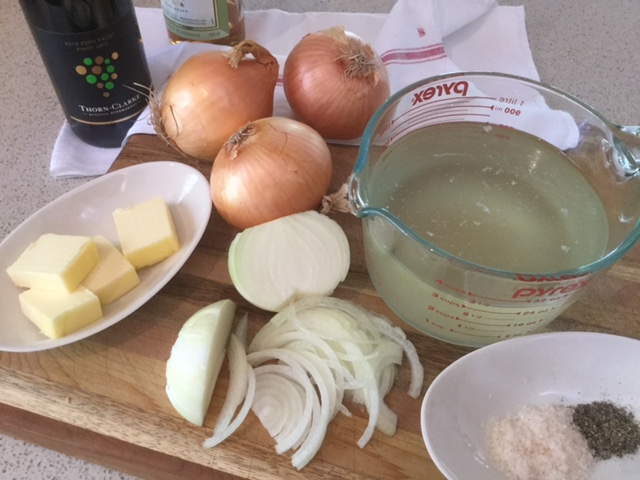
4 brown onions
4 cups of chicken stock
4 tbsp unsalted butter
1/2 cup of white wine (Pinot Gris)
1 tbsp brandy
sea salt and cracked black pepper
1 cup of grated Gruyere cheese
4 thick slices of crusty bread


1.  Peel and halve the onions from stem to root. Remove and discard the hard root ends. Slice the onion halves thinly, crosswise.

2.  Melt the butter in a heavy-based saucepan over a low heat. I used a French oven (enamelled cast iron) which is perfect for cooking this soup.


3.  Add the onion and a generous pinch of salt. Let them slowly sweat and cook, stirring occasionally. Reduce the temperature to ensure that the onions do not start browning too early. Cover partly with a lid as the onions slowly soften without browning.

4.  Slow cook them, up to an hour or more, to bring out the  amazing sweetness in the onions. There is no need for sugar. Add a pinch or two of salt along the way to enhance the flavour.

5.  As the onions gradually take on some colour, increase the heat slightly and stir, allowing them to caramelise until they are a deep golden brown. Adjust the temperature so that they don't burn and become bitter.

6.  Pour in half the white wine to deglaze the pan, stirring constantly.

7.  Add the chicken stock and the rest of the wine. Bring to a very gentle simmer and allow to cook for another 40-60 minutes until the liquid has reduced by a third. The flavour will be more intense and the soup will have thickened.

8.  Taste along the way and season with more salt and a little pepper if necessary.

9.  Add the tablespoon of brandy at the end of cooking and stir. Both the wine and brandy at once contrast with and complement the sweetness of the onions.

10.  Toast the slices of bread. Pile one side of each toast with a generous mound of Gruyere cheese (emmentaler cheese can be substituted). Gruyere has a wonderful nutty flavour and elastic texture. Melt under a grill until bubbling and starting to colour.

11.  Ladle soup into bowls. Float a toast on top of each bowl and drizzle another small spoonful of soup on top. Serve immediately.

Bon appetit!


Friday, February 26, 2016

Fettuccine with shrimp sautéed in garlic and olive oil

by Amy


Gabri approached carrying a tray with four steaming plates. Within minutes they were sitting around the fireplace eating fettuccine with shrimp and scallops sautéed in garlic and olive oil. Fresh bread was produced and glasses of dry white wine poured.”

This isn’t the first time Gabri finds a culinary solution for an awkward moment. There’s a meal for every occasion and he is a master at producing them. I was looking forward to this one. I love pasta.

Once again, this project introduced an ingredient I had never cooked before. I like shrimp. I order shrimp at restaurants, but had never made any at home. The main reason is that I live far from the coast and sea-food isn’t as fresh or as affordable here.

The other ingredients were easier. I picked some basil, marjoram, and grape tomatoes from my backyard garden. I didn’t have scallops, but I had leeks and I absolutely LOVE leeks. So I used that instead. I cooked the fettuccine al dente while I made the sauce. I’ve actually made this meal numerous times – without the shrimp. Sometimes I’ll add chicken or sausage or some other meat, but I’ll usually make vegetarian pasta and make some kind of meat on the side for my husband.


This meal matches the scene in the books perfectly. It’s pretty effortless in terms of mental engagement. It gives the cook a chance to think about other things and listen in on conversations.  I’m sure Gabri was listening with at least half an ear (even if he was all the way in the kitchen) while Olivier and Gamache talked. I was cooking while my husband sat at the table nearby and shared tidbits on his day. In the meantime, my eight-year-old was pacing and talking non-stop about the new characters he’s invented to compose the Marvel universe and what adventures they – and the regular heroes – got into. I confess that I only listened to that conversation with half an ear myself. It was a very convoluted plot.

The only secret to this meal is that you cannot prepare it in advance. This is the kind of meal that you make minutes before you’re to eat it and, preferably, have the table set and everyone hungry before you’re halfway into cooking it… AND, ideally, there are no leftovers. I hate leftover sea food.


I sliced two cloves of garlic, 1 red chili (I removed the seeds, but I’m sure some people prefer to use them for a bit more bite), and half a large leek. I chopped the basil and marjoram leaves (I usually leave the thinner stalks as well). Then I halved the grape tomatoes.


In a large pan over medium heat, I placed a bit of olive oil and fried the garlic, chili, leeks, basil, marjoram and tomatoes. I added some white wine (about 2/3 of a glass) and the juice of one lime. I let it simmer for a couple of minutes, then added the shrimp and cooked it all for about 5 minutes. I didn’t add salt to the sauce because I’d cooked the pasta in very salty water, but I think some people might need an extra pinch of salt.


Toss the pasta with the sauce and you’re done!

“Chaos is coming, old son. It’s taken a long time, but it’s finally here.”

In a previous post we talked about secrets and the little lies we tell ourselves. I can only imagine how it felt like to be Olivier right then. He had so many secrets and lies… but he had questions, too. He knew the Hermit and he knew he’d been killed. But he wasn’t the murderer and he wasn’t the one who placed him in the bistro. On the other hand, he had so many of the answers that were crucial to the investigation and he wasn’t willing to share his information because it would compromise his secrets. He shared many of their questions, too…

“People lied all the time in murder investigations. If the first victim of war was the truth, some of the first victims of a murder investigation were people’s lies. The lies they told themselves, the lies they told each other. The little lies that allowed them to get out of bed on cold, dark mornings. Gamache and his team hunted the lies down and exposed them. Until all the small tales told to ease everyday lives disappeared. And people were left naked. The trick was distinguishing the important fibs from the rest. This one appeared tiny. In which case, why bother lying at all?”

This paragraph is the core of this book, in my opinion. Lies were exposed. Olivier was left naked and vulnerable. But the main question, for all of us, is “why bother lying at all”?

I wonder how frequently our little lies are an attempt to make us look better – even if the only ones judging are ourselves. Frequently they are reinterpretation of motivation and significance, not of facts. They are tiny lies when it comes to the facts of a murder investigation, but they might be crucial when it comes to our understanding of ourselves.

All quotes from The Brutal Telling. Page 33 in the paperback edition.

Friday, February 19, 2016

Lemon Meringue Pie and seeing God

by Amy


“’I have a question for you,’ Gamache said, his change of tone alerting Reine-Marie. ‘Did I do the right thing with Arnot?’
Reine-Marie’s heart broke, hearing Armand ask that. Only she knew the price he’d paid. He’d put on a brave and firm public face. Not Jean Guy, not Michel Brébeuf, not even their best friends had known the agony he’d gone through. But she knew.
[…]
But he’d known all along what he had to do. And the fisherman had put it beyond doubt.”

We all need validation sometimes.

There is comfort in the certainty that someone, preferably someone who is an authority in any given subject, endorses us.

Little signs. Serendipity. Coincidences. Proof. The writing on the wall.

Where there is love, there is courage
Where there is courage, there is peace
Where there is peace, there is God.
And when you have God, you have everything.”
Omniscient. Omnipresent. Who could be better to assure us that we’re on the right track than God himself? There is no greater authority. Be it in the guise of a fisherman or a homeless woman, He can give us the love, courage, and peace we need.

“You don’t know either,” said Myrna. “You want to believe it was God. I have to tell you, people are locked up for less.”

I suppose faith can seem like a form of insanity when you don't believe.

“I tell them there are certain attributes our faith assigns to God: omniscience, omnipotence, justice, and grace. We human beings have such a slight acquaintance with power and knowledge, so little conception of justice, and so slight a capacity for grace, that the workings of these great attributes together is a mystery we cannot hope to penetrate.” (Gilead – Marilynne Robinson)

One of the things I love about Louise Penny’s books is Gamache’s faith. He respects religion, he respects symbols and ritual and tradition. He even respects those who have no religion and/or no faith in the existence of a God. He isn’t preachy. But he has faith.  He believes in God – although he does not always condone or agree with all the man-made rules and traditions and rituals that have sprung from the interpretation of Scriptures.

I do not intend to turn this into a religious discussion. I certainly do not intend to preach. I don’t think faith can be explained into existence – nor can any explanation dissuade you from it if you believe. I do believe that God is bigger than doubts – anyone’s doubts. Including my own.

One of my favorite scenes with a clergyman was the answer given to the main character by a local priest in Andrew Davidson’s THE GARGOYLE. When the main character is found admiring statues in the church, he promptly tells the priest that he is an atheist. The priest doesn't hesitate:

“‘Well, God believes in you,’ he said. ‘May I offer you a cup of tea?’”

In A FATAL GRACE, both Clara and Gamache believe they met with God. Both are blessed with encounters that edify them and give them the validation they need.

“There was no movement. Clara grew concerned. Was she even alive? Clara reached out and gently lifted the grime-caked chin.
“Are you all right?”
A mitten shot out, black with muck, and cupped itself round Clara’s wrist. The head lifted. Weary, runny eyes met Clara’s and held them for a long moment.
“I have always loved your art, Clara.”
“But that’s incredible,” Myrna didn’t want to sound as though she doubted her friend, but really, ‘incredible’ was charitable. It was unbelievable. And yet despite the cup of tea and fire in the grate her forearms broke out in goosebumps.”

It was unbelievable.

If you don’t believe in God, it’s just an interesting coincidence and wishful thinking. If you do, a homeless woman probably wouldn’t the first image that pops into your head when you think of Him.

Well, I do believe in God. I also believe that God isn’t a homeless woman or a fisherman. But I believe God has a sense of humor and endless creativity. Just as the “heavens declare the glory of God” (Psalm 19:1), I think the men and women he created in his image are also capable of, at times, being His emissaries.

I may be wrong, but I think that is how Gamache interprets it. He does believe the writing on the wall is a message from God. It doesn’t necessarily mean he believes Billie is God.

“He asked me to give you this.” She held up the small paper bag on her lap, protecting it from their latest family member. Henri sat in the back seat, listening alertly to their conversation and wagging his tail. Reine-Marie opened the bag to show Gamache a slice of lemon meringue pie.”


When Gamache was given the message from God he was eating lemon meringue pie. Don’t you love how there’s an olfactory and savory memory associated with the message? Isn’t it wonderful that, from then on, lemon meringue pie would be a reminder that God not only cared about his worries, but was willing to send him comfort in the person of a stranger?

My family recently went through a phase where doubts and questions abounded and decisions had to be made. There were no right or wrong answers, but one choice precluded others and had rippling effects on our lives. My husband and I talked, weighed alternatives, engaged in “what if” conversations… and prayed.

One day my husband came home and said, “You know what? This happened. It must be a sign for us to choose plan A.” If you knew my husband, you'd understand when I say he is not the type to look for signs - or to give them credence even if they come knocking. The next day he called me mid-morning and said, “You know what? This OTHER thing just happened. I think it’s a sign that God is saying that He isn’t really sending signs.”

We laughed.

But there were more of them. Little signs. Serendipity. Coincidences. The writing on the wall.

Like Gamache, we knew what we had to do. It still made us feel blessed and comforted that God was willing to send us "writing on the wall" and the memory of those moments – like the memory of the lemon meringue pie – to assure us that we’re making the right decision.

Where there is love, there is courage
Where there is courage, there is peace
Where there is peace, there is God.
And when you have God, you have everything.”

Lemon meringue pie is actually a VERY frequent dessert in our home. Lime meringue pie, actually. It’s one of my husband’s favorites and we make it often. I don’t even think we have a recipe!


The dough for the pie crust is usually made with flour, butter, an egg and a splash of water (if needed). I’m not sure about amounts. Sometimes I use butter and an equivalent of graham crackers to make a cookie crust. I’ve been known to buy ready-made pie crusts when we’re in the US and I’m being lazy.

The creamy filling is the same (see? I have so few recipes!) lime filling that we use on every dessert apparently. Just mix the juice from two limes or two lemons with 1 can of condensed milk.


Then we add meringue. It’s supposed to be beaten egg whites and then you add a couple of tablespoons of refined sugar and keep beating the egg whites until they make peaks. Then bake for a few minutes just until the tips of the peaks start to brown.

One day we didn’t have refined sugar in the house. Or white sugar at all. We just added brown cane sugar, crossed our fingers and hoped it wouldn’t turn out too weird. It did turn out a bit odd. In a good way, according to my husband.


Now my husband has a new favorite pie. It doesn’t look as beautiful. The meringue is flatter and it tends to have this caramel-like gooey layer between the cream and the meringue. He says it’s the best thing EVER, though.

Since then, that’s how the pie has been made here. One day we didn't have brown sugar... He was terribly disappointed with the beautiful white peaks of meringue that didn't have the caramel-gooeyness he loves. Not that it stopped him from eating it...

Friday, February 12, 2016

A Dinner of Interactions - Fettuccine with Basil, Tomatoes, and Brie

by Amy


“What does that piece of wood mean?” Gamache asked his team as they ate.“Well, it was just about the only thing in the cabin that wasn’t an antique,” said Lacoste. “And what with the whittling tools I’m guessing he made it himself.”
Gamache nodded. It was his guess as well.”
[…]
“Why would someone carve that for himself?” Gamache put down his knife and fork. “And you found nothing else in the cabin that looked as though it had been whittled?” (The Brutal Telling)

I love watching Gamache and his team interact. I love how they share the evidence that they’ve uncovered and then they speculate, interpret, and add to each other’s ideas. They seem to talk their way towards conclusions.

They all feel free to share ideas – even when they turn out to be far-fetched ones like going to the Charlotte Islands. Sometimes they fill in the gaps in the other’s line of thought with evidence that supports it. Sometimes they question a conjecture and will add their own reasoning and why they disagree. As a team, they complement each other.

These conversations might be a writer’s strategy to give us, the reader, important information regarding the mystery itself. Usually we move forward in the investigation by “listening in” on the team’s conversations as well as their interviews with suspects and witnesses. Louise Penny has mastered the craft. The conversations don’t read like information dump. You don’t have people monologuing about their findings. Even in these conversations, which could be a plot-advancing strategy, we are given a wealth of feeling and deep interactions.

“He liked the food, but what he mostly loved were the conversations with the Chief. Just the two of them.” (A Trick of the Light)

We can all empathize with Beauvoir here. That’s what this blog is all about, in fact. We all love the food. The mention of their menus frequently has me salivating (except for Beauvoir's meals in the earlier books – I’m not much of a meat eater). But what we really love most are the conversations interactions between the characters. The menu is less important than the company. Or is it just me (and Beauvoir)?

Some people think out loud. Others need time to process their ideas alone, and then they share them. Some people can easily switch from one train of thought to another and can go back and forth between ideas and contradict themselves and question themselves and easily incorporate other people’s ideas. Others have to follow a straight line and need time to digest and ponder over new lines of thought before they are ready to modify their own.

Gamache not only allows himself to use both strategies, he also encourages other to use either or both. Time and again he takes long walks after an interview with a suspect. I believe he uses that time to silently gather his thoughts. He organizes his ideas, but he doesn’t cement them. He values interactions with his team and is open to reordering his initial conclusions. I believe he asks his agents the questions he has asked himself already. He listens to their answers and adds their thoughts and impressions to his own. It is in this interaction that he gains a broader view. He is a better Chief and investigator because he is willing to listen. I think that's one of the things that makes Lacoste a good successor - she's a bit like Gamache that way. (Although  I think Beauvoir, in his own way, would have been just as great.)

On a tangent here, I'm kind of glad Gamache as the chief (and Louise Penny, as the author) had such a solid reason not to have Jean-Guy as the next chief. Beauvoir is still kind of growing up as a character. It's the growing up that makes him interesting... and I like that there's still so much that could happen to him! So many roads he could follow. That kind of potential is attractive in a character (in real people, too).

“It struck Gamache like a ton of bricks. Why hadn’t he thought of that? He’d been so overwhelmed by what was there, he’d never even considered what might be missing.”

I know exactly how he feels! Time and again someone will say something and I think, “WHY DIDN’T I THINK OF THAT?” Of course, once it’s been pointed out, it seems so obvious!

Isn't it great how one comment prompts another? This is true not only of this scene. It’s not really an argument or a discussion. It’s more like they’re trying to find a path and it is in their wording and working through their impressions – out loud, sharing – that they slowly find their way together.


I understand Gamache’s need for alone time because I, too, need time by myself (preferably in silence, which is why running or walking is a good option) to process and organize thoughts. Once I do, they’re still kind of spread out and confusing even to me. It is in trying to verbalize them that I am able to actually explain things to myself.

There are few things I enjoy more than talking to someone who contributes to the process. I value the colleagues and friends that are able and willing to converse like this. Professionally, it is a blessing to have people to “think out loud” with. Frequently it is in interacting with other professionals, particularly those with different backgrounds, that we reach a better understanding of a patient’s needs. And in any role - personal or professional - it is always enriching to broaden my ideas through contrasting and complementing my perceptions with other points of view.


Books can play a role in this. In my life, at least, they do. Like I said in the Myrna post, I believe in the magic and therapeutic power in books and stories. However, there is a different (not better or worse) power in the interaction between people.

A friend told me recently that one of his two criteria for finding a life partner is “good conversation”. I think he has a point.


“The main courses had arrived. A fruit-stuffed Rock Cornish game hen, done on the spit, for Gamache; melted Brie, fresh tomato and basil fettuccine for Lacoste; and a lamb and prune tagine for Beauvoir.”

Lacoste and I make similar food choices. Sometimes it's the same choice because she is choosing a lighter meal (although there have been a few times where she’s drooled over Gamache’s dish while eating a salad). Usually because it is truly the one that most agrees with my own taste buds. This is one of those times. It didn't hurt that it was also the easiest of the three to make.

Versions of this meal are a staple in my home. Pasta is usually quick to put together and pleases most people. I have two versions here. One is the way I usually make it (the spaghetti pictures) and the other is from allrecipes.com. I think I like my own version better – it’s less oily and I prefer the brie on the side. But then, the reheated left-overs of the allrecipes version tasted awesome. I think it has to do with it absorbing the tastes longer. I'll have to keep making them to reach a decision...

This is one of the recipes: http://allrecipes.com/recipe/11932/fettuccini-with-basil-and-brie/. If I were to make it again, I’d keep the brie, but I’d probably use grape tomatoes and leave in the seeds. I’d also use half the amount of olive oil they recommended.  I did enjoy the touch of red wine vinegar. 

My own version involves chopping fresh basil and halving grape tomatoes. I cook the pasta (whichever one I have in the house) and once it’s cooked, I drain it. In a large pan I add a few tablespoons of olive oil and throw in the tomatoes and the basil and usually a squeeze of lemon juice (a couple of tablespoons, probably). Then I add the pasta. If necessary I add a bit more olive oil. I don’t like it too oily which is probably why I didn’t enjoy the other recipe as much. I sometimes add garlic and fry it a bit in the olive oil. Usually not. I prefer the lemon taste. I usually add some cheese. Sometimes on the side, sometimes mixed in. Usually Parmesan.


Which of the three main courses would be your choice if you were at Olivier’s Bistro?

In your line of work is conversation and interaction and important tool for problem solving?

Friday, February 5, 2016

Hot Chocolate and Regret

by Libby


Armand Gamache felt he could nod off. His socks were now dry and slightly crispy, the mug of hot chocolate warmed his hands, and the heat from the stove enveloped him. (How the Light Gets In, Kindle, p.223)
Hot chocolate, what a winter warmer! It's winter's drink, isn't it? I drink coffee or tea all year round, but hot chocolate always seems to be reserved for those brisk to freezing days where the creamy, sweet richness of chocolate warms your body, comforts and seems to give you an attitude lift. Is there anything more cosy than cradling a cup of hot chocolate with its inviting aroma wafting around your face, as you prepare to savour every sip?

Louise Penny certainly understands this. She has reminded us in every book in the series, that is set in autumn or winter. Recently I was drawn to the hot chocolate references in the freezing winter of Bury Your Dead. It seems that as Gamache pursues several lines of enquiry (assisting the investigation into the death of Augustin Renaud), he stops to warm up and puzzle over the information he is collecting with a cup of chocolat chaud. 

Le Café Buade, Quebec City
Once out of the alley he found the Café Buade and went in to both warm up and think. Sitting in a banquette with a bowl of chocolat chaud he pulled out a notebook and pen. Occasionally sipping, sometimes staring into space, sometimes jotting thoughts, eventually he was ready for the next visit. From the café he hadn’t far to go. Just across the street to the great monolith that was Notre-Dame Basilica, the magnificent gilded church that wed, christened, chastised, guided and buried the highest officials and the lowest beggars. ... The entire altar appeared dipped in gold. ... It was both glorious and vaguely repulsive. (Bury Your Dead, Kindle, p.129)
 
'The entire altar appeared dipped in gold.'   Notre-Dame Basilica
We've all got our favoured version of hot chocolate. My preference these days is for le chocolat chaud, in the Parisian style. This is no commercial drinking chocolate, which I've always found a bit too sickly sweet for my taste, or milky cocoa which reminds me of being a young child. But rather a rich, smooth and creamy, intensely chocolatey experience (can we have more adjectives please!) that leaves you totally satisfied with one cup. Though I guess that depends on the size of the cup! It really is an adult's drink, particularly if one goes as far as adding a dash of liqueur 'deliciousness' like Kahlua, Frangelico or Amaretto.

The key to a great chocolat chaud though, is the quality of the chocolate that is used. There is chocolate and there is chocolate!! For this drink, for me, there is only one choice and it is couverture chocolate. Couverture chocolate is chocolate which has a minimum of 32% cocoa butter. It is the chocolate that chocolatiers work with. It melts beautifully unlike most chocolate found on supermarket shelves, which is comparatively low in cocoa butter. Mouth melt is outstanding. And it also has a high cocoa mass. Most couverture has a cocoa mass of at least 55-70%. It is different to cooking chocolate which has little cocoa butter and vegetable oil (usually palm oil) substituted. 

And certain chocolate is thought to have some health benefits (research is still ongoing). Some recent research even points strongly to the beneficial effects on brain activity, including reasoning, memory and recall. But it needs to be cacao-rich, dark chocolate with a minimum cocoa mass (as opposed to cocoa butter mass) of 60%. Suits me as I've never really cared for milk chocolate, and my brain does need a bit of attention! I'm starting to think that all those cups of hot chocolate have served Gamache well in deciphering the information he has collected.

Armand Gamache sat in the Paillard bakery on rue St-Jean and stared at Augustin Renaud’s diary. Henri was curled up under the table while outside people were trudging head down through the snow and the cold. ... Gamache took a sip of hot chocolate. (Bury Your Dead, Kindle, p.243)
Paillard bakery, rue St-Jean

This was the moment that Gamache started to make sense of the information he had been puzzling over, and identified some significant connections. It is a relief to have him so engaged with the investigation, giving respite from the voices in his head and the pain of working through Agent Morin's death and that of his other agents. He is haunted by a terrible mistake. 

His late night walks through the streets of Quebec City, as conversations with Agent Morin play in his mind, have recently resonated with me rather deeply. I have had the voice and face of a dear girlfriend in my head in anticipation of catching up with her husband who I had not seen for quite a few years, as he lives interstate. We are forever connected by her, and she, like Agent Morin is forever young, killed in (what seems a lifetime ago) a horrendous car accident with their eldest child. It was so terribly, numbingly shocking. I don't know if (in those days) we really understood well enough how to handle grief or support someone else through their grief. Back then there was a stultifying reserve in talking about things. And there certainly wasn't the level of counselling services that are available today. And we were all so young and relatively inexperienced, in our twenties.

So, there's a part of me that feels I didn't support my friend well enough in dealing with the death of his wife, my friend, and the care of his two other infant children, severely injured in the accident. I've spoken to him about that and as much as he reassures me, I still feel a sadness over it all, knowing that I could have done more, a little haunted by regret. It has taken him a long time to feel truly comfortable in his life and she is still with him, and is with me too, and I take solace in that. I still see her bright, smiling face and feel her bubbling spirit, wit and verve. Forever young.

But I have a lump in my throat writing this. Some things never leave you, and it is thirty plus years later (yes I am quite a bit older than Amy!). So perhaps it's true, that regrets about action not taken are more likely to stay with us over a longer period of time, than regrets for action taken that leads to a mistake being made or something not working out. But somehow we manage to find ways to accept, learn and move on, or at least try to. I know Amy has written about how books can add layers of meaning to your ideas and the thinking driving them, and how they even coincide at times with particular events or feelings you are experiencing. Well this has been one of those times for me.


I thought more about all of this while slowly immersing myself in a comforting world of chocolate.

As far as chocolate goes, the higher the cocoa mass the more intense the chocolate flavour. But it is the percentage of cocoa butter in it that indicates the quality of a chocolate, for that's what gives chocolate it's melt-in-the-mouth character. So for me, dark couverture chocolate it is for le chocolat chaud!

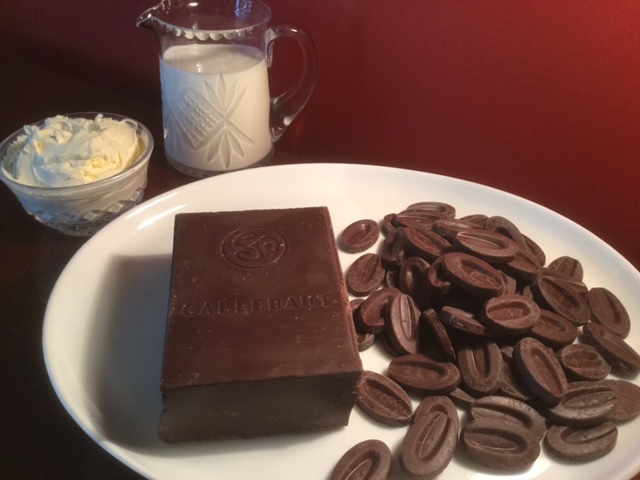
You can get it in blocks (which are easy to shave with a serrated knife), chips or drops. Some recognised brands of couverture chocolate are Callebaut, Valrhona, Sharfen Berger, Veliche and Michel Cluizel. The bottom line, though, is if the word 'couverture' is not on the packet then it's not couverture chocolate. For this recipe I used a mixture of Callebaut (55.5% cocoa mass) and Valrhona (I had drops of 60% and 70% cocoa mass).


Le Chocolat Chaud 
 

145g / 5oz couverture chocolate
2 cups whole milk
lightly whipped pure cream for serving
chocolate shavings for serving

1.  Chop or shave the chocolate into small pieces for an easy melt.

2.  Heat the milk in a saucepan until it is almost reaching simmer point.

3.  Add the chocolate pieces all at once and stir constantly with a whisk until it completely melts into the milk.


4.  Increase the heat to bring the mixture to a low boil while whisking constantly.

5.  Allow the hot chocolate mixture to reduce to thicken it slightly, lowering the temperature if necessary.

6.  Pour into a serving pot or directly into cups.

7.  Top each cup with some whipped cream and a scattering of chocolate shavings.


The amount of milk, chocolate and cooking time can be adjusted to taste. A thinner hot chocolate, for example, requires less reduction. Any leftover (highly unlikely!) can be refrigerated and heated up the next day, without any change to the texture or flavour. Great for making ahead of time!

The richness and smoothness of this hot chocolate is deeply satisfying, and soothing. There is no 'graininess', or 'fattiness' to it.  And It doesn't cry out to be accompanied by anything. I had planned to make some biscotti (double-baked Italian biscuits) to eat with it, but changed my mind.

The whipped cream elevates the drinking experience to another level. There is an amazing silkiness, sipping the hot chocolate and cream together. Serve this to family and friends and their hearts will fill with warm feelings, it is so totally distracting (there's a presumption here that they like chocolate). 

Or at least they'll want to run their finger around the inside of the cup to get out the last of the lusciousness...like I did!