by Libby

She’d leaned in and whispered into his ear, and he could smell her fragrance. It was slightly citrony. Clean and fresh. ... Annie smelled like a lemon grove in summer. (A Trick of the Light, Kindle, p.8)
Annie Gamache would never be the most attractive woman in the room. She never turned heads. Until she laughed. And spoke. ...Jean-Guy Beauvoir had figured out something many men never got. How very beautiful, how very attractive, happiness was. Annie Gamache was happy, and Beauvoir fell in love with her. (How the Light Gets In, Kindle, p.47)
This is a dessert bringing together several
elements inspired by the character of Annie Gamache and how we see her, too,
through the eyes of Jean-Guy Beauvoir and Armand Gamache.
So here is 'Annie Gamache', on a plate -- lemon
sherbet, lemon madeleine, lemon butter sauce, a drizzle of sticky lemon
caramel, creme fraiche with almond praline, fresh blueberries on chocolate
ganache
There's a big lemon theme happening in this dessert with some punchy
contrasts. Like the contrasts in Annie's character that Armand Gamache
understood so well in his daughter. She was 'smart, competitive, funny', proud and fierce but also vulnerable. She's a passionate woman with a
zest for life.
He’d seen her laugh with real gaiety, seen her listen to very boring people as though they were riveting. She looked as though she was genuinely glad to see them. As though they were important. He’d seen her dance, arms flailing and head tilted back. Eyes shining. And he’d felt her hand in his. Only once. In the hospital. (A Trick of the Light, Kindle, p.7)
The punchy contrasts In this desert also
remind me of the tensions played out between Annie and Beauvoir.
They never talked. They argued. ... This was an argument played out every brunch, every Christmas, Thanksgiving, birthday. The words changed slightly. ... If Annie said blue, Beauvoir said orange. ... ‘You what?’ demanded Annie. ‘You pathetic piece of legal crap.’ ... ‘Legal crap?’ said Annie, her voice dripping disdain. ‘Brilliant. Fascist moron.’ ... ‘Fascist? Fascist?’ Jean Guy Beauvoir almost squealed. ... Annie said something unintelligible. But Beauvoir’s response was perfectly clear. ‘Screw you.’ (The Brutal Telling, Kindle, p.12-15)
If that isn't attraction!
The starting point for this dessert was lemon
sherbet as to me it is quintessentially Annie; fresh, lively with a sharp,
zingy lemon flavour that packs a bit of a punch, but with a soft creamy
texture. It's an interesting contrast.
Opinionated, strong-willed, strong physically. ... Where other women, including Enid, were lovely, Annie Gamache was alive. Late, too late, Jean-Guy Beauvoir had come to appreciate how very important it was, how very attractive it was, how very rare it was, to be fully alive. (A Trick of the Light, Kindle, p.10)

Lemon Sherbet
(makes 1 quart/1 litre)
1 tbs lemon zest (from an organically grown
lemon)
1 cup of superfine/ caster sugar
2 cups of lemon juice, including the juice of
one lime
2/3 cup of pure cream
2 tablespoons of limoncello or Cointreau
1. Blitz the lemon zest and sugar in a food
processor.
2. With the motor running, gradually pour in the lemon juice and
process until the sugar is dissolved.
3. Pour through a fine mesh strainer into a
large jug. Chill.
4. Lightly hand whisk the cream to soft peaks.
 |
| Ready for churning |
5. Gradually
hand whisk the juice mixture into the cream until it is well
incorporated.
6. Chill for several hours or overnight.
7. Churn for 25
minutes.
8. Add the limoncello or Cointreau in the last 5 minutes of
churning. Freeze.

Note: An electric hand whisk can be used instead of a churn.
Whisk the mixture and place in the freezer. Whisk again after an hour and
return to the freezer. Repeat once or twice more for a light sherbet.
I love the way different flavours and textures
can be brought together to complement or contrast each other in a dessert. It
can be as simple or as complex as you like, but it's really about trying to
find ways for the parts to work together, so that there are surprises to your
palate and some 'hmmm' moments. Well, shouldn't desserts be yummy and shouldn't
you want to lick your plate?!
I thought that a little cake, a lemon madeleine, would be perfect to
serve with the cold, creamy sherbet. But unlike the sharp tang of the sherbet,
these cakes have a very subtle lemon flavour and delicate sweetness.

Madeleines really are
the sweetest little cakes, French in origin, slightly crisp on the outside and
soft and spongy on the inside. They are baked in special madeleine trays which
are readily available and worth having as the cakes have instant eye appeal, as
'shells'. They're great for desserts. In this case though, the pattern on the
madeleine's brought to mind the lines of whiskers around a lion's mouth. Of
course! Annie the lion, loving and passionate, but also vulnerable.
Annie Gamache became their cub. And grew into a lioness. But sometimes, on quiet walks together, she’d tell her father about her fears and her disappointments and the everyday sorrows of her young life. And Chief Inspector Gamache would be seized with a desire to hold her to him, so that she needn’t pretend to be so brave all the time. She was fierce because she was afraid. Of everything. The rest of the world saw a strong, noble lioness. He looked at his daughter and saw Bert Lahr, though he’d never tell her that. (The Brutal Telling, Kindle, p.17)
Annie must still deal with her fears, while
trying to keep her perspectives from becoming skewed.
After spending most of her life scanning the horizon for slights and threats, genuine and imagined, she knew the real threat to her happiness came not from the dot in the distance, but from looking for it. Expecting it. Waiting for it. And in some cases, creating it. Her father had jokingly accused her of living in the wreckage of her future. Until one day she’d looked deep into his eyes and saw he wasn’t joking. He was warning her. But it was a hard habit to break, especially since she now had so much to lose. And had almost lost it all. To a bullet. A needle. A tiny pill. (The Long Way Home, Kindle, p.22)
Lemon Madeleines
This recipe makes 24
little cakes and they're perfect, too, for serving with tea, coffee, or a
digestif.
 |
| Buttered and floured madeleine moulds |
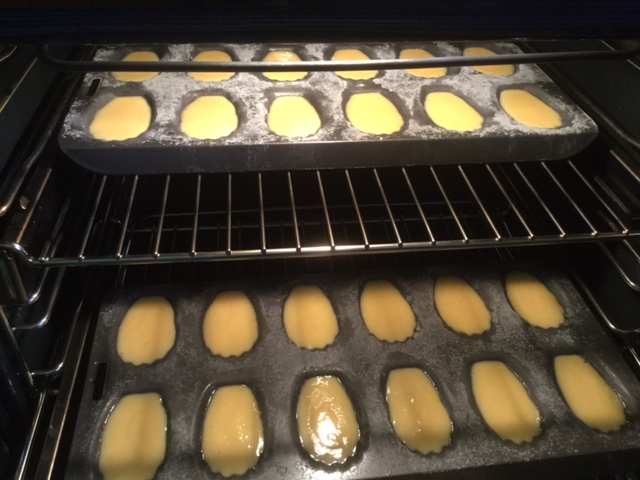 |
| Ready for baking |
90g/3oz
unsalted butter
zest and the
strained juice of half a lemon (organically grown)
2 free range
eggs (room temperature)
1/3 cup of
superfine/caster sugar
1 tbs of soft
brown sugar
a drop of
vanilla extract
90g/3oz all
purpose flour
1 teaspoon of
baking powder
pure icing
sugar, for dusting
1. On a low
heat, melt the butter with the lemon juice and zest. Cool to room temperature.
2. Blend the eggs, the caster and brown sugars and vanilla in a blender or food
processor.
3. Sift the flour and baking powder into the mixture, add the cooled
butter and blend until smooth.
4. Rest the batter for an hour or two at room
temperature. It can also be refrigerated overnight but then needs to be brought
to room temperature.
5. Preheat the oven to 180C/360F.
Spoon the batter into the
buttered and floured madeleine moulds so that they are about two thirds full. Bake for 9-12 minutes,
depending on your oven. Test with a skewer. I baked them on two oven shelves
and then swapped them over at the 7 minute mark, for an extra couple of
minutes.
6. Remove from the oven and after a minute bang the trays on the bench to
dislodge the madeleines. Cool on a rack with the patterned side facing up. Dust
with icing sugar just before serving.
Lemon Butter
Sauce
The gentle velvety sweetness of the lemon butter
sauce complements the ‘quieter’ madeleines and throws into relief the sharpness
of the lemon sherbet. It at once, contrasts and harmonises with it. Not unlike
Annie and Beauvoir.
As he spoke he looked at Annie. Her eyes never left him, barely blinked. She took in every word, every gesture, every inflection. Enid, his ex-wife, had also listened. ... Enid left him drained, and yet still feeling inadequate. But Annie was gentler. More generous. Like her father, she listened carefully and quietly. With Enid he never talked about his work, and she never asked. With Annie he told her everything. (The Beautiful Mystery, Kindle p.7)
“What’ve you got there?” Annie Gamache asked, leaning across the table. ... “Nothing,” he grinned. “Just a little je ne sais quoi I saw, and thought of you.” Beauvoir lifted it into plain sight. “You asshole,” Annie said, and laughed. “It’s a toilet plunger.” “With a bow on it,” said Beauvoir. “Just for you, ma chère. We’ve been together for three months. Happy anniversary.” “Of course, the toilet plunger anniversary. And I got you nothing.” “I forgive you,” he said. Annie took the plunger. “I’ll think of you every time I use it. Though I think you’ll be the one using it most of the time. You are full of it, after all.” “Too kind,” said Beauvoir, ducking his head in a small bow. (The Beautiful Mystery, Kindle p.7)
Annie Gamache was none of the things he’d always found attractive in a woman. But Annie knew something most people never learn. She knew how great it was to be alive. It had taken him almost forty years, but Jean-Guy Beauvoir finally understood it too. And knew now there was no greater beauty. (The Beautiful Mystery, Kindle p.8)
This sauce is
an important part of this desert in the way it brings together the other
elements harmoniously. It really is rather luscious, but also lively.

2 egg yolks
(free range)
40g/1.5oz unsalted butter
2/3 cup of caster/superfine
sugar
2 teaspoons of grated lemon zest
100ml/3.4fl oz lemon juice
100ml/3.4fl oz lemon juice

1. Lightly hand
whisk the egg yolks and sugar together in a bowl.
2. Add the butter, zest and
lemon juice and whisk over a saucepan of simmering water (don't let the bowl
touch the water) until the butter melts and the sauce thickens slightly to a
pouring consistency.
Serve at room temperature or slightly chilled.
Sticky Lemon Caramel
Annie
faces some difficult and heartbreaking experiences, and like Beauvoir and
because of Beauvoir, she is forced to rethink the course of her life. Oh, the
course of true love...
“Listen,” she said, leaning forward, her voice softening a bit. “I’m sorry about you and Enid. Your separation.” “Yeah, well, it happens. ... ” She looked at him with searching eyes ... “Especially after what you’ve been through, I guess. It makes you think about your life. Would you like to talk about it?” Talk about Enid with Annie? ... The thought revolted him and he must have shown it. Annie pulled back and reddened as though he’d slapped her. “Forget I said anything,” she snapped and lifted the paper to her face. (A Trick of the Light, Kindle, p.8)
But all he saw was his daughter, his little girl, in their living room Sunday night. She’d swung from sobbing to raging. From hating David, to hating herself, to hating her parents for suggesting counseling. (A Trick of the Light, Kindle, p.238)
Annie Gamache sat in the dark, staring out the window. ... She’d kicked Jean-Guy out of their home when he refused to go back to rehab. They’d fought and fought, until there was nothing left to say. And then they fought some more. ... Finally, he’d left. But he hadn’t actually gone. He was still inside her, and she couldn’t get him out. ... And she sometimes wondered if that was him, beating on her heart. And she wondered what would happen if he stopped. Every night she came here. Parked. And stared at the window. Hoping to see some sign of life. (How the Light Gets In, Kindle p.162)
This
sticky lemon caramel provides an intense flavour and texture contrast in the
dessert. The caramelised sugar and finely zested strips of lemon lend a
richness, a hint of bitterness, and wonderful stickiness to the dessert.

1/2
cup of superfine/caster sugar 1/4 cup of water
fine strips of lemon zest from
half a lemon
1 tbs limoncello (optional)
1. Stir all the ingredients, except the
limoncello, in a small saucepan over medium heat until all the sugar has
dissolved.
2. Stop stirring and allow the water to gradually evaporate as it comes
to the boil so that the mixture thickens and turns amber in colour.
3. Remove from the heat. Stir in the
limoncello as it cools. It should be thick and sticky but not set, when cool.
Crème Fraîche
This is a
very versatile cream and goes with anything. It's soft creamy texture is a good
foil for some of the sharper flavours in the dessert. A bit like Annie's gentle
and constant heart.
“Je t’aime,” he whispered into her ear, as he held her. “Je t’aime,” she whispered into his ear. ... Once he was gone and she could no longer see the back of his car, Annie Gamache closed the door and held her hand to her chest. She wondered if this was how her mother had felt, for all those years. How her mother felt at that very moment. Was she too leaning against the door, having watched her heart leave? Having let it go. (The Beautiful Mystery, Kindle, p.14)
I love the
fresh taste of this cream, with its subtle tanginess. It's easy to purchase,
but it's just as easy to make. It only takes a few hours to be ready.
1 cup of pure
cream (no thickeners)
1 tbs of
cultured yoghurt (whole milk)
1. Mix the cream
and yoghurt together in a small glass bowl.
2. Cover with a piece of muslin or
fine netting and leave on the bench top at room temperature for several hours
or overnight.
3. Give it a stir after a couple of hours. It will have already
thickened. You can taste it every few hours to judge the degree of sourness
(which is much lighter than sour cream) and thickness you prefer.
4. Cover and
refrigerate. It lasts for a week.
Almond
Praline
Annie is a spirited woman, not to be cowed by
anything or anyone. She's got attitude! In the media campaign, linking Gamache to the man he
brought down, Arnot, she too was hounded.
On the television was a live picture of a young woman leaving an apartment building, her briefcase up to her face. Annie. ‘Oh, God,’ whispered Gamache. Then she lowered the case and stood still. This seemed to stun the reporters who preferred their prey on the run. She smiled at them. ‘No, don’t,’ whispered Beauvoir. Annie raised her arm and gave them the finger. (The Cruellest Month, Kindle, p.383)
Now this Annie made me consider a 'crunch'
factor in the dessert. What better than almond praline with its salty, caramel
notes presenting a bit of 'attitude', too!
I love the
flavour and texture of praline, which is lifted to another level with a tiny
sprinkle of sea salt at the end of cooking. This method of making praline is
based on that of food writer, David Lebovitz, and the result is the best ever. Chopped
praline over creme fraiche contrasted with all the lemony bits in this dessert,
is quite the thing!

1 cup of
almonds, with skins
1/2 cup of
superfine/caster sugar
1/4 cup of
water
pinch of sea
salt
Place the
almonds sugar and water in a saucepan over medium heat. Stir with a wooden
spoon until the sugar has completely dissolved.

Bring to the boil and then
lower the heat slightly, stirring until all the water has evaporated and the
mixture turns 'sandy'.

Watch closely so that the almonds don't burn.

Chop or blitz
into small pieces, when cool. Store in an air-tight container.
Chocolate
Ganache and Fresh Blueberries
Blueberries
and chocolate, and Beauvoir go very well together so they had to feature in
this dessert.
“I miss you,” Jean-Guy wrote. “ Merde! All the chocolates are gone! How did that happen?” Then he rolled over, the BlackBerry held lightly in his hand. But not before typing, in the darkness, his final message of the day. “ Je t’aime .” He carefully wrapped the chocolates and put them in the nightstand drawer. For Annie. He closed his eyes, and slept soundly. (The Beautiful Mystery, Kindle, p.106)
I made a
little chocolate ganache to accompany the blueberries. However, fresh
blueberries by themselves works well too. I couldn't avoid having two helpings of dessert
for the purpose of this important 'tasting' research! Blueberries and lemon are
also a great match. The in-season berries were needed for their 'explosive'
texture and 'fresh fruitiness' against all the other elements in the dessert.
125g/4oz
bittersweet dark chocolate
1 cup of pure cream
2 cups of
fresh blueberries
Heat the
cream in a bowl over a small saucepan of simmering water. Add the chocolate and stir until melted and
well incorporated. Remove the bowl from the heat and whisk the mixture until
cool, and soft peaks form.
A generous
dob of chocolate ganache covered with a small handful of blueberries completes
the dessert.
A serve of
Annie Gamache
A coy smile could capture him, but it was finally a hearty laugh that had freed him. No knees would buckle for Annie Gamache. No eyes would follow her substantial body. No wolf calls for her pretty plain face. But she was by far the most attractive woman in any room. Late into his thirties, with a broken body and a shattered spirit, Jean-Guy Beauvoir had been seduced by happiness. (The Long Way Home, Kindle, p.103)
I hope there's plenty to be seduced by, in this dessert too!

On each plate
place one madeleine, a quenelle of lemon sherbet, and 2 tablespoons of
lemon butter sauce between
them.
Add a generous dob of creme
fraiche sprinkled with almond praline. Drizzle sticky lemon caramel around
the creme and at the edge of the lemon butter sauce.
In the space remaining,
add a dob of ganache (or not) and cover with a mound of blueberries.
Voila! Annie
Gamache!
Santé! Annie
and Jean-Guy

Ruth held Rosa and, leaning into Beauvoir, they kissed on both cheeks. “There’s pink lemonade in the fridge for you,” she said. “I made it.” (The Long Way Home, Kindle, p.18)
Someone
suggested that 'Annie Gamache' could also be a cocktail. Well, I always find a
good cocktail hard to resist! And I thrive on making ingredients for cocktails. So in keeping with the lemon theme and inspired by Ruth's pink lemonade for
Beauvoir, I devised a cocktail using home-made limoncello (vodka infused, over
time, with lemon rinds and mixed with a sugar syrup) and grenadine (freshly
squeezed pomegranate juice mixed with a heavy sugar syrup). They last
indefinitely stored in the freezer.
This cocktail has a nice balance between a
light sweetness, a sharp sourness and a dry finish. And as for that
sparkle!!! It's a perfect
aperitif. I love the pink blush, too. Very Beauvoir!! Now if I was making this cocktail for him, I'd substitute
fresh lemon juice for the limoncello, and sparkling lemonade for the sparkling
wine.
Annie Gamache
cocktail
(Makes two
servings)

1 measure/2.5
tbs limoncello
1 measure/2.5
tbs fresh lime juice, sieved
1/2 teaspoon
of grenadine
8 ice cubes
dry sparkling
white wine (I used Prosecco)
a curl of lemon rind
and lime slices for decoration
Vigorously shake the limoncello, lime juice,
grenadine and ice cubes together.
Strain into two cocktail glasses. Top with
dry sparkling wine.
Decorate with a curl of lemon rind slightly submerged, and
a half slice of lime on the glass edge.

