Reading may seem like a solitary pleasure, but we do not believe it is so. As we read, we intimately interact with writers, the worlds they create, and our own inner selves as well as the real world that surrounds us. Some of us are also blessed enough to have friends to share the experience with.

While discussing the idyllic village of Three Pines and the captivating characters author Louise Penny created in the Inspector Gamache books, we were aware of the sensory pleasure to be had in the meals described. Olivier’s Bistro, Gabri’s baking, and dinners at the Morrow’s can easily make us salivate while reading the books… Louise Penny's books, are a wonderful entrée into a sensual world, where each book is a season, capturing its mood and flavours, and contributing to the layers of meaning about the characters, who are marvellously revealed over the series.

At one point, a daydream of going through the series with a notebook in hand, writing down all these meals and later cooking them, took shape. This is our "notebook". We hope you enjoy this literary-culinary-sensory-philosophical journey.

Showing posts with label Beauvoir. Show all posts

Friday, June 3, 2016

Filet Mignon & Blue Cheese Sauce and Random Miscellaneous Musings

by Amy


“He looked at Clara Morrow. She was also in pajamas and a dressing gown and, he glanced down, slippers. Could this be a new, and nightmarish, fashion trend? How long had he slept? While he knew flannel was an aphrodisiac to Anglos, it did nothing for Beauvoir. He’d never, ever worn it and didn’t plan to start.”

I love this scene. I love, love, love their pajama day idea! I think that it is the very definition of a lazy day - even if you get bucket loads of things done. Actually, it’s one of my favorite things about hospital work. Scrubs are as comfortable as pajamas. Doctors (and other healthcare professionals) don’t really wear scrubs here in Brazil unless it’s hospital work that involves operating rooms. Since I work in neonatal care and delivery rooms, I get to wear scrubs when I’m in the hospital. At the office the white coat is more appropriate. I consider scrubs to be glorified pajamas.

 “It’s very relaxing. I stay in them all day.”

“Beauvoir tried to look disapproving but had to admit, she did look comfortable. She completed the look by having bed-head, though that was nothing new. Her hair always stuck out in all directions, probably where she ran her hands through it. And that would also account for the crumbs in there, and the flecks of paint.”

I know. Not the same. But this scene gives me flashbacks to my residency years. Beauvoir was so tired he crashed. Then he wasn’t sure if it was early morning or evening. He wasn’t sure if he wanted breakfast or dinner. The people around him were wearing comfortable – although not very elegant – clothing (what could be worse than scrubs and crocs?). And bed-head? Yeah. Flashbacks.

“He laughed, surprising himself. He’d never had an actual conversation with Clara. With any of them. The Chief had. Somehow he’d managed to become friends with most of them but Beauvoir had never been able to pass through that membrane, to see people as both suspects and human. He’d never wanted to. The idea repulsed him.”


I love Beauvoir. And I love watching him mature through the series. This is a huge milestone. He’s
started to blur the distinction between “them” and “us”. Although the idea still “repulses him” to an extent, he’s already started to see people as human. One of the things I love in The Long Way Home is when Gamache asks him what it is with him and the elderly. He answers that he just treats them like people. This is one of the scenes where he begins to see people as human – even if they are suspects.

“Clara hesitated. She didn’t like the idea of being a spy but if he was right then an innocent man was in prison and a murderer was among them. Almost certainly in the room with them at that moment.”

Clara, on the other hand, had no difficulty in seeing people as human. The hard part here, for her, was seeing them as suspects. In an earlier post we talked about how hard it is to let go of those we love and remember grace when we are constantly made aware of the evil that is in the world (https://thenightisastrawberry.blogspot.com.br/2016/01/chicken-pesto-sandwich-and-letting-go.html). Clara is made uncomfortably aware of the fact that, even in idyllic Three Pines, a murderer was – or is – among them.

I once read an interview in which Louise Penny said she had originally thought Peter and Clara would be amateur sleuths who would assist Gamache. I think this book (BURY YOUR DEAD) has Clara playing that role. She isn’t always discreet. Beauvoir frequently cringes in his interactions with her. But, all in all, he’s both impressed and grateful. And it is in this book that his own bonds of friendship are established with Three Pines. Up until now he'd investigated them. He now befriends them.

 “Myrna and Peter arrived and Beauvoir joined them for a bistrô dinner, ordering the filet mignon with cognac blue cheese sauce. They chatted about various events in the village, the ski conditions at Mont Saitn-Rémy, the Canadiens game the night before.”


I was looking forward to the sauce. I’m not much of a meat eater, but my husband loves filet mignon, so I thought this meal might possibly please us both. I’d eat potatoes and blue cheese sauce. He’d have the filet. In the end, he was happy with the filet. He tolerated the sauce. He ate a couple of potatoes, but preferred rice. My son gags with baked potatoes – even when they’re on the firm side – and can’t stand most sauces. He tried it. But stuck to filet and rice. I thought the sauce was a bit too rich for my tastes, but happily ate potatoes.

So… I think this meal was a bit of a failure. I’m having a hard time writing about it because it wasn’t a particularly enjoyable meal. It was okay. I also consider the presentation to be flawed. But then, I think meat is always kind of ugly. It’s easy to see I’m not a meat lover.  Although I wasn't pleased with it, I must concede that the only thing left over was the sauce. So I guess it was okay.

Part of me wants to start over and try a different recipe. The other part thinks that part of being a non-cook posting about cooking is posting failed attempts – or less than stellar meals. So voilá!

Filet Mignon with Potatoes and Blue Cheese Sauce

Potatoes:
Quarter the potatoes and boil them in water until they’re al dente. Dip in cold water and then flavor with salt, olive oil, rosemary and garlic and bake in oven until “ready”. Mine were on the undercooked side this time.

Filet Mignon:
Season with pepper and garlic and sear on both sides (I used olive oil).


Blue Cheese Sauce:
Melt 1 tablespoon of butter in a pan. Add 1 tablespoon of flour. Whisk in 400ml of milk. Once it’s creamy (or doesn't drip from the spoon), add 60g of blue cheese and some nutmeg. Allow cheese to melt. Sauce is done.

If I were to make this again (and I don’t plan to), I’d bake the potatoes whole, I’d make the filets in strips and add them to the sauce – kind of like a stroganoff. Or serve it on pasta.  


I do recommend we all grow and mature and mellow as did Beauvoir. His choice in meals? Nowhere near my own tastes. 

Friday, April 15, 2016

Gamache & Beauvoir

by Amy


“Sitting heavily in one of the leather wing chairs of the St-Laurent Bar, Chief Inspector Gamache asked for a glass of water […] getting to his feet and putting down a hundred dollars for the water and the use of the quiet table by the fireplace.”

Louise Penny wrote an elegant and delicately woven book in BURY YOUR DEAD.

In the early books, Gamache and Beauvoir are usually together. Beauvoir is Gamache’s right hand man and their different outlooks and styles compliment and contrast each other.

In BURY YOUR DEAD they are apart. Both are grieving. Both use cases as distractions and coping mechanisms while they deal with what happened. Both remember. We learn about the tragic outcome in the factory as they sort through their memories, share bits and pieces with others, or listen to the voices in their heads.

“Are you going to watch?” Beauvoir asked.Gamache thought. “Yes. You?”“Maybe.” He also paused. “Yes.” There was a silence as both men considered what that meant. “Oh, God,” sighed Beauvoir.“When you do, don’t be alone,” said Gamache.“I wish-““So do I,” said Gamache. They both wished the same thing. That if they had to relive it, they could at least be together.”

It is here, when they spend time away from each other, that the bond between them becomes even more evident. It is our awareness of their closeness that makes their estrangement, in the next books, so poignant.

The entire book goes back and forth between them. While they try to heal, we are allowed to peek into their memories and, slowly, we are shown what happened at the factory. In the meantime, we see Gamache help out in a new case, interacting with his mentor Émile, and we watch as Beauvoir reworks an old case, without his own mentor at his side.

Beauvoir is not Gamache. I don’t think any of us would like him to be.

In BURY YOUR DEAD Louise Penny shows us how important choices are. There is foreshadowing. We watch as the two men are faced with similar situations and, because of their backgrounds, personalities, and choices, they act differently.

Gamache once told Agent Nicole:

“We choose our thoughts. We choose our perceptions. We choose our attitudes. We may not think so. We may not believe it, but we do. I absolutely know we do. I’ve seen enough evidence, time after time, tragedy after tragedy. Triumph over triumph. It’s about choice.” (Still Life)

And so it is.

Thoughts. Perceptions. Attitudes.

“And there were always choices to make. Every day, every hour, offered the opportunity to make a decision, a decision which determined whether you would or would not submit to those powers which threatened to rob you of your very self, your inner freedom; which become the plaything of circumstance, renouncing freedom and dignity to become molded into the form of the typical inmate.” (MAN’S SEARCH FOR MEANING – Viktor Frankle)

Not long after their phone conversation and their admission that they would have liked to watch the video together, we are shown how hurt and betrayed Gamache feels because of the choice Émile, his mentor, made in the case at hand.

“What’s happened?” Émile asked, seeing the look on Gamache’s face.”Gamache hesitated. For the first time in his life he was tempted to lie to this man who had lied to him.”

It’s eerie. In the next book, it is the video that triggers a feeling of abandonment in Beauvoir. He has many opportunities to confront Gamache, to question him, to give him the chance to explain himself. He doesn’t choose to do any of those things in A BEAUTIFUL MYSTERY. Not that there was any accusation to be made, but our feelings don’t always align with facts and aren’t always reasonable. Beauvoir is no exception. While he knew Gamache had to find Morin, he still felt left behind.

“You lied to me,” said Gamache.“It was just half an hour.“It was more than that and you know it. You made a choice, chose a side.”“A side? Are you saying the Champlain Society is on a different side than you?”“I’m saying we all have loyalties. You’ve made yours clear.”Émile stared. “I’m sorry, I should never have lied to you. It won’t happen again.”

Thoughts. Perceptions. Actions.

Gamache and Émile interpreted things differently. When Gamache chose to explain his interpretation of Émile’s lie, he gave his mentor a glimpse into how he felt and what that half an hour, apparently insignificant, meant to him. Even as he confronts him about that – and other, worse lies – Gamache is giving his friend an opportunity to know how he feels.

In the next book, Beauvoir’s pain is palpable. He doesn’t make Gamache privy to his feelings. He doesn’t confront Gamache. He reminds me a bit of a teenager who cannot come to grips with the fact that their parents – who were once their heroes – are, in fact, only human. Beauvoir oscillates between justifying Gamache in his own mind, and feeling an enormous pain of abandonment. He sways back and forth from guilt to blame. He cannot find middle ground. I can’t help feeling that if he’d only just broken down and TOLD his mentor all would have been well... But then the story wouldn’t be half as good, would it?

“Émile stared, stricken, but said nothing.Gamache turned and strode down the long corridor, his phone buzzing again and his heart pounding.“Wait, Armand,” he heard behind him but kept walking, ignoring the calls. Then he remembered what Émile had meant to him and still did. Did this one bad thing wipe everything else out?”

Sigh.

Thoughts. Perceptions. Actions. Choices.

“That was the danger. Not that betrayals happened, not that cruel things happened, but that they could outweigh all the good. That we could forget the good and only remember the bad. But not today. Gamache stopped.”

Can’t you just see Beauvoir making a similar choice? What if, instead of getting on that helicopter with Francoeur (in The Beautiful Mystery), he had chosen to stay with Gamache? What if they had finally watched that video together? What if Gamache had confided his suspicions and his plans?

Again: Beauvoir is not Gamache. I wouldn’t want him to be. I have a soft spot for Beauvoir. Like the ladies eating their post-exercise scones, I too have a crush on him. While I would have liked for him to make the same kind of choice as Gamache, I realize Beauvoir’s actions are probably closer to what most of us would do in similar circumstances.

When Viktor Frankl tells of the experiences prisoners went through in concentration camps, he talks about choices and about those who rise above circumstances and are models of resilience. They are the exception. Not the rule. Just as Gamache is an exeption in behavior, time and again.

Of the prisoners only a few kept their full inner liberty and obtained those values which their suffering afforded, but even one such example is sufficient proof that man’s inner strength may raise him above his outward fate.” (MAN’S SEARCH FOR MEANING – VIKTOR FRANKL)

To rise above our outward fate. What a great goal.

Gamache is not naïve. He isn’t unaware of cruelty, betrayal, pain, or evil in the world. He couldn’t be. Not in his line of work. He has the strength of character necessary to rise above his outward circumstances, and the faith it takes to see and show grace and love and forgiveness in the light of suffering. That is why the Chief Inspector is such a wonderful role model.

“In his [Gamache] pocket he felt the bottle of pills. His hand went to it, closing over it.He closed his eyes.Then taking his empty hand from his pocket he started calling the officers who’d survived, and the families of those who hadn’t. He talked to their mothers, their fathers, their wives and a husband. In the background he could hear a young child asking for milk. Over and over he called and listened to their rage, their pain, that someone could release a video of this event. Not once did they blame him, though Armand Gamache knew they could.”
[…]
“Before he [Beauvoir] left he went into the washroom and splashed cold water onto his face. He looked into the reflection and saw there a man far older than his thirty-eight years. Drawn and tired. And not wanting to do what came next.He felt an ache deep down.Bringing the pill bottle out of his pocket he placed it on the counter and stared at it. Then pouring himself a glass of water he shook a pill into his palm. Carefully breaking it in half he swallowed it with a quick swig.”

These scenes echo in my mind. Time and again we see Beauvoir in a similar situation and succumbing where the Chief did not. It’s easy to judge and say he should have chosen differently. It isn’t hard to make excuses and say he didn’t have his mentor’s support system, maturity or wisdom. It's easy to justify that they had different wounds and different pain - both physical and emotional.

“Those who see the heart only as a place of weakness will be fearful of their own hearts. For them, the heart is a place of pain and anguish, of chaos and of transitory emotions.” (BECOMING HUMAN – Vanier)

It’s true. He should have chosen differently. While there are other factors involved, addiction involves a choice at some point. He didn't make the best choice. And it is also true that he had neither the self-assurance, nor the wisdom of his mentor. He didn’t have Gamache’s faith in grace. It doesn’t excuse his choice, but it might help explain it. Beauvoir still has a long road to travel before he learns to deal with his heart, his vulnerability, and, ultimately, his inner strength. It’s a beautiful journey, though. I’m glad we were invited to come along. “Things are strongest when they’re broken,” is a recurring phrase in the Chief Inspectors memories of Paul Morin. Beauvoir is a stronger – and better – man in the later books. And yes, I still have a crush on him.

“Man is not fully conditioned and determined but rather determines himself whether he gives in to conditions or stands up to them. In other words, man is ultimately self-determining. Man does not simply exist but always decides what his existence will be, what he will become in the next moment.” (MAN’S SEARCH FOR MEANING – Viktor Frankl)

Thoughts. Perceptions. Actions. Choices.

If we realize how much of an impact the interpretation we spin on life affects our actions, we might consciously learn to determine it. We have a choice in how we perceive the world around us. We have a choice regarding what we let our thoughts dwell on. We are not in complete control of our fate, but our choices help shape our lives and our future.

We cannot control what others do or say. We can choose how we react. We frequently cannot control the conditions in our lives. Sometimes we have a choice in promoting a change in our circumstances. Sometimes we can make a choice in how we change ourselves in order to handle what life has given us.

I am frequently teased about being a “Pollyanna”. I’m not an optimist. Far from it. I tend to be very critical and am not unaware of problems, pain, or sorrow. Pollyanna did have an impact in my life, though. Both the book and the movie are probably indelibly engraved in my psyche. As I grew up, I began to do it ever more consciously. It’s become a habit. A good one, I think. Although I’m still very much a work in progress.

“Merci.”Émile paused, taken by surprise. “What for?”“For not leaving me.”Émile reached out and touched Gamache on the arm, then clicked the button and the video started to play.”

Again there are echoes. Gamache chose to confront his mentor and, ultimately, to forgive a lie that he relegated to a small portion in the whole of who his mentor was to him. He had his old mentor at his side when he watched the video. The one thing he thanks Émile for is the one thing that Beauvoir later feels Gamache himself had once failed to do.

Thoughts. Perceptions. Actions. Choices.

I pray that we all are blessed with grace. I pray that we find the strength to change that which can be changed, to confront and forgive when needed, and to understand our plight or at least find meaning, so we can not only endure, but raise ourselves above our fate.

I should drink more water. We should probably all drink more water. I have a little bush in my backyard that has citrus-scented leaves. I like to add them to a water jug and it gives a faint citrus taste to my water.


Unless stated otherwise all quotes are from BURY YOUR DEAD

Friday, February 12, 2016

A Dinner of Interactions - Fettuccine with Basil, Tomatoes, and Brie

by Amy


“What does that piece of wood mean?” Gamache asked his team as they ate.“Well, it was just about the only thing in the cabin that wasn’t an antique,” said Lacoste. “And what with the whittling tools I’m guessing he made it himself.”
Gamache nodded. It was his guess as well.”
[…]
“Why would someone carve that for himself?” Gamache put down his knife and fork. “And you found nothing else in the cabin that looked as though it had been whittled?” (The Brutal Telling)

I love watching Gamache and his team interact. I love how they share the evidence that they’ve uncovered and then they speculate, interpret, and add to each other’s ideas. They seem to talk their way towards conclusions.

They all feel free to share ideas – even when they turn out to be far-fetched ones like going to the Charlotte Islands. Sometimes they fill in the gaps in the other’s line of thought with evidence that supports it. Sometimes they question a conjecture and will add their own reasoning and why they disagree. As a team, they complement each other.

These conversations might be a writer’s strategy to give us, the reader, important information regarding the mystery itself. Usually we move forward in the investigation by “listening in” on the team’s conversations as well as their interviews with suspects and witnesses. Louise Penny has mastered the craft. The conversations don’t read like information dump. You don’t have people monologuing about their findings. Even in these conversations, which could be a plot-advancing strategy, we are given a wealth of feeling and deep interactions.

“He liked the food, but what he mostly loved were the conversations with the Chief. Just the two of them.” (A Trick of the Light)

We can all empathize with Beauvoir here. That’s what this blog is all about, in fact. We all love the food. The mention of their menus frequently has me salivating (except for Beauvoir's meals in the earlier books – I’m not much of a meat eater). But what we really love most are the conversations interactions between the characters. The menu is less important than the company. Or is it just me (and Beauvoir)?

Some people think out loud. Others need time to process their ideas alone, and then they share them. Some people can easily switch from one train of thought to another and can go back and forth between ideas and contradict themselves and question themselves and easily incorporate other people’s ideas. Others have to follow a straight line and need time to digest and ponder over new lines of thought before they are ready to modify their own.

Gamache not only allows himself to use both strategies, he also encourages other to use either or both. Time and again he takes long walks after an interview with a suspect. I believe he uses that time to silently gather his thoughts. He organizes his ideas, but he doesn’t cement them. He values interactions with his team and is open to reordering his initial conclusions. I believe he asks his agents the questions he has asked himself already. He listens to their answers and adds their thoughts and impressions to his own. It is in this interaction that he gains a broader view. He is a better Chief and investigator because he is willing to listen. I think that's one of the things that makes Lacoste a good successor - she's a bit like Gamache that way. (Although  I think Beauvoir, in his own way, would have been just as great.)

On a tangent here, I'm kind of glad Gamache as the chief (and Louise Penny, as the author) had such a solid reason not to have Jean-Guy as the next chief. Beauvoir is still kind of growing up as a character. It's the growing up that makes him interesting... and I like that there's still so much that could happen to him! So many roads he could follow. That kind of potential is attractive in a character (in real people, too).

“It struck Gamache like a ton of bricks. Why hadn’t he thought of that? He’d been so overwhelmed by what was there, he’d never even considered what might be missing.”

I know exactly how he feels! Time and again someone will say something and I think, “WHY DIDN’T I THINK OF THAT?” Of course, once it’s been pointed out, it seems so obvious!

Isn't it great how one comment prompts another? This is true not only of this scene. It’s not really an argument or a discussion. It’s more like they’re trying to find a path and it is in their wording and working through their impressions – out loud, sharing – that they slowly find their way together.


I understand Gamache’s need for alone time because I, too, need time by myself (preferably in silence, which is why running or walking is a good option) to process and organize thoughts. Once I do, they’re still kind of spread out and confusing even to me. It is in trying to verbalize them that I am able to actually explain things to myself.

There are few things I enjoy more than talking to someone who contributes to the process. I value the colleagues and friends that are able and willing to converse like this. Professionally, it is a blessing to have people to “think out loud” with. Frequently it is in interacting with other professionals, particularly those with different backgrounds, that we reach a better understanding of a patient’s needs. And in any role - personal or professional - it is always enriching to broaden my ideas through contrasting and complementing my perceptions with other points of view.


Books can play a role in this. In my life, at least, they do. Like I said in the Myrna post, I believe in the magic and therapeutic power in books and stories. However, there is a different (not better or worse) power in the interaction between people.

A friend told me recently that one of his two criteria for finding a life partner is “good conversation”. I think he has a point.


“The main courses had arrived. A fruit-stuffed Rock Cornish game hen, done on the spit, for Gamache; melted Brie, fresh tomato and basil fettuccine for Lacoste; and a lamb and prune tagine for Beauvoir.”

Lacoste and I make similar food choices. Sometimes it's the same choice because she is choosing a lighter meal (although there have been a few times where she’s drooled over Gamache’s dish while eating a salad). Usually because it is truly the one that most agrees with my own taste buds. This is one of those times. It didn't hurt that it was also the easiest of the three to make.

Versions of this meal are a staple in my home. Pasta is usually quick to put together and pleases most people. I have two versions here. One is the way I usually make it (the spaghetti pictures) and the other is from allrecipes.com. I think I like my own version better – it’s less oily and I prefer the brie on the side. But then, the reheated left-overs of the allrecipes version tasted awesome. I think it has to do with it absorbing the tastes longer. I'll have to keep making them to reach a decision...

This is one of the recipes: http://allrecipes.com/recipe/11932/fettuccini-with-basil-and-brie/. If I were to make it again, I’d keep the brie, but I’d probably use grape tomatoes and leave in the seeds. I’d also use half the amount of olive oil they recommended.  I did enjoy the touch of red wine vinegar. 

My own version involves chopping fresh basil and halving grape tomatoes. I cook the pasta (whichever one I have in the house) and once it’s cooked, I drain it. In a large pan I add a few tablespoons of olive oil and throw in the tomatoes and the basil and usually a squeeze of lemon juice (a couple of tablespoons, probably). Then I add the pasta. If necessary I add a bit more olive oil. I don’t like it too oily which is probably why I didn’t enjoy the other recipe as much. I sometimes add garlic and fry it a bit in the olive oil. Usually not. I prefer the lemon taste. I usually add some cheese. Sometimes on the side, sometimes mixed in. Usually Parmesan.


Which of the three main courses would be your choice if you were at Olivier’s Bistro?

In your line of work is conversation and interaction and important tool for problem solving?

Monday, December 28, 2015

Annie Gamache...a dessert and a cocktail


by Libby


She’d leaned in and whispered into his ear, and he could smell her fragrance. It was slightly citrony. Clean and fresh. ... Annie smelled like a lemon grove in summer. (A Trick of the Light, Kindle, p.8)
Annie Gamache would never be the most attractive woman in the room. She never turned heads. Until she laughed. And spoke. ...Jean-Guy Beauvoir had figured out something many men never got. How very beautiful, how very attractive, happiness was. Annie Gamache was happy, and Beauvoir fell in love with her. (How the Light Gets In, Kindle, p.47)

This is a dessert bringing together several elements inspired by the character of Annie Gamache and how we see her, too, through the eyes of Jean-Guy Beauvoir and Armand Gamache.

So here is 'Annie Gamache', on a plate -- lemon sherbet, lemon madeleine, lemon butter sauce, a drizzle of sticky lemon caramel, creme fraiche with almond praline, fresh blueberries on chocolate ganache

There's a big lemon theme happening in this dessert with some punchy contrasts. Like the contrasts in Annie's character that Armand Gamache understood so well in his daughter. She was 'smart, competitive, funny', proud and fierce but also vulnerable. She's a passionate woman with a zest for life.
He’d seen her laugh with real gaiety, seen her listen to very boring people as though they were riveting. She looked as though she was genuinely glad to see them. As though they were important. He’d seen her dance, arms flailing and head tilted back. Eyes shining. And he’d felt her hand in his. Only once. In the hospital. (A Trick of the Light, Kindle, p.7)
The punchy contrasts In this desert also remind me of the tensions played out between Annie and Beauvoir.
They never talked. They argued. ... This was an argument played out every brunch, every Christmas, Thanksgiving, birthday. The words changed slightly. ... If Annie said blue, Beauvoir said orange. ... ‘You what?’ demanded Annie. ‘You pathetic piece of legal crap.’ ... ‘Legal crap?’ said Annie, her voice dripping disdain. ‘Brilliant. Fascist moron.’ ... ‘Fascist? Fascist?Jean Guy Beauvoir almost squealed. ... Annie said something unintelligible. But Beauvoir’s response was perfectly clear. ‘Screw you.’ (The Brutal Telling, Kindle, p.12-15)
If that isn't attraction!

The starting point for this dessert was lemon sherbet as to me it is quintessentially Annie; fresh, lively with a sharp, zingy lemon flavour that packs a bit of a punch, but with a soft creamy texture. It's an interesting contrast.
Opinionated, strong-willed, strong physically. ... Where other women, including Enid, were lovely, Annie Gamache was alive. Late, too late, Jean-Guy Beauvoir had come to appreciate how very important it was, how very attractive it was, how very rare it was, to be fully alive. (A Trick of the Light, Kindle, p.10)

Lemon Sherbet
(makes 1 quart/1 litre)
1 tbs lemon zest (from an organically grown lemon)
1 cup of superfine/ caster sugar
2 cups of lemon juice, including the juice of one lime
2/3 cup of pure cream
2 tablespoons of limoncello or Cointreau

1.  Blitz the lemon zest and sugar in a food processor.

2.  With the motor running, gradually pour in the lemon juice and process until the sugar is dissolved.

3.  Pour through a fine mesh strainer into a large jug. Chill.

4.  Lightly hand whisk the cream to soft peaks.

Ready for churning
5.  Gradually hand whisk the juice mixture into the cream until it is well incorporated.

6.  Chill for several hours or overnight.

7.  Churn for 25 minutes.

8.  Add the limoncello or Cointreau in the last 5 minutes of churning. Freeze. 


Note:  An electric hand whisk can be used instead of a churn. Whisk the mixture and place in the freezer. Whisk again after an hour and return to the freezer. Repeat once or twice more for a light sherbet.


I love the way different flavours and textures can be brought together to complement or contrast each other in a dessert. It can be as simple or as complex as you like, but it's really about trying to find ways for the parts to work together, so that there are surprises to your palate and some 'hmmm' moments. Well, shouldn't desserts be yummy and shouldn't you want to lick your plate?!

I thought that a little cake, a lemon madeleine, would be perfect to serve with the cold, creamy sherbet. But unlike the sharp tang of the sherbet, these cakes have a very subtle lemon flavour and delicate sweetness.


Madeleines really are the sweetest little cakes, French in origin, slightly crisp on the outside and soft and spongy on the inside. They are baked in special madeleine trays which are readily available and worth having as the cakes have instant eye appeal, as 'shells'. They're great for desserts. In this case though, the pattern on the madeleine's brought to mind the lines of whiskers around a lion's mouth. Of course! Annie the lion, loving and passionate, but also vulnerable.
Annie Gamache became their cub. And grew into a lioness. But sometimes, on quiet walks together, she’d tell her father about her fears and her disappointments and the everyday sorrows of her young life. And Chief Inspector Gamache would be seized with a desire to hold her to him, so that she needn’t pretend to be so brave all the time. She was fierce because she was afraid. Of everything. The rest of the world saw a strong, noble lioness. He looked at his daughter and saw Bert Lahr, though he’d never tell her that. (The Brutal Telling, Kindle, p.17)
Annie must still deal with her fears, while trying to keep her perspectives from becoming skewed.
After spending most of her life scanning the horizon for slights and threats, genuine and imagined, she knew the real threat to her happiness came not from the dot in the distance, but from looking for it. Expecting it. Waiting for it. And in some cases, creating it. Her father had jokingly accused her of living in the wreckage of her future. Until one day she’d looked deep into his eyes and saw he wasn’t joking. He was warning her. But it was a hard habit to break, especially since she now had so much to lose. And had almost lost it all. To a bullet. A needle. A tiny pill. (The Long Way Home, Kindle, p.22) 
Lemon Madeleines
This recipe makes 24 little cakes and they're perfect, too, for serving with tea, coffee, or a digestif.

Buttered and floured madeleine moulds
Ready for baking
90g/3oz unsalted butter
zest and the strained juice of half a lemon (organically grown)
2 free range eggs (room temperature)
1/3 cup of superfine/caster sugar
1 tbs of soft brown sugar
a drop of vanilla extract
90g/3oz all purpose flour
1 teaspoon of baking powder
pure icing sugar, for dusting

1.  On a low heat, melt the butter with the lemon juice and zest. Cool to room temperature. 

2.  Blend the eggs, the caster and brown sugars and vanilla in a blender or food processor.

3.  Sift the flour and baking powder into the mixture, add the cooled butter and blend until smooth.

4.  Rest the batter for an hour or two at room temperature. It can also be refrigerated overnight but then needs to be brought to room temperature.

5. Preheat the oven to 180C/360F.
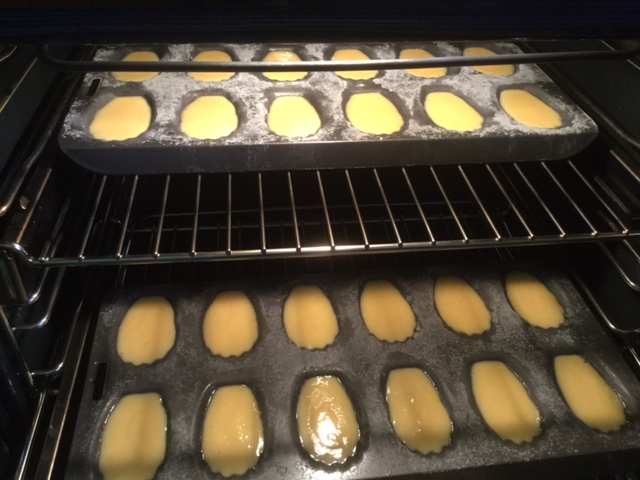
Spoon the batter into the buttered and floured madeleine moulds so that they are about two thirds full. Bake for 9-12 minutes, depending on your oven. Test with a skewer. I baked them on two oven shelves and then swapped them over at the 7 minute mark, for an extra couple of minutes.

6.  Remove from the oven and after a minute bang the trays on the bench to dislodge the madeleines. Cool on a rack with the patterned side facing up. Dust with icing sugar just before serving.

Lemon Butter Sauce
The gentle velvety sweetness of the lemon butter sauce complements the ‘quieter’ madeleines and throws into relief the sharpness of the lemon sherbet. It at once, contrasts and harmonises with it. Not unlike Annie and Beauvoir.
As he spoke he looked at Annie. Her eyes never left him, barely blinked. She took in every word, every gesture, every inflection. Enid, his ex-wife, had also listened. ... Enid left him drained, and yet still feeling inadequate. But Annie was gentler. More generous. Like her father, she listened carefully and quietly. With Enid he never talked about his work, and she never asked. With Annie he told her everything. (The Beautiful Mystery, Kindle p.7) 
“What’ve you got there?” Annie Gamache asked, leaning across the table. ... “Nothing,” he grinned. “Just a little je ne sais quoi I saw, and thought of you.” Beauvoir lifted it into plain sight. “You asshole,” Annie said, and laughed. “It’s a toilet plunger.” “With a bow on it,” said Beauvoir. “Just for you, ma chère. We’ve been together for three months. Happy anniversary.” “Of course, the toilet plunger anniversary. And I got you nothing.” “I forgive you,” he said. Annie took the plunger. “I’ll think of you every time I use it. Though I think you’ll be the one using it most of the time. You are full of it, after all.” “Too kind,” said Beauvoir, ducking his head in a small bow. (The Beautiful Mystery, Kindle p.7)
Annie Gamache was none of the things he’d always found attractive in a woman. But Annie knew something most people never learn. She knew how great it was to be alive. It had taken him almost forty years, but Jean-Guy Beauvoir finally understood it too. And knew now there was no greater beauty. (The Beautiful Mystery, Kindle p.8)

This sauce is an important part of this desert in the way it brings together the other elements harmoniously. It really is rather luscious, but also lively.


2 egg yolks (free range)

40g/1.5oz unsalted butter

2/3 cup of caster/superfine sugar

2 teaspoons of grated lemon zest

100ml/3.4fl oz lemon juice


1.  Lightly hand whisk the egg yolks and sugar together in a bowl. 

2. Add the butter, zest and lemon juice and whisk over a saucepan of simmering water (don't let the bowl touch the water) until the butter melts and the sauce thickens slightly to a pouring consistency. 

Serve at room temperature or slightly chilled.

Sticky Lemon Caramel
Annie faces some difficult and heartbreaking experiences, and like Beauvoir and because of Beauvoir, she is forced to rethink the course of her life. Oh, the course of true love...
“Listen,” she said, leaning forward, her voice softening a bit. “I’m sorry about you and Enid. Your separation.” “Yeah, well, it happens. ... ” She looked at him with searching eyes ... “Especially after what you’ve been through, I guess. It makes you think about your life. Would you like to talk about it?” Talk about Enid with Annie? ... The thought revolted him and he must have shown it. Annie pulled back and reddened as though he’d slapped her. “Forget I said anything,” she snapped and lifted the paper to her face. (A Trick of the Light, Kindle, p.8) 
But all he saw was his daughter, his little girl, in their living room Sunday night. She’d swung from sobbing to raging. From hating David, to hating herself, to hating her parents for suggesting counseling. (A Trick of the Light, Kindle, p.238)
Annie Gamache sat in the dark, staring out the window. ... She’d kicked Jean-Guy out of their home when he refused to go back to rehab. They’d fought and fought, until there was nothing left to say. And then they fought some more. ... Finally, he’d left. But he hadn’t actually gone. He was still inside her, and she couldn’t get him out. ... And she sometimes wondered if that was him, beating on her heart. And she wondered what would happen if he stopped. Every night she came here. Parked. And stared at the window. Hoping to see some sign of life. (How the Light Gets In, Kindle p.162) 
This sticky lemon caramel provides an intense flavour and texture contrast in the dessert. The caramelised sugar and finely zested strips of lemon lend a richness, a hint of bitterness, and wonderful stickiness to the dessert.

1/2 cup of superfine/caster sugar 1/4 cup of water
fine strips of lemon zest from half a lemon
1 tbs limoncello (optional)

1.  Stir all the ingredients, except the limoncello, in a small saucepan over medium heat until all the sugar has dissolved.

2.  Stop stirring and allow the water to gradually evaporate as it comes to the boil so that the mixture thickens and turns amber in colour.   
3.  Remove from the heat. Stir in the limoncello as it cools. It should be thick and sticky but not set, when cool.

Crème Fraîche
This is a very versatile cream and goes with anything. It's soft creamy texture is a good foil for some of the sharper flavours in the dessert. A bit like Annie's gentle and constant heart.
Je t’aime,” he whispered into her ear, as he held her. “Je t’aime,” she whispered into his ear. ... Once he was gone and she could no longer see the back of his car, Annie Gamache closed the door and held her hand to her chest. She wondered if this was how her mother had felt, for all those years. How her mother felt at that very moment. Was she too leaning against the door, having watched her heart leave? Having let it go. (The Beautiful Mystery, Kindle, p.14)
I love the fresh taste of this cream, with its subtle tanginess. It's easy to purchase, but it's just as easy to make. It only takes a few hours to be ready.

1 cup of pure cream (no thickeners)
1 tbs of cultured yoghurt (whole milk)

1.  Mix the cream and yoghurt together in a small glass bowl. 

2.  Cover with a piece of muslin or fine netting and leave on the bench top at room temperature for several hours or overnight. 

3.  Give it a stir after a couple of hours. It will have already thickened. You can taste it every few hours to judge the degree of sourness (which is much lighter than sour cream) and thickness you prefer. 

4.  Cover and refrigerate. It lasts for a week.

Almond Praline
Annie is a spirited woman, not to be cowed by anything or anyone. She's got attitude! In the media campaign, linking Gamache to the man he brought down, Arnot, she too was hounded.
On the television was a live picture of a young woman leaving an apartment building, her briefcase up to her face. Annie. ‘Oh, God,’ whispered Gamache. Then she lowered the case and stood still. This seemed to stun the reporters who preferred their prey on the run. She smiled at them. ‘No, don’t,’ whispered Beauvoir. Annie raised her arm and gave them the finger. (The Cruellest Month, Kindle, p.383)
Now this Annie made me consider a 'crunch' factor in the dessert. What better than almond praline with its salty, caramel notes presenting a bit of 'attitude', too!

I love the flavour and texture of praline, which is lifted to another level with a tiny sprinkle of sea salt at the end of cooking. This method of making praline is based on that of food writer, David Lebovitz, and the result is the best ever. Chopped praline over creme fraiche contrasted with all the lemony bits in this dessert, is quite the thing!


1 cup of almonds, with skins
1/2 cup of superfine/caster sugar
1/4 cup of water
pinch of sea salt

Place the almonds sugar and water in a saucepan over medium heat. Stir with a wooden spoon until the sugar has completely dissolved.


Bring to the boil and then lower the heat slightly, stirring until all the water has evaporated and the mixture turns 'sandy'.
Continue to stir until the sugar crystals start to liquefy. Keep stirring until all the almonds are covered with a shiny glaze.

Watch closely so that the almonds don't burn.
Pour onto a baking sheet lined with baking paper and spread out. Sprinkle immediately with the sea salt.

Chop or blitz into small pieces, when cool. Store in an air-tight container.


Chocolate Ganache and Fresh Blueberries
Blueberries and chocolate, and Beauvoir go very well together so they had to feature in this dessert.
“I miss you,” Jean-Guy wrote. “ Merde! All the chocolates are gone! How did that happen?” Then he rolled over, the BlackBerry held lightly in his hand. But not before typing, in the darkness, his final message of the day. “ Je t’aime .” He carefully wrapped the chocolates and put them in the nightstand drawer. For Annie. He closed his eyes, and slept soundly. (The Beautiful Mystery, Kindle, p.106)
I made a little chocolate ganache to accompany the blueberries. However, fresh blueberries by themselves works well too. I couldn't avoid having two helpings of dessert for the purpose of this important 'tasting' research! Blueberries and lemon are also a great match. The in-season berries were needed for their 'explosive' texture and 'fresh fruitiness' against all the other elements in the dessert.

125g/4oz bittersweet dark chocolate
1 cup of pure cream
2 cups of fresh blueberries

Heat the cream in a bowl over a small saucepan of simmering water. Add the chocolate and stir until melted and well incorporated. Remove the bowl from the heat and whisk the mixture until cool, and soft peaks form.
A generous dob of chocolate ganache covered with a small handful of blueberries completes the dessert.


A serve of Annie Gamache
A coy smile could capture him, but it was finally a hearty laugh that had freed him. No knees would buckle for Annie Gamache. No eyes would follow her substantial body. No wolf calls for her pretty plain face. But she was by far the most attractive woman in any room. Late into his thirties, with a broken body and a shattered spirit, Jean-Guy Beauvoir had been seduced by happiness. (The Long Way Home, Kindle, p.103)
I hope there's plenty to be seduced by, in this dessert too!

On each plate place one madeleine, a quenelle of lemon sherbet, and 2 tablespoons of lemon  butter sauce between them.   

Add a generous dob of creme fraiche sprinkled with almond praline. Drizzle sticky lemon caramel around the creme and at the edge of the lemon butter sauce. 

In the space remaining, add a dob of ganache (or not) and cover with a mound of blueberries.

Voila! Annie Gamache! 


Santé! Annie and Jean-Guy


Ruth held Rosa and, leaning into Beauvoir, they kissed on both cheeks. “There’s pink lemonade in the fridge for you,” she said. “I made it.” (The Long Way Home, Kindle, p.18)
Someone suggested that 'Annie Gamache' could also be a cocktail. Well, I always find a good cocktail hard to resist! And I thrive on making ingredients for cocktails. So in keeping with the lemon theme and inspired by Ruth's pink lemonade for Beauvoir, I devised a cocktail using home-made limoncello (vodka infused, over time, with lemon rinds and mixed with a sugar syrup) and grenadine (freshly squeezed pomegranate juice mixed with a heavy sugar syrup). They last indefinitely stored in the freezer. 

This cocktail has a nice balance between a light sweetness, a sharp sourness and a dry finish. And as for that sparkle!!!  It's a perfect aperitif. I love the pink blush, too. Very Beauvoir!!  Now if I was making this cocktail for him, I'd substitute fresh lemon juice for the limoncello, and sparkling lemonade for the sparkling wine.

Annie Gamache cocktail
(Makes two servings)

1 measure/2.5 tbs limoncello
1 measure/2.5 tbs fresh lime juice, sieved
1/2 teaspoon of grenadine
8 ice cubes
dry sparkling white wine (I used Prosecco)
a curl of lemon rind and lime slices for decoration

Vigorously shake the limoncello, lime juice, grenadine and ice cubes together. 

Strain into two cocktail glasses. Top with dry sparkling wine. 

Decorate with a curl of lemon rind slightly submerged, and a half slice of lime on the glass edge.