Reading may seem like a solitary pleasure, but we do not believe it is so. As we read, we intimately interact with writers, the worlds they create, and our own inner selves as well as the real world that surrounds us. Some of us are also blessed enough to have friends to share the experience with.

While discussing the idyllic village of Three Pines and the captivating characters author Louise Penny created in the Inspector Gamache books, we were aware of the sensory pleasure to be had in the meals described. Olivier’s Bistro, Gabri’s baking, and dinners at the Morrow’s can easily make us salivate while reading the books… Louise Penny's books, are a wonderful entrée into a sensual world, where each book is a season, capturing its mood and flavours, and contributing to the layers of meaning about the characters, who are marvellously revealed over the series.

At one point, a daydream of going through the series with a notebook in hand, writing down all these meals and later cooking them, took shape. This is our "notebook". We hope you enjoy this literary-culinary-sensory-philosophical journey.

Showing posts with label fear. Show all posts

Friday, May 13, 2016

Hors d’Oeuvres and Wine...Hope and Fear

by Libby


Gamache glanced into the body of the room, packed with men and women milling about and chatting, juggling hors d’oeuvres and wine. (A Trick of the Light, Kindle, p.16)

It is Clara's opening at the Musée d’Art Contemporain in Montréal. This is no mean feat having a solo exhibition at such a major art museum as the MAC. 


I really like this scene. It is very much an 'exposition' of hope and fear, through the eyes of several key players. And I like the sense of being right there with them, amongst the crowd, quietly observing and listening.


Oh, no, no, no, thought Clara Morrow as she walked toward the closed doors. She could see shadows, shapes, like wraiths moving back and forth, back and forth across the frosted glass. Appearing and disappearing. Distorted, but still human. (A Trick of the Light, Kindle, p.1)

Clara's crisis of confidence in professionally showing her work speaks of her self-doubt. Understandable really. The thing about making art is that it is so inextricably tied up with your sense of self, that it’s a bit of a tightrope and easy to teeter between self-belief and self-doubt.

This one event is the culmination of all her hopes and ambitions as an artist. But fear shadows hope. At this level in the art world she has a lot to gain or lose as her work is judged in the most public way.

Through her emotional and intellectual challenges as an artist she has finally found a language of expression that fulfils her vision, her ideas, and that is resonating with others. Now she is faced with putting it out there. It’s risky and it's personal. Will her works be understood, and stand up to rigorous scrutiny at the highest levels in the art world? How will others see and interpret her works that have great personal meaning and import, that are the product of years of working towards this moment. There is more on show here than Clara's paintings. It is a collision of all her artistic hopes and fears.

We are there in that moment Clara panics. She has always been in Peter's shadow. He was the recognised artist. His works sold. He should be the first to exhibit at the MAC. All she wants to do is flee. But who comes to her aid, understands her fears at that moment better than anyone, and steadies her?

It wasn’t Peter. Instead, ... Olivier Brulé. He was kneeling beside her, watching, his kind eyes life preservers thrown to a drowning woman. She held them. ... “I don’t think I can do it.” Clara leaned forward, feeling faint. ... “I know,” whispered Olivier. “But I also know you. Whether it’s on your knees or on your feet, you’re going through that door.” He nodded toward the end of the hall, his eyes never leaving hers. “It might as well be on your feet.” (A Trick of the Light, Kindle, p.3)

We know Olivier faces his own fears about acceptance and rejection, about redefining himself in the Three Pines community and rebuilding relationships when trust has been broken. But he is there for Clara, and he wins our respect.

And what of Peter? This scene is as much about him as it is of Clara. In counterpoint to her, Peter has entered the exhibition in a seemingly buoyant mood. What appears to be a supportive albeit brave face, masks an artist whose hopes and fears are also at a crossroad. Peter's art has come to a standstill, and he has much to fear. He is trapped in a cycle of producing the tightly executed works that had made his reputation as an artist...and now faced with the horror of an empty canvas, an absence of vision and new ideas, his creative process paralysed in his pursuit of some sort of 'detailed' perfection.

You cling ever more tightly to what you already know you can do — away from risk and exploration, and possibly further from the work of your heart. ... The trap is perfection: unless your work continually generates new and unresolved issues, there’s no reason for your next work to be any different from the last. (David Bayles, Art and Fear: Observations on the Perils (and Rewards) of Artmaking)

Plagued by the fear that Clara's art will eclipse his own, and that his will no longer be relevant, we watch as he moves through the exhibition space looking for an opportunity to inveigle himself into the company of any prominent art dealer who can shore up his reputation and give him the recognition he needs. We feel for him, and wince.

Clara's paintings are not the only focus at this show. We know that Gamache is experiencing some trepidation of his own, in anticipation of seeing Olivier. And as their eyes meet across the room, as much as Gamache hopes Olivier can reconcile with him, he fears, well really accepts, that it will take more time.

And then, we’re with Beauvoir sharing his view of Annie Gamache, and we are privy to his intimate feelings. What can he possibly hope? What do we? And what should he fear as Ruth joins him, grips his arm and follows his gaze across the room to find what is capturing his attention. What a moment!

And once again we’re with Gamache, who perhaps more than any other, has seen the truth in Clara's work and has been greatly moved by it. Sometimes what we see in an artwork is what we bring to it.

I like the way Louise Penny ends this scene on a slightly cryptic note, that leaves us wondering, and even marvelling, about the power of art.

Amid all the brush strokes, all the elements, all the color and nuance in the portrait, it came down to one tiny detail. A single white dot. In her eyes. Clara Morrow had painted the moment despair became hope. François Marois stepped back half a pace and nodded gravely. “It’s remarkable. Beautiful.” He turned to Gamache then. “Unless, of course, it’s a ruse.” “What do you mean?” asked Gamache. “Maybe it isn’t hope at all,” said Marois, “but merely a trick of the light.” (A Trick of the Light, Kindle, p.28)

Hors d’Oeuvres


I love to entertain with lots of 'small bites' or finger food to eat. At Clara's exhibition opening, hors d'oeuvres (that are not identified) are served with wine. So I prepared three possibilities, with ingredients that can be prepared ahead of time and quickly assembled, to serve easily as finger food with drinks: baked ricotta with an oven-dried tomato and basil leaf on a cocktail stick; witlof (endive) leaves with goat's curd, roasted capsicum (pepper) and vincotta; hot-smoked trout with crème fraîche, lemon and parsley on sourdough bread.

Baked ricotta with an oven-dried tomato and basil leaf on a cocktail stick


- bite-sized slices of baked ricotta (recipe follows)
- oven-dried tomato halves (recipe follows)
- fresh basil leaves
- cocktail sticks to serve


Place a piece of baked ricotta, a large basil leaf and an oven-dried tomato on a cocktail stick, to serve.


Baked ricotta

The ricotta cheese used in this recipe is the low-fat, hard ricotta that is sold in pieces cut from a wheel (not the soft ricotta sold in tubs). Slow-baked with a covering of herbs to create an aromatic and spicy flavour, it can be cut into bite-sized pieces for assembling with other ingredients. You can make this two or three days ahead of time, and refrigerate, to allow the flavour to develop.
 
-  a wedge of low fat ricotta

-  3 tbsp of dried oregano

-  3 tbsp of finely chopped fresh oregano

-  3/4 teaspoon of dried chilli flakes

-  1 tsp of sea salt and freshly ground black pepper

-  6-10 fresh bay leaves

-  several sprigs of fresh rosemary

extra-virgin olive oil


1.  Pre-heat the oven to 180C/350F


2. Pat the ricotta piece dry with some kitchen paper.


3. Coat it generously with extra-virgin olive oil.


4. Mix the herbs and spices together, except for the bay leaves and rosemary, and roll the cheese in this to coat all surfaces.


5.  Place a layer of bay leaves and rosemary sprigs together on a baking sheet (in the shape of the cheese). Sit the cheese on the leaves and cover with aluminium foil.


6. Bake for 20 mins and then remove the foil. Continue baking for another 30 mins or until lightly browned.


7. Cut into bite-sized pieces when cool.


Oven-dried tomatoes

These are richly flavoured and very versatile for enhancing a range of dishes. I always have some, completely submerged in extra-virgin olive oil and stored in a lidded, glass container in the fridge. In this way they will last several weeks.


- small to medium sized tomatoes, sliced in halves lengthways

- sprigs of fresh thyme chopped

- extra-virgin olive oil

- cracked black pepper

-    sea salt flakes


1.     Pre-heat the oven to 110C/230F

2.  Scoop out the seeds of the tomato halves and place, cup side up, on a baking tray.

3.  Drizzle each cup with extra-virgin olive oil.

4.  Sprinkle each cup with pepper, salt and thyme.

5.  Slowly dry in the oven for several hours so that they still retain some moisture.

6.  Cool, and store in extra-virgin olive oil. Refrigerate until required.


Witlof (endive) leaves with goat's curd, roasted capsicum (pepper) and vincotto


Any leaves, with a cup shape, can be used to make these delicious little 'boats'. I have used witlof, but you can also use radicchio, chicory or baby cos lettuce. I've never liked goat's cheese but goat's curd, with its fresh, light tanginess, is a revelation. A crisp, slightly bitter leaf, the creamy curd, the sweet savouriness of roasted capsicum (pepper), a drizzle of 'sweet and sour' vincotto (this is a delicious reduction of the crushed fruit and skins of unfermented dark grapes) and a sprinkle of chopped chives is a taste treat. If you can't find vincotto, a reduction of balsamic vinegar with a pinch of sugar can be substituted.


- witlof/endive or other 'boat shaped' leaves, washed and dried

- goat's curd

- 1 red capsicum (pepper), halved and seeds and stem removed

- vincotto for drizzling

- fresh chives, chopped

- extra-virgin olive oils 

    - cracked black pepper


1.    Roast or grill the capsicum (pepper) halves until the skin is completely blackened. Peel off the skin when cool. Pat the flesh dry with paper towel and then cut into strips. Drizzle with a little olive oil and sprinkle with cracked black pepper. Set aside.

2.  Scoop a spoonful of goat's curd into each leaf boat. Use the back of the spoon to smooth it along the length of the leaf.

3.  Place one or two strips of roasted capsicum on the curd. Sprinkle with chives, cracked black pepper and a drizzle of vincotto.


Smoked trout, with crème fraîche, lemon and parsley on sourdough bread


This is hot-smoked trout that I buy whole with its skin on. The flesh is soft and luscious. It's a great standby for a quick and easy snack with drinks, and pairs wonderfully with crème fraîche, good crusty bread, lemon, and herbs such as watercress or parsley. Smoked salmon could easily be substituted.
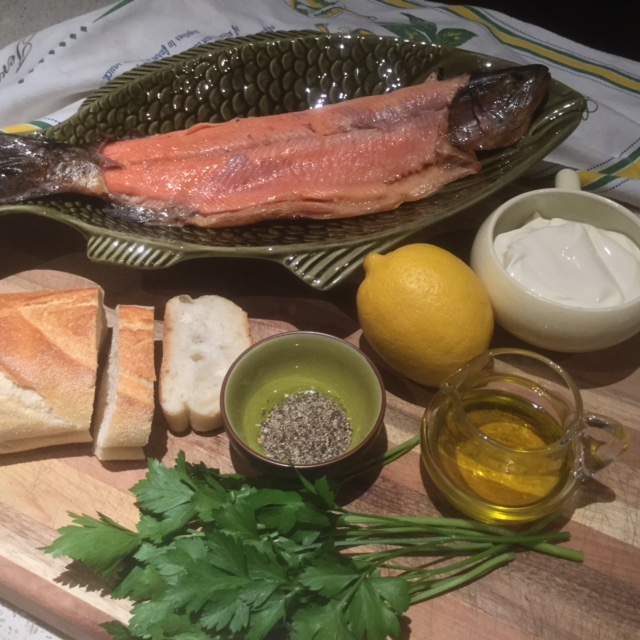


- hot-smoked trout, broken into pieces 

- crème fraîche

- sourdough baguette, sliced

- freshly grated lemon rind

- sliced flat-leaf parsley or watercress

- cracked black pepper

- extra-virgin olive oil


1. Place a generous helping of smoked trout on each slice of bread.

2. Spoon creme fraiche over the trout

3. Grate lemon rind over the crème fraîche.

4. Sprinkle over parsley or watercress

5. Finish with a drizzle of extra-virgin olive oil and cracked black pepper.


These hors d'oeuvres go particularly well with a nicely chilled white wine that has a dry finish, such as a Pinot Gris or a Semillon Sauvignon Blanc.


Thursday, March 24, 2016

Omelletes & Do you want to talk about it?

by Amy

Do you want to talk about it?

"The owner of the bistro brought their breakfasts of omelettes, fresh fruit and a croissant each."


I’m the kind of person who asks that question. A lot. Sometimes I ask with actual words. Most often, though, people seem to tell me how they feel or what they're going through and I don’t really remember having asked. Or, if I did, I barely noticed doing so. Maybe it’s the white lab coat? Or the certainty that my phone is on at any and all times of day? Or maybe (most likely) I’m also the kind of person who will probably answer “yes” any time the question is (sincerely) posed to me. I talk through my issues. I listen to those of others. I enjoy it. I think it's part of who I am. 


“Jean-Guy Beauvoir and Ruth Zardo stared at each other.
It felt like a cage match. Only one would emerge alive. Not for the first time in Ruth’s company, Beauvoir felt an unpleasant retraction below his belt.

“What do you want?” Ruth demanded.

“I want to talk,” snapped Beauvoir.

“Can’t it wait, asshole?”

“No, it can’t, you lunatic.” He paused. “Do you like me?”

Her eyes narrowed. “I think you’re anal, idiotic, cruel and perhaps slightly retarded.”

“And I think the same of you,” he said, relieved. It was as he thought, as he’d hoped.
“Well, glad we got that straight. Thank you for coming by, now, nighty night.” Ruth reached for the doorknob.
“Wait,” Beauvoir said, his hand out, almost touching her withered arm. “Wait,” he said again, almost in a whisper. And Ruth did.”
There’s more than one way to listen. There’s more than one way to empathize. There’s more than one kind of confessor. I probably wouldn’t make a good listener for Jean-Guy here. I don’t think I could be as ruthless as Ruth (Ruthless Ruth – haha! That might be a good nickname for her). Jean-Guy purposefully looked for someone who would listen, but wouldn’t care (although she does care). To him the idea of dealing with someone’s sympathy or pity was worse than being silent.

No one likes to be pitied.

“Ruth sat across from him, a pot of watery tea on the white pre-formed table, and one cup. Her thin arms were strapped across her chest, as though trying to keep her innards in. But not her heart, Beauvoir knew. That had escaped years before, like the duck. In time all things fled Ruth.He needed to talk to someone, but someone without a heart, without compassion. Someone who didn’t care.”
Empathy is not pity. But even the most empathetic listener is not the best listener for everyone. Even if the person does his or her best to not judge, what is said cannot be unsaid. It cannot be unknown.

Lila, I know I’ve said this any number of times. But people do talk to me. About all sorts of things. Sometimes it helps. At least that’s what they tell me.
She said, “Then for the rest of their life you’re gonna think about it. Every time you look at them. Hear their name even.”“True.”“Well, I spose it would have to be true, wouldn’t it. The worse it was, the more you’d remember. Maybe I don’t want you looking at me that way.”“Fine,” he said. “Whatever you say.”“I don’t know how those people go on living in the same town with you.”“A few of them do leave the church. Maybe because they’ve told me more than they meant to. I’ve suspected that was part of it. In some cases.” (Lila – Marilynne Robinson)

Relationships change when “confessions” are made. I think the closer you hold your secrets, the harder it is to reveal them. The more comfortable you are with yourself, the easier it is to share. I think. I might be wrong. Remember Constance in A TRICK OF THE LIGHT? Remember how close she’d kept her secret? To the point where even the merest hint seemed like an enormous revelation? But then, it isn’t when we feel comfortable with ourselves that we feel the need to unburden, is it?


Sometimes it's easier to share with a stranger. Or, according to Beauvoir's logic, with someone who doesn't care. Maybe that's part of why professional therapists, healthcare workers, religious leaders, and people who respond to crisis end up being on the listening end of so many conversations. If a person isn't personally involved, then their judgement, their forgiveness, and the remainder of their lives (after the conversation takes place) doesn't matter as much to you.

"There is a saying that to understand is to forgive, but that is an error, so Papa used to say. You must forgive in order to understand. Until you forgive, you defend yourself against the possibility of understanding. [...] If you forgive, he would say, you may indeed still not understand, but you will be ready to understand, and that is the posture of grace." (Home - M. Robinson)

Reverend Amos, in Robinson’s book LILA, says “people do talk to me. About all sorts of things. Sometimes it helps.” I can say the same. People talk to me. It sometimes changes the dynamics of our relationship. Sometimes it means, like Beauvoir feared - like Lila feared - that I know their vulnerabilities and, from then on, I tend to shield them. Spare them.

While sharing with a stranger, or a professional, or a neutral party can be cathartic, there is a special kind of redemption and pardon to be had when you feel like you are heard, seen, understood, and loved by someone who cares. Someone who has their own version of events, but is still willing to put themselves in your shoes and try to understand your side of the story. That is the magic of empathy. Empathy is willing to understand someone else's "truth", even when it doesn't match their own.

"I told him almost everything, and when I was done he said, 'You are a good man.' Imagine that."(Home - M. Robinson)


I recently had a conversation with someone who listened. I had been very sick (with dengue fever of all things) and the feeling of helplessness and exhaustion had left me emotionally drained. I mentioned that I was feeling empty, with little to offer and, because I felt so tired, I was made aware of how many people made emotional demands on my time. In a moment of utter exhaustion I complained about being so needed.

A couple of weeks later I felt better. I was back to wanting to know what made people tick and feeling rewarded when I knew I’d made a positive impact – no matter how small – on someone else’s life. Nevertheless, my previous words cannot be retracted. While being heard had been priceless, it had also made the listener aware of the fact that there are in fact more emotional demands in my life than perhaps he had previously realized. It made the listener aware, even as I was, that people call me, all the time, with their problems, their pain, their doubts, their expectations, their needs. It made the listener wish to shield me. Spare me.

A few days ago this same listener was sick and felt wary of calling me and asking for help. He didn’t want to add to the burden. Since the person in question was my dad, it was easy to be the one to call and to laugh when he said he didn’t want to be any trouble. I told him we’re past that. I appreciate him having been willing and able to listen when I was feeling drained. The fact that he cared and understood was part of the turning point in refilling my emotional reservoir. I was ready to give back again. He could get over being protective. He’s my dad, though. I don’t think it’s possible for a parent to stop feeling protective. I’m a parent myself. I know it’s impossible. We could share, though. I could help him carry his pain just as he’d helped me carry mine. I was back to being me.

[On a side note, can you tell I have incredible parents?]

“Gamache took a deep breath and looked down at the table, his lips tight.Émile paused. “Do you want to talk about it?”Armand Gamache looked up. “I can’t. Not yet. But thank you.”“When you’re ready.” Émile smiled, took a sip of strong, aromatic coffee, and picked up Renaud’s diary again.”

I love how Émile responded here. He was respectful of Gamache’s need for time. He was available. He didn’t push. As a true friend, he knew that it was more important to be there and to be willing to listen. Sometimes it is enough to know you are loved and cherished and that you have people who care enough to listen should you need or want to share. Just as important, it’s invaluable to know that you’ll be respected if you choose silence.

No one likes to be pitied.

We all want to be seen, though.

No one likes to be judged.

We all want to be understood.

No one likes to be exposed.

We all want to be loved.


Beauvoir chose someone he believed didn’t care – and wouldn’t tell. He felt could trust her with his vulnerability because she wouldn’t pity him. He didn’t believe she had a heart, so there was no heart to bleed when she listened to his pain. Also, he didn’t care enough about her for her judgement to matter. Or so he thought.

 “I never even thought of telling anybody what was on my mind all those years. Not Doll, not any of ‘em. I don’t even think I knew people did that.” (Lila – Marilynne Robinson)

I’m pretty sure most of us can empathize with Beauvoir at least a little bit. Baring your soul (while sober and aware) can be scary. So many people – like Beauvoir, like Olivier –are so afraid of being ridiculed, misunderstood, or judged for who they think others might see, that they choose not to let people see or hear or know.

“She hated to remember how swept up in it all she had been, how ridiculous she would have seemed to anyone who knew what she’d been thinking. That’s one good thing about the way life is, that no one can know you if you don’t let them.” (Lila – Marilynne Robinson)
But is it? A good thing?

While it can be scary to be exposed, I wonder how much scarier it is to hold it all inside. Those who don’t share tend to have an exaggerated view of the importance of their secrets and revelations. Like Olivier. Like Constance. Those who try to project an infallible, strong, tough exterior are frequently covering a sensitive, hurt core. Like Beauvoir.

 “Do you want to talk about it?”

Sometimes the answer will be no.

Sometimes I’ll be faced with people whose pain is so raw that they cannot bear to put it into words. Like Gamache. I can learn from Émile. I can be present. I can share meals and time and space. I can enable engagement with distractions – coping mechanisms – like the research of a long gone battle. I can be available to listen and even remind them, occasionally, that I am aware of their pain and willing to help. I can learn to not push.

Sometimes I’ll be faced with the Lilas and Beauvoirs of the world: those who are afraid to share because they are afraid to shift the balance of the relationship. They both (if you haven’t read Lila, maybe you should) learn that while trust should not be given lightly, when it is given to the right person it can be a deliverance.

“That was loneliness. When you’re scalded, touch hurts, it makes no difference if it’s kindly meant. Now he could comfort her with a look. And what would she do without him. What would she do.” (Lila – Marilynne Robinson)
For those of us who easily find ourselves in the role of confidant, an important lesson to learn is to know when to retreat. Not every listener, therapist, counselor, advisor is for everyone. Being available is not the same as forcing someone to confide in you. If someone is not ready to talk or prefers not to share their secrets with you (even if you love them and feel like they should trust you), then back off.

In a way, Lila was right. When she tells Reverend Amos (her husband), “Maybe I don’t want you looking at me that way,” she has a point. When Beauvoir chose someone he believed wouldn’t care, he was protecting himself from a look he didn’t think he could bear. He was shielding himself from the pain of being judged, or pitied, or misunderstood by someone who mattered. He was also choosing someone he thought was heartless enough not to feel his pain. When I unburdened myself to my father, I forgot to take into account that he might then change his attitude towards me and adjust his behavior. When Gamache began his informal therapy sessions with Myrna, he didn’t expect her to chastise him (discretely, but still) real-time when he became overprotective of Beauvoir.

I read a study years ago that illustrated this relationship shift. I’m glad this isn’t an academic paper because I cannot remember where I read it and thankfully won’t have to look it up. It was a paper on children with chronic pain and terminal disease. The authors talked about how children, noticing the worry and angst in parents, caregivers, and health professionals, would report less pain than they truly felt. In order to spare those around them, most children would pretend they didn’t know they had a terminal illness (although they did know, but they perceived it wasn’t something their caregivers wanted to dwell on). Most children would answer, “Better”, when asked how they were feeling. Why? Because they realized those around them were happier when they pretended to feel less sick. They, too, understood Lila and "maybe I don't want you looking at me that way."

There is a burden there. The burden of pretense. The burden of strength. The burden of keeping your afflictions to yourself. The children couldn’t bear to see those they loved in pain. They learned to mask their own pain in order to spare those they loved and cared for. They created a fiction of improvement in order to shield their family and doctors from the despair of impotence. They carried their pain within them to avoid being pitied.

In love there is room for vulnerability. There should be. When Annie tells her father her fears, she knows she is no less lion because she is scared. As my son has learned (and repeats every chance he gets), courage is not the absence of fear. It is the willingness to face fear. When Peter bares his soul to Clara he is closer to her than at any time before. When Olivier peels off all his layers he rediscovers himself. When people feel like they are accepted and understood despite their fears and their pain, they feel safe and loved. 

It is important to note that those who fear vulnerability aren’t wrong to do so. In the wrong hands, a soul’s secrets can become a weapon. Francoeur knew that well. He simulated empathy. He had a gift for listening. He used it with cruelty. He understood. He judged. He twisted truths and reinterpreted and gave new meaning. He manipulated fears and feelings and expectations. He used nightmares against those who had first dreamt them. He made a travesty out of intimacy.

When the video of the raid was leaked, the agents involved were exposed to the world, to strangers, to judgement. Too much was shown to too many people. It was like those nightmares where you show up to school in your underwear.

There is safety – or should be - in the sanctity of a confessional, the ethical privacy of a therapeutic relationship, the trustworthiness of friendship and love.

I hope you have people you can trust. People who are willing to listen, even if (or maybe because) they are unconventional like Ruth. People who respect your timing as did Émile. I hope you have a chance to show your vulnerabilities. I also hope that the "mirror" of the listener reflects you as stronger than you thought. I hope we can all learn to be the kind of confidant others need. I hope I can learn to be the confidant those around me need.

Jean-Guy and Ruth sat and talked over weak tea. I couldn’t bring myself to make weak Ruth-like tea to accompany this post. Gamache and Émile, on the other hand, had a breakfast meal that included an omelette.

I made my son an omelette for breakfast the other day. This is his favorite egg recipe. It’s not gourmet. It’s not fancy. It’s not even really a recipe. It does please the 8-year-old with a knack for talking through his thoughts… and who’s learning to listen to those of others. We spent most of breakfast talking about his issues. Most of them involve Minecraft and/or Pokemon.

M-style omelettes:
I beat the eggs and add a pinch of salt. A little bit of butter goes on the skillet, then I pour the eggs in. Wait a few minutes until the egg forms a bit of a crust. Add a bit of grated parmesan. Fold. Done! Sometimes basil or marjoram is added. Parmesan omelette is his favorite, though. It doesn't look very appetizing, does it? (It's the picture below)


What do you like on your omelettes? Do you like to add milk to the beaten egg? I did for mine. I'm not a huge egg fan, so the milk means I can use just one egg and have a decent sized omelet. Do you like to add ham or cheese? My husband likes his omelettes with quite a bit of ham and cheese in them. I tend to add veggies and usually some cheese (I added feta to the one pictured in the beginning of the post). They still don’t disguise the egg taste. Although I suppose omelettes are supposed to taste egg-like, right? Still, the green and red in mine make it look more appetizing, don't you think? Or is it just me?

All quotes, unless stated otherwise, are from Louise Penny's BURY YOUR DEAD.

Friday, March 18, 2016

Strawberry Shortcake... And Souls

by Amy

“Peter handed Gamache a shortcake, which he cut in half, and Peter piled sliced ripe strawberries in their own brilliant red juice on top of it.

Gamache noticed Clara getting up and Myrna going with her. Olivier came over and put the coffee on to perk.

“Can I help?” asked Gabri.

“Here, put cream on. The cake, Gabri,” said Peter as Gabri approached Olivier with a spoonful of whipped cream. Soon a small conga line of men assembling strawberry shortcakes was formed. When they’d finished they turned around to take the desserts to the table but stopped dead.”

I’ve always loved this image of a conga line of men assembling strawberry shortcakes. It makes me smile every time.

“There, lit only by candles, was Clara’s art. Or at least three large canvases, propped on easels. Gamache felt suddenly light-headed, as though he’d traveled back to the time of Rembrandt, da Vinci, Titian. Where art was viewed either by daylight or candlelight. Was this how the Mona Lisa was first seen? The Sistine Chapel? By firelight? Like cave drawings.”

I’m jealous.

I know I’m confessing to an ugly sentiment, but I really am jealous of Clara and her art.

“He looked at it closely. Clara painted people’s souls, and he wanted to know what this soul held.”

That is an amazing concept. Can you imagine having the ability to paint, sculpt, dance, sing, play, or write a person’s soul? To be able to express that which cannot be said? To see beyond the surface, explore the depths, and to turn it into art?


That is probably where the magic is. The ability to convey feeling and emotion beyond words. Even when the medium involves words – as is the case in literature, poetry, even dramatic arts – the words go beyond their quotidian use.

“Clara Morrow had painted Ruth as the elderly, forgotten Virgin Mary. Angry, demented, the Ruth in the portrait was full of despair, of bitterness. Of a life left behind, of opportunities squandered, of loss and betrayals real and imagined and created and caused. She clutched at a rough blue shawl with emaciated hands. The shawl had slipped off one bony shoulder and the skin was sagging, like something nailed up and empty.
“And yet the portrait was radiant, filling the room from one tiny point of light. In her eyes. Embittered, mad Ruth stared into the distance, at something very far off, approaching. More imagined than real.”
“Hope.”
“Clara had captured the moment despair turned to hope. The moment life began. She’d somehow captured Grace.”

And there you go. Since I’m confessing, I suppose I should be completely honest.

I said before that I’m jealous of Clara’s art. I’m probably more realistically jealous of Louise Penny’s talent. She, after all, is the one who wrote the character – and described the image – that captured Grace and Hope. Her books see the soul and her words evoke an entire world that we fell in love with.


I can understand Peter’s feelings. They aren’t really nice feelings. In fact, they are nothing to be proud of. What they are is understandable. And, like Peter, it isn’t only the end product that I am jealous of. It is the fearlessness and dedication that Clara – and Penny – are willing to invest in their work.

“It took Gamache’s breath away and he could feel a burning in his eyes. He blinked and turned from it, as though from something so brilliant it blinded. He saw everyone else in the room also staring, their faces soft in the candlelight.”

We are attracted to raw honesty. Penny has not shied away from tough issues. Her characters aren’t picture perfect, nor are they typical models of success. Clara paints the elderly, the flawed, and even the ugly. The beauty in their art lies not in the perfection of its subjects, but in the cracks that let the light in, in the promise of redemption, in the hope found even in the darkest places, and in grace.

Both the author and her character are willing to explore their own souls, explore the souls of their subjects, and, through their art, encourage us to hold up our own souls to scrutiny.

“They’re brilliant, you know. You have nothing to be afraid of.”
“If that was true I’d have no art.”

I used the word fearless before, but I was wrong. There is fear. If there weren’t, the art probably wouldn’t be half as good. They carry on regardless.

I know for a fact that there is fear. Not only has Louise Penny mentioned it more than once in social media and in her newsletters, but when I first thought of writing this blog, I wrote to her and asked for permission. If there ever was a gracious writer, it is she. Her answer, among other things, was “Noli timere.”

Noli timere. Do not fear.

Just the fact that she recognizes that fear is a factor when you bare your soul is proof (at least it is to me) that she is not immune to such fear, but has chosen to face it. I often think of the process or production art and of an artist’s courage when I read the Gamache books.

The Brutal Telling is a book about secrets and lies. It is also the book where Clara’s art is revealed as brilliant. Unquestionably brilliant. We knew before. Now everyone knows. Everyone who matters to Clara, that is. Soon the whole world will know.

Clara’s art is the opposite of Olivier’s lies. The light to his darkness. Clara has spent a lifetime digging deep within and exposing her soul. She isn’t always understood. In fact, she usually isn’t comprehended by those who likely matter most to her. She is open, though. She is willing to look and explore and to try to understand…

“Nay, be a Columbus to whole new continents and worlds within you, opening new channels, not of trade, but of thought.” (Walden, Thoreau)

As I read, I am challenged to explore these depths within myself. Not infrequently do I wonder where I stand, what I think, who I am. It’s easy to get so caught up in the hectic rhythm of daily life that we forget to ask ourselves questions that pertain to our individuality, our identity, our core beliefs.

What makes me me? What are the things only I can say? When I leave this world, what will I have left behind of myself? Have I made a difference in someone’s life? What motivates me to get up in the morning? What makes me feel like I’ve had a good day? When people think of me, how do they see my soul?

Olivier hid under so many layers and so many lies that he no longer felt like he could be himself and be loved. In a way, the character he created was larger than the scared soul that lived inside. Clara, on the other hand, had very little polish and was apparently a wreck. But that is only because she let the whole world see the FINE (Ruth’s FINE: Fucked up, Insecure, Neurotic and Egotistical) soul she was. Clara had no veneer. No pretense. She was who she was.

I’m still jealous of her art. I will never be able to paint a person’s soul. I highly doubt that I could ever develop any art to the point that it spoke more than words. I’ll have to stick to words. And maybe hugs.

"Language is a finer medium. 'Yes, for those who can't paint.'" (Middlemarch - George Eliot)
I do not need to be jealous of Clara’s fearlessness, though. While the results of my own forays will not lead to world-class art, I can learn to look into the soul. I can try to understand myself more elementally, and to try to look at others and see beyond the surface. I can recognize the shortcomings and failures that make me fallible and learn to love myself (and allow others to love me) in spite of them. I can see the cracks in the veneer of those around me and learn to offer grace and unconditional love.

I’d never eaten Strawberry Shortcake. Unlike Clara’s paintings and Louise Penny’s books, mine was not a masterpiece. Two attempts at making perfect homemade whipped cream failed. The first failed miserably (it was a very hot day and I probably should have let the cream freeze a bit instead of just refrigerating it). The second was better. The cake itself wasn’t anything special. They’re a good base for the strawberry and sugar mixture. I’m a chocolate kind of girl, so I think it would be perfect with brownies instead of shortcake. Is that sacrilegious?


I did like the lemon added to the whipped cream. That was perfect. I have a friend who gave me a few tips on the perfect whipped cream so I kept trying. I tried refrigerated cream. I tried it slightly frozen. I tried adding the sugar way after or soon after. I tried... Of course, the third time - when I DIDN'T have any strawberries - it worked. But then I don't know exactly what it as that I did differently. So what's your secret? If it is that you make awesome whipped cream, that is...


Here’s the recipe I used (with some few modifications): http://www.foodnetwork.com/recipes/strawberry-shortcake-recipe3.html

Unless otherwise specified, all quotes are from The Brutal Telling. The shortcake dessert scene.